
EMCD Payment: a virtual Mastercard you fill from a USDT wallet — and what that costs you
 Available in US
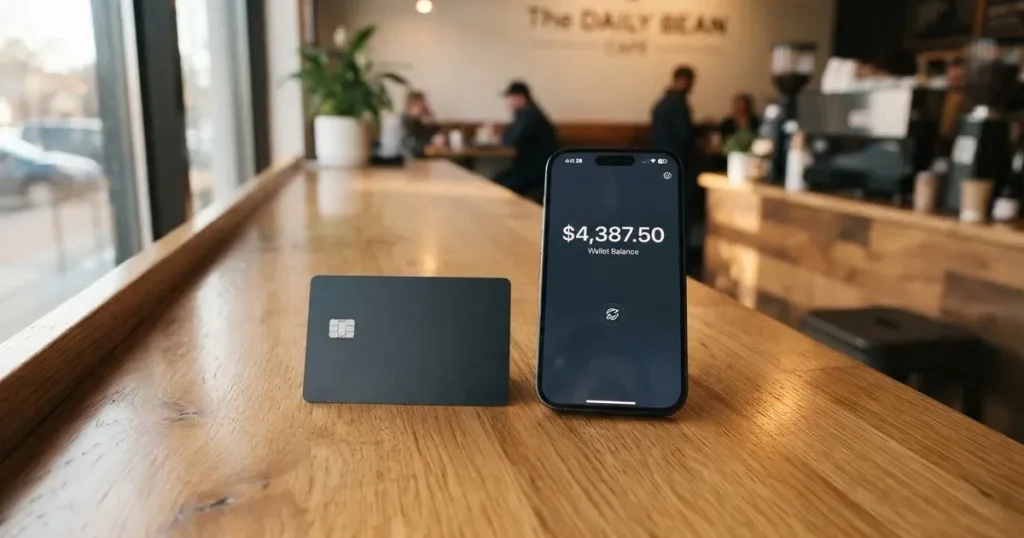
EMCD Payment is a virtual Mastercard, not a plastic card in an envelope, and it does not spend from your bank account. You load it from the USDT wallet inside the EMCD app, the USDT becomes dollars, and the card spends that balance wherever Mastercard is taken online. That is a genuinely narrow, genuinely useful thing — and also a short list of options where other cards do more. My score for it is 5.3 out of 10. If you are one of the people holding USDT who needs to pay a website in dollars and cannot get an ordinary card, that is exactly this card’s job and the case for it is real. If you want cash, a physical card, spending-limit controls or a network you can pay in, you will be disappointed, and the pricing will take the pleasure out of what you do get.
The conditions described here are current as of October 28, 2026.
Verdict: 5.3 out of 10
| Criterion | Mark | Why |
|---|---|---|
| Who can get it | 9 / 10 | Works wherever Mastercard is accepted, except Afghanistan, Belarus, Cuba, Iran, North Korea, Syria, Venezuela, Russia, Myanmar, Somalia, Ukraine, Yemen and China |
| Cost | 2 / 10 | Plus $19 issuance, Premium $25, $5 monthly maintenance, 1.5% top-up, 1.5% + $0.50 purchase; the press release says “Issuance is free”, the help centre says otherwise |
| Top-up options | 5 / 10 | Top-up from the internal USDT wallet, USDT converts to USD; networks not stated, topping up by card number is not possible |
| Reliability and complaints | 5 / 10 | The card is operated by KazeFi, EMCD “does not issue cards”; issuing country and licences not named; Light is closed to issuance; Trustpilot emcd.io shows blocks after KYC, no complaints about the card |
| Everyday use | 5 / 10 | Virtual Mastercard only; Apple Pay and Google Pay available; no ATM; no 3D Secure |
The audience this is built for is narrow and specific: EMCD users spending USDT online with a virtual Mastercard. That is the whole pitch. You already hold USDT, you already have an EMCD account with its internal wallet, and your problem is turning that balance into a dollar-denominated payment at shops and websites that would never open an account for you. In that situation the card does something no bank in your position will do, and the 9 out of 10 for reach is honest — a card that works across Latin America and the rest of the world, minus thirteen named countries, is genuinely broad.
Everything around that centre is thinner. The cost line is the worst on the sheet, and it is worse than the raw numbers suggest, because you pay to put money in and then pay again to spend it: 1.5% on the top-up and 1.5% plus fifty cents on each purchase, on top of five dollars a month. Three dollars of real cost on a twenty-dollar top-up is not a rounding error. And the everyday-use marks reflect that this is a virtual card without 3D Secure, which means a slice of merchants will simply decline it every time.
Who will they give you the card
Almost everyone, which is the strong point. The card works wherever Mastercard is accepted, except in Afghanistan, Belarus, Cuba, Iran, North Korea, Syria, Venezuela, Russia, Myanmar, Somalia, Ukraine, Yemen and China. Whether that exclusion list applies to your citizenship, your residence or simply the place you are standing is not stated by the card’s own pages, and that is the first thing to ask support if you live near one of those borders or hold one of those passports.
A February 2026 press release describes the card as “available to eligible users in Latin America”, with no country list attached, which suggests the launch region rather than a limit on where the card may later be used. Read the two together and the sensible summary is: the announcement was regional, the working rule is the exception list.
The identity bar is one document, not a stack. A valid government-issued ID is mandatory, and verification is completed after your first top-up rather than at sign-up — so you can explore the app before committing. If your document is rejected, you retry with a different one. If verification is still running after thirty minutes, you contact support. Whether proof of address is required, and what the minimum age is beyond the general rule that prepaid and debit cards go to adults at eighteen or older, the card does not state.
How to get it
Three steps, in this order: top up from the USDT wallet, issue the card, verify your ID. The order matters, and people get stuck by doing it the other way round.
What you end up holding is virtual only — the help centre is explicit that “Currently, we only offer virtual cards — Plus and Premium”. It is a Mastercard, denominated in dollars, valid for two years, and you may keep up to two active cards. There is no physical version, so nothing is posted to you and there is no delivery step, no waiting and no shipping cost. That is a fair trade for people who pay everything online, and a poor one if you have ever had a card swallowed by a machine and needed a replacement that day.
You choose between two tiers. Plus and Premium differ in issuance price and in limits; the older Light tier is closed to new issuance, and cards issued before July 2025 are the only ones that exist. App-side, the iOS build comes from developer Emcd Tech Limited and, on the Nepal storefront I could see, shows no rating at all — “not enough ratings” — and the card is not available through the App Store build, meaning you issue it in the app rather than by downloading it. That Google Play was not found is a thing worth knowing early if Android is your only phone: on 2026-10-21 I could not locate the Android app, and I would want to confirm that with support before planning around it.
Fees: what it really costs
The costs table first, because it is where this card’s argument lives or dies.
| Fee or limit | Value |
|---|---|
| Issuance, Plus | $19 |
| Issuance, Premium | $25 |
| Monthly maintenance, Plus and Premium | $5 |
| Top-up fee | 1.5% |
| Purchase fee | 1.5% + $0.50 |
| Declined payment | $1.50 |
| Refund | $0.50 |
| Reversal | $2.00 |
| Chargeback | $35 |
| Card closure | $15 |
| Currency conversion, non-USD purchases | 3% may apply |
| ATM and cash withdrawal | Not available |
| Limits, Plus | $1,000 per transaction, $3,000 daily, $10,000 monthly |
| Limits, Premium | $10,000 per transaction, $50,000 daily, $400,000 monthly |
| Spending-limit controls | Not yet available |
Before that table: there is a contradiction you should know about. The press release of 13 February 2026 says “Issuance is free, with no monthly maintenance fee”, with additional fees under the Terms. The help centre says Plus costs $19 to issue, Premium $25, and both carry $5 monthly maintenance. Both statements are on the card’s own properties. I have priced this review off the help centre, because that is where the numbers are itemised, but if the free issuance were ever true it would change the arithmetic a great deal — which is exactly why it is worth asking.
Two everyday payments, so the percentages land on something real. Pay twenty dollars from a twenty-dollar top-up: the top-up takes 1.5%, leaving $19.70, and the purchase takes another 1.5% plus fifty cents, so $18.90 reaches the merchant. These fees, combined with the five dollars a month the card costs to exist, show how costs add up. Buy a subscription of five dollars a month and the maintenance fee alone doubles its price.
Now a euro-denominated purchase. The balance is in dollars and you can pay in any currency, with the conversion handled automatically, but a 3% conversion fee may apply to non-USD purchases — on top of the 1.5% plus fifty cents already charged. A twenty-euro item that would have cost you twenty-one dollars will cost more once the 3% conversion fee and standard purchase fees are added. This is the pattern to watch generally: with a purchase fee, a top-up fee and possibly a conversion fee all stacked, a card with no FX markup is not this one, and every cross-currency purchase is where the pricing shows itself.
Top up: how money gets in
One route only, and it is worth being blunt about. You top up manually from the internal USDT wallet, through the card menu in the app; the USDT converts to USD and the balance is available. Funding by card number is not possible, so this is not a card you fund from a bank account or another exchange. The network is not stated, which is the detail to chase: USDT exists on several chains, sending the wrong one is unrecoverable, and the card’s pages do not tell you which to use.

The first top-up has a floor and a lock-up. The minimum is $20, and $15 of that is held as a security reserve until your total spending passes $2,500. So your available balance on day one is five dollars, not twenty, and the rest comes back to you eventually rather than being gone — but the mechanism is unusual enough to read twice. After that, the top-up fee is 1.5% on Plus and Premium. Top-ups and card issuance typically complete in three to five minutes.
Money does not come back the way it went in. There is no withdrawal of the card balance to your EMCD account; whatever remains is refunded as USDT when you close the card, and closing costs $15. The bank may close cards holding $20 or less, or cards inactive for thirty days — that note comes from the Light article, so it may not describe Plus and Premium, but it is a warning about how small a balance can be. The network fee payer is not stated, and there is no fiat top-up: this card is funded with USDT only.
Paying with it every day
Add it to Apple Pay or Google Pay — add it from inside the wallet app and choose email verification; if the wallet asks you for a phone call instead, contact support. That is the practical daily path, because there is no plastic to carry, and tokenised wallet payments generate a fresh security code each time, which is one of the safer habits in card use generally.
Two gaps shape the day. There is no ATM and no cash withdrawal at all, which is not a limitation to work around so much as a category this card does not enter. And 3D Secure is not supported, so merchants who require that extra identity check decline the payment — no code is sent, no second factor is offered, the sale simply fails. That is the single reason the everyday-use mark sits at five rather than higher. Whether specific merchant categories are blocked is not stated, and with 3D Secure absent you may find some subscriptions and some card-on-card purchases simply do not work.
There is no cashback mentioned anywhere in the card’s help articles or its press release — not zero, simply absent, so treat it as none. Spending-limit controls are not yet available either, which for a prepaid balance is a smaller problem than it would be on a credit card: the card draws only on money you have loaded and cannot overdraw.
One merchant-side detail worth carrying in your head: some shops decline prepaid or foreign-issued cards because the issuer lookup reveals the card type and country of issue. That is a general property of how cards work, not an EMCD failing, but it is why a declined payment here may not mean anything is wrong with your account — and a declined attempt costs you $1.50.
What can go wrong
Start with the structural risks, because they are the ones you cannot fix later. The card balance sits separately from your Main account and is not a bank account; the custody model and how funds are safeguarded are not stated. The usual protections — app-based two-factor authentication, an instant in-app freeze — are also not stated. You are trusting an arrangement the public pages do not fully describe.
Next, who is actually behind it. EMCD, or Emcd Tech Limited as the app developer, is the front. The card is operated by KazeFi under its regulatory authorisations, and EMCD states plainly that it “does not issue cards, process payments, or convert crypto to fiat”. Registration country, issuing bank, issuing country and the licences themselves are not named. That is a real gap for a card you are funding with money that is hard to get back. It is also the ordinary shape of this category — many crypto cards are marketed by a brand while a licensed issuer and a programme manager sit behind it — but here you cannot read who they are.
On complaints, the picture is mixed rather than alarming. Official incidents: the Light card is closed to new issuance for cards issued after July 2025, which the help centre frames as a programme change. On the press side, no independent complaints about the card were found. On Trustpilot for emcd.io — the whole company, not the card — the rating was unavailable due to a breach of guidelines, across 190 reviews with 83% five-star and 11% one-star, as I read it on 2026-10-21. The user-reported themes were account blocks and bans after KYC in November 2025 and March 2026, slow verification in November 2025, and missing bonuses in November 2025. No complaint on that page concerned the card itself. Blocked accounts are still the thing to weigh, because a frozen EMCD account is also a frozen card balance.
One timing detail that matters if you are deciding whether the product is settling: the 13 February 2026 press release announced the Mastercard-linked USDT card for Latin America and the end of Light issuance, dating the announcement to November 2025. The sources differ on the date. Not alarming, but a reminder that this is a young product.
And the failure modes when money goes wrong on the card: a refund costs $0.50, a reversal $2.00, a chargeback $35. No time frames are stated for any of them. If USDT was deducted but the card was not credited, support asks for the last four digits, the date and the amount — a reasonable process, with no published turnaround.
What to take instead
| Card | Score | Cost shape | What it does differently |
|---|---|---|---|
| EMCD Payment | 5.3 / 10 | $19–$25 issuance, $5 monthly, 1.5% in, 1.5% + $0.50 out | USDT wallet funding, broad acceptance, virtual only |
| CardFlow | 4.9 / 10 | Virtual card creation free; monthly fee not stated; fees not stated | Aimed at Nigeria and global users; Bitcoin, USDT, ETH or Naira transfer funding |
| HyperCard | 4.7 / 10 | Not stated on the pages I could read | USD or EUR balance, deposit crypto in the app |
| Card.fi | 6.6 / 10 | Virtual Classic $49, Virtual Premium $249 one-time; no monthly, annual, inactivity or minimum-balance fee | Physical, metal and virtual tiers; 32 coins across 5 networks; cashback on spending |
Read across that table and the trade is clear. CardFlow scores lower and its funding routes are broader — Bitcoin, USDT, ETH or a Naira bank transfer — with a virtual USD Mastercard created in three minutes and card creation described as free. Its fees are not stated, which is itself a problem, and its positioning is explicitly Nigerian.
HyperCard scores lower still. Its official pages state no country list, though the App Store says the card works in “more than 176 countries” — that is acceptance, not eligibility, and the difference matters. It is a prepaid card with a USD or EUR balance, funded by depositing crypto such as USDT, BTC or ETH in the app, converted on the card. Neither its fees nor its network are stated on the pages I could read.
Card.fi is the one that beats this card at 6.6. It ships to “200+ countries” and its terms bar residents of, or orders from, “a country subject to sanctions that would prohibit the service”. It has Virtual and Premium plus physical Classic, Premium and a stainless-steel metal version, every physical order including a virtual card, issued under licence from the relevant card schemes. Its pricing is heavier up front — $49 for Virtual Classic, $249 for Virtual Premium — but there is no monthly, annual, inactivity or minimum-balance fee, and the running costs are thinner where they matter: top-up 1.5% + $1.00 on Classic and 1% on Premium, FX 3.5% on Classic and 2.5% on Premium, with the conversion fee shown before each top-up. It also pays cashback on spending. Against that, its funding is the one real hazard on this row: 32 coins across five networks, a deposit address per card, conversion at market rate on arrival, and permanent loss if you pick the wrong chain.
If your money is USDT already inside EMCD, moving it out to fund Card.fi costs you a network transfer and a conversion you did not need. That is the case for staying.
Who I would recommend it to
I would recommend it to someone who already keeps USDT, already trusts EMCD enough to hold it there, and spends online in dollars — subscriptions, hosting, a foreign platform that will not open a bank account. For that person the card turns an unusable balance into a usable one, the acceptance is wide, Apple Pay and Google Pay cover most daily payments, and 9 out of 10 for access is not a marketing number.
I would not recommend it to you if any of these are true. You need cash or an ATM. You want a physical card. You are charged for failures and reversals often enough that $1.50, $2.00 and $35 start to matter. You need 3D Secure for specific merchants. You want to hold a balance above the Plus limits and cannot justify Premium’s $25 plus $5 a month. Or you simply would rather pay one conversion fee than a top-up fee and a purchase fee on the same money.
What I would do first, in order: confirm the Android app situation if you are not on iPhone; ask which network to send USDT on, because it is not stated and a wrong chain is unrecoverable; ask who the issuing bank and country are and which licences cover KazeFi; and ask whether the “issuance is free” line in the press release is still meant to apply. Then decide.
On the background your own research will turn up: a card number starts with a six- or eight-digit issuer identification number that anyone at a merchant can look up, which is why a card issued in one country can read as foreign in another; prepaid cards draw on a stored balance while crypto cards usually convert and load one; and the crypto brand is often only a front end over a licensed issuer, exactly as EMCD describes itself. Separately, remember that exchanges treat crypto as property: each payment funded from crypto is a disposal measured in your local currency at the day’s value, so this card’s spending is a tax question for you and your accountant to answer, not one for me.
Frequently asked questions
What is the EMCD Payment card?
It is a virtual Mastercard that spends a balance you load from the USDT wallet inside the EMCD app. You top up, the USDT converts to dollars, and the card pays out that balance wherever Mastercard is accepted, outside thirteen named countries. It is virtual only, valid for two years, and comes in Plus and Premium tiers. There is no physical version.
How does the EMCD Payment card work?
You top up from the internal USDT wallet through the card menu, USDT converts to USD, and the balance becomes card spend. Top-ups and issuance typically take three to five minutes. The network for the USDT transfer is not stated on the card’s pages, and funding by card number is not possible, so this is a USDT-only funding route.
Is EMCD Payment a bank?
No. The card balance sits separately from your Main account and is not a bank account. The card itself is operated by KazeFi under its regulatory authorisations, and EMCD states it “does not issue cards, process payments, or convert crypto to fiat”. Registration country, issuing bank and the licences are not stated.
Who owns EMCD Payment?
EMCD is the brand, with Emcd Tech Limited named as the app developer on the App Store. The card programme behind it is operated by KazeFi. The press release is datelined Hong Kong. Ownership percentages are not stated, so the useful question is not who owns it but which licensed entity is responsible for your balance.
Does the EMCD Payment card require KYC?
Yes. A valid government-issued ID is mandatory, and verification is completed after your first top-up rather than at sign-up. If a document is rejected you retry with another; if verification is still running after thirty minutes you contact support. Proof of address and any minimum-age detail beyond the general eighteen-plus rule are not stated.
How much does the EMCD Payment card cost?
Plus costs $19 to issue and Premium $25, and both carry $5 monthly maintenance. Top-ups cost 1.5% and each purchase costs 1.5% plus $0.50. A declined payment is $1.50, a refund $0.50, a reversal $2.00, a chargeback $35 and closing the card $15. A 3% conversion fee may apply to non-USD purchases.
Can I use the card at an ATM or get cash?
No. Cash withdrawals and ATM use are not supported at all, which is the clearest line in the whole feature set. There is no workaround to plan for — if your spending includes physical cash, this is not the card, and the premium you would need is somewhere else in this category.
How do I add the card to Apple Wallet?
Add it from inside the EMCD app or the wallet app and choose email verification when asked. Apple Pay and Google Pay are both supported. If the wallet prompts you for a phone call instead of email verification, contact support. Note that 3D Secure is not supported on the card, so merchants who require it will decline the payment.
What are the limits, and can I raise them?
Plus allows $1,000 per transaction, $3,000 daily and $10,000 monthly. Premium allows $10,000 per transaction, $50,000 daily and $400,000 monthly. Spending-limit controls within those caps are not yet available. The first top-up must be $20, of which $15 is held as a security reserve until your total spending exceeds $2,500.
Is the EMCD Payment card worth it?
For someone already holding USDT in EMCD who needs to pay dollars online, often yes — the access is broad and the funding route is built in. If you need cash, a physical card, 3D Secure at specific merchants, or a cheaper way to spend, then no. Weigh it against Card.fi at 6.6 out of 10, which costs more up front but has no monthly fee and lower top-up and FX percentages, against the cost of moving your USDT to use it.
Virtual cards: picking one for online use – cryptocardpicker
Content created by the «cryptocardpicker» team