
A virtual card that spends gold and silver, with most of the details missing
 Available in US
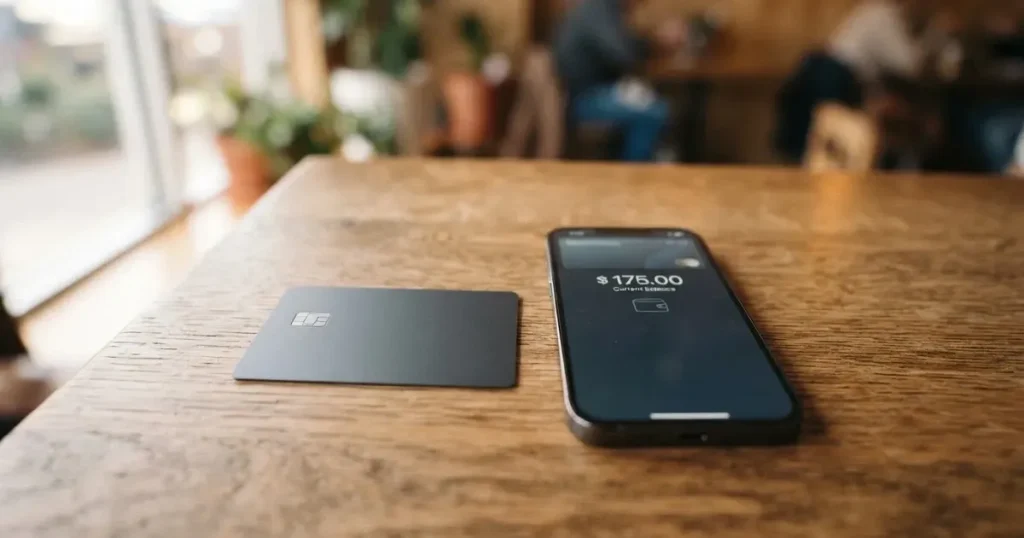
The Kinesis card is a virtual payment card that spends money you hold as gold, silver, crypto or the C1USD stablecoin on the Kinesis platform. The pitch is unusual and, for a certain kind of person, genuinely appealing: you convert metal into fiat value at the point of sale and the card simply spends that balance, and you get 2% of what you spend back in gold. That last part is the part I keep coming back to. Cashback denominated in gold is not the same thing as cashback in dollars, and understanding why tells you most of what you need to know about who this card is built for.
The catch is that when I went through the public pages carefully, a great many of the ordinary questions a card has to answer came back blank. No country list, no fee table, no stated card network, no mention of Apple Pay or Google Pay, no ATM, no stated limits, no named issuer or licence. Third-party sites fill some of those gaps, but third-party sites are not the card, and they disagree with each other on the numbers that matter most. That is why this review comes out at 4.8 out of 10 rather than higher. It is not a verdict on whether Kinesis is a bad company or a bad product. It is a verdict on how little the public record lets an ordinary person verify before signing up.
If you are reading this because an ordinary bank card has been difficult for you to get — because of where you live, your status, your history, or a country whose banking system is closed to you — then read on, because this is genuinely the population the card is aimed at and there is real logic in that aim. If you are reading it because you want a better rewards rate on everyday spending, the honest answer is that a card whose fee schedule is not published is a poor vehicle for optimising anything.
The conditions described here are current as of October 28, 2026.
Verdict: 4.8 out of 10, and the blanks are the reason
Kinesis scores 4.8 out of 10. The single strongest thing about it is the concept: convert gold, silver, crypto or a stablecoin into spendable fiat balance at the point of sale, then get 2% back in gold, paid into a Kinesis account. For someone whose reason for wanting a crypto card is that normal banking has closed off, that combination — spendable balance, metal-backed rewards, no dependence on a local bank’s willingness to open an account — is more than a gimmick.
The single weakest thing is that the card’s own public pages do not tell you who issues it, which network it runs on, what it costs, where it is available, what the limits are, or whether Apple Pay and Google Pay work. I am not going to fill those gaps with guesses, and I would be wary of anyone who does.
Here is how the score breaks down, criterion by criterion.
| Criterion | Mark | Why |
|---|---|---|
| Who can get it | 5 / 10 | No country list on the page read. Starting data points to the United States, Latin America and the Caribbean. Overall availability unclear; the site shows pre-registration. |
| Cost | 6 / 10 | Not disclosed officially. Unofficial: no monthly fee and no sign-up fee, a 1.95% transaction fee on one page, and 0.22% conversion plus 0.45% transaction in another source. |
| Top-up options | 5 / 10 | Instant conversion of gold (KAU), silver (KAG), crypto and C1USD from a Kinesis account at the point of sale. Networks not stated. |
| Reliability and complaints | 4 / 10 | Card issuer and licences not named. Kinesis Money scores 2.4 out of 5 on Trustpilot from 750 reviews, with withdrawal delays of around 40 days and complaints about fees and liquidity. |
| Everyday use | 3 / 10 | Virtual only. Apple Pay and Google Pay not mentioned. No ATM. |
That last row is the one that costs the most, and it is worth dwelling on. A virtual-only card with no mobile wallet and no ATM is not a primary payment card for most people. It is a supplementary one, and the people it is most aimed at — the readers I described at the top, people who have trouble getting an ordinary card — are precisely the people least likely to be able to absorb a decline at the supermarket.
The rewards structure tells you who this is for. 2% cashback in gold is not 2% of your purchase handed back as spendable money. It is 2% of your purchase converted into KAU, the ERC-20 gold token, held on the platform, exposed to whatever gold does and to whatever that platform does. If you are already a gold holder, that is a reward you actually want. If you are not, it is a reward with two extra moving parts attached to it.
Will they give you the card?
Here is the honest, and slightly awkward, answer: the page I read does not name a single country or state whose residents can get the card. Starting data points to the United States, Latin America and the Caribbean as the intended regions. Beyond that, general availability is unclear, and the site itself currently presents a pre-registration rather than a straightforward application.
There is a second layer to this question that is not about geography at all, and it is worth understanding before you spend time on a sign-up form. Kinesis links a KYC verification guide from the site, but the content of that guide was not available to me, and the card’s own page does not state what identity checks are required, what documentation counts, or what happens if your documents are in a language the review team does not read. In other jurisdictions the answers are published and standardised; here they are not.
That matters because of how the general rules work, even where a card provider does not spell them out. In the EU, customer due diligence covers name, address, date of birth, nationality and identity documentation, a sanctions check, the purpose of the relationship, and whether you are a politically exposed person. In the US, the customer identification programme requires name, date of birth, address and an identification number, and electronic KYC systems validate proof-of-address documents against records. And nationality is screened separately from residence, because sanctions screening and issuer risk policy are often applied to citizenship and country of birth, not merely to your address.
So the practical answer to “will they give me the card” has two parts. The country part is not stated, and you will have to find out by trying. The identity part is: yes, almost certainly, because everyone does it, and the questions asked will include your nationality, not just where you live.
How to get it
The card is virtual. That is stated, and it is the defining fact about how you obtain and use it. The network it runs on is not stated officially; unofficial reporting says it runs on Mastercard, operated by BAANX, and that a separate physical Visa card issued in the US in 2021 is a different product. Which network a card runs on is not a trivial detail, because of the reasons in the risk section below, but for this card you have to take the network on trust.
There is no stated card currency either. You will be spending whatever balance your account holds, converted at the point of sale, and what that conversion produces in the currency of the shop depends on what the platform does in the middle. If you are paid in euros and buy something priced in euros, you want to know how much of the platform’s spread you are paying to get there. That number is not published.
Physical delivery does not apply to a virtual card. Nor is there any stated tier structure: this is a single card, not a ladder of metal and titanium versions with different fees and different cashback rates. That is a genuine simplification if you were expecting the tiered treatment some crypto card brands offer, and it also means there is no upgrade path and no status to chase.
What is happening right now, according to the site’s own news: pre-registration for the virtual card, with a six-month free cashback plan running from launch. Third-party coverage describes the virtual card as live, though I could not confirm a date for that. If you are reading this and trying to work out whether to wait, that ambiguity is itself part of the picture — the offer described on the site and the product described by outside coverage are not quite the same state of things.
Fees: what a Kinesis payment really costs
I want to be blunt here, because this section is where the review has least to work with. The official position is that costs are not stated. There is a link to a general fees page, but I did not have its contents. What exists instead is a scatter of third-party figures that do not agree with each other.

Unofficial promotional coverage from 2026 says there is no monthly fee and no sign-up fee. That part is plausible and consistent with the shape of this kind of product, and if it is true it is a genuine advantage — most competitors charge at least a subscription for their paid tier. But one unofficial page quotes a 1.95% transaction fee, and another source gives 0.22% conversion plus 0.45% per transaction. Those are very different numbers, and 1.95% per transaction is the kind of figure that changes how you use a card entirely.
| Fee or limit | What is stated |
|---|---|
| Issuance | Not stated. Unofficial: no sign-up fee. |
| Monthly fee | Not stated. Unofficial: no monthly fee. |
| Conversion | Not stated. Unofficial: 0.22% in one source. |
| Transaction fee | Not stated. Unofficial: 1.95% in one page; 0.45% in another. |
| FX / card currency | Card currency not stated. FX treatment not stated. |
| ATM | Not stated. No ATM mentioned. |
| Daily limit | Not stated. Unofficial: up to $15,000 in one source; €15,000 in another. |
| Monthly limit | Not stated. Unofficial: over $400,000 in one source. |
| Tiers | Not stated. Single card. |
Now, three everyday payments, and what I can and cannot tell you about them.
A coffee costing 4.00. If the 0.45% figure is right, the fee is under two cents and you would never notice it. If the 1.95% figure is right, it is nearly eight cents on a four-euro purchase — a small amount, but a meaningful one when it applies to every single transaction you ever make. Nobody reading the public pages can tell you which of those is correct, and that ambiguity, not the fee itself, is the real cost.
A weekly grocery run at 70.00. At 0.45% that is 31 cents. At 1.95% it is 1.37. At the same time, the conversion question looms: your balance is built from gold, silver, crypto or C1USD, so a euro shop is charging you whatever the platform’s spread is on top of the transaction fee. That number is not published. If the spread is wide, the transaction fee is the least of it.
A flight at 400.00. At 1.95% that is 7.80 in fees. This is the case where the missing numbers stop being a curiosity and start being a planning problem: people who spend large amounts on a card with an unpublished fee schedule cannot budget, and cannot compare. The unofficial monthly limit of over $400,000 in one source and €15,000 daily in another are also unverified, and I would not treat either as a fact you can spend against.
The broader point, which applies to every crypto card rather than this one specifically: the cost of using one of these cards is rarely a single number. It is a transaction fee plus a conversion spread plus the network or gas cost of moving value in plus, if you hold metals or tokens, the market movement between the moment you acquire and the moment you spend. Only the first and last of those are visible to most card users.
Top up: it is conversion, not transfer
This is the concept that most often trips people up, so I will state it plainly. Topping up a Kinesis card is not topping up a prepaid card. You do not send money to a card account. What happens is that you hold assets on the Kinesis platform — gold as KAU, silver as KAG, cryptocurrency, or the C1USD stablecoin — and when you spend, the platform converts from your account balance at the point of sale.
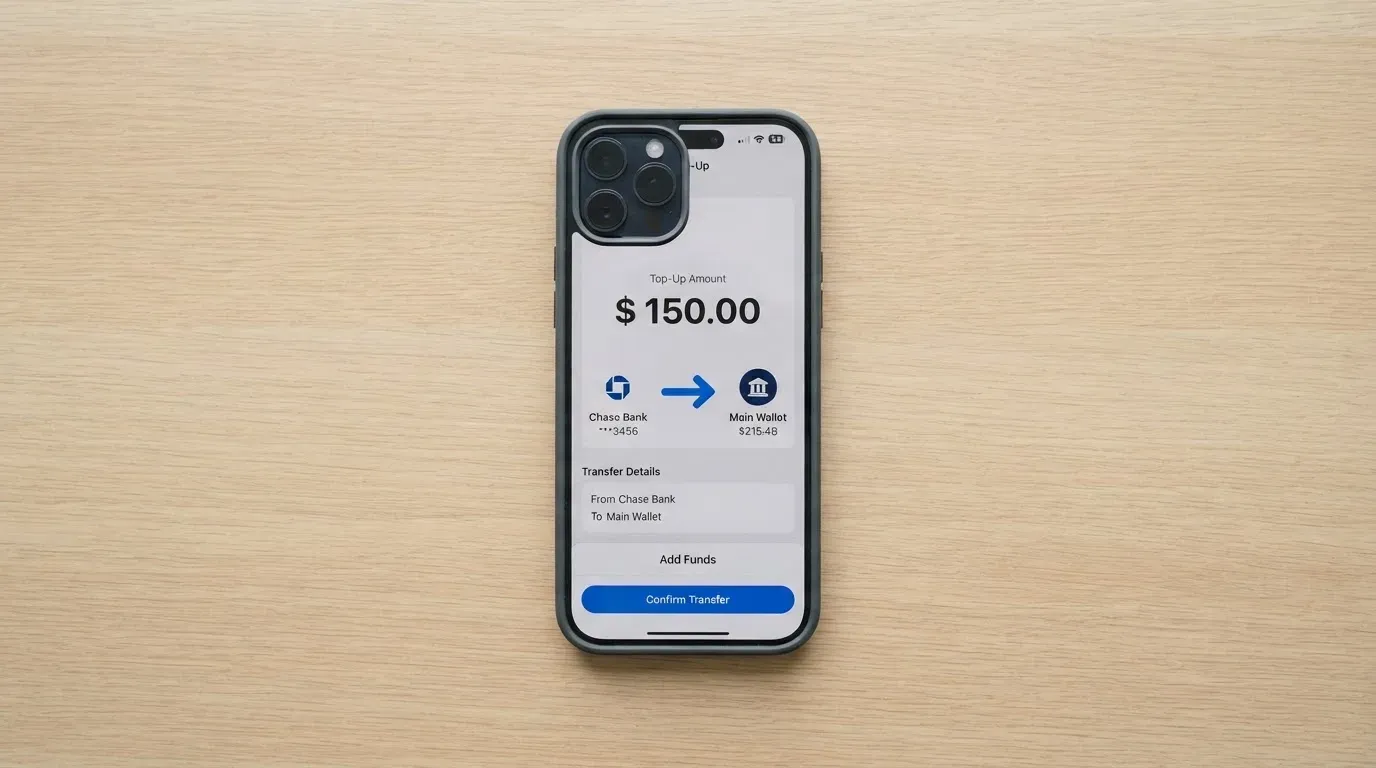
That means the funding route is the platform’s asset list, not a network deposit address. The starting data describes it as instant conversion of gold, silver, crypto and C1USD from your Kinesis account. The page also says you can buy gold and crypto with “your card or bank transfer”. A card-specific top-up fee and a minimum are both not stated, so I cannot tell you what it costs to get value in, or how little you can get in to start.
What I want to flag clearly, without turning into a how-to for evading anything: the networks are not stated. In this category that is not a technicality. USDC is listed as natively supported on 38 networks, including Ethereum, Solana, Base, Polygon PoS, Avalanche, Arbitrum and Stellar, and USDT has been issued on Ethereum, Tron, Solana, Polygon, Avalanche and others. Circle stopped supporting USDC on Tron in February 2024, so “USDC over TRC20” is not a native option. Blockchain transfers are irreversible, and a deposit sent on a network the card provider does not support, or to an address belonging to a different network, can be lost or need manual support recovery with no guarantee. If a card’s own pages do not tell you which networks are supported, you are being asked to take a risk on every transfer you make. Please confirm this with the provider in writing before you move anything of size.
Paying with it every day
Virtual only. No physical card, no ATM mentioned, and Apple Pay and Google Pay not mentioned. Wallet support for the card is not stated. In practice that means the number of places you can tap to pay is close to online checkouts and anywhere that takes card numbers, and it means no cash withdrawals.
Some reassurance: there is a mobile app, mentioned on the site with the line “Keep track of your assets on the go”. I could not read the store ratings — the store lookups failed — so I am not going to tell you how people rate it.
The rewards are the daily-use hook. “Get 2% cashback in gold”, with access to the cashback plan “6 months free from launch”, paid in gold. As I said up front, this is a reward that pays you in KAU rather than fiat, which makes sense if you hold gold anyway and is a curiosity if you do not. It also puts a conversion step between you and your own reward: you earn metal, and if you ever want to spend it as cash, you go back through the platform.
What is not stated is how disputes work. If a charge goes wrong, whether you can charge it back, and how, is not described on the card pages. That is not unusual in this category and it is not a mark against the card specifically — but it is a mark against relying on it for anything you would be upset to lose.
Let me also explain one everyday frustration that catches crypto card users out, because it is not this card’s fault and has nothing to do with crypto. The address verification service compares the numeric parts of the billing address you type with the issuer’s records, and it is mainly offered in the US, Canada and the UK. It is generally unavailable for foreign-issued cards, which can cause declines. Separately, merchants can look up the card’s first six or eight digits, which identify the issuing institution and country, and apply extra scrutiny when the issuer country differs from the billing address. This is why a card issued in one country can look “foreign” to a shop in another. It is also why some merchants decline prepaid or foreign-issued cards outright. If you are outside the regions the card is aimed at, this is the practical reason a payment may fail, and no amount of care on your part will prevent it.
What can go wrong
No official card-specific incidents came up in what I checked. But the platform behind the card has a visible complaint record, and you should read it as platform risk, not card risk.
On Trustpilot, Kinesis Money — the platform, not the card — scores 2.4 out of 5 from 750 reviews, 115 of them in the last 12 months. The sampled reviews mention delayed or frozen withdrawals, some around 40 days, running from July to October 2026. There are complaints about templated support replies, about fee disclosure, and about liquidity, and complaints mentioning CIMA appear in October 2026. None of the reviews I sampled mentioned the card, which cuts both ways: the card is new enough not to have generated card complaints yet, and the sample is not a card sample.
On the company side: Kinesis Money is the name; starting data places it as Kinesis Cayman, and KMS Labs is described as the issuer of the ERC-20 gold and silver tokens KAU and KAG. The card issuer and its licences are not stated on the page. I want to be careful about what I am saying here, so plainly: this does not mean the card is unregulated, it means the card’s own public pages did not tell me who is regulated for what. In this category that distinction is not pedantic. Visa and Mastercard do not issue crypto cards to consumers themselves; they license issuers, and they can suspend a programme. WaveCrest, a Visa issuer that supplied crypto card brands, was suspended by Visa in Europe in 2018, closing all its Visa programmes. And when Visa terminated its global agreements with FTX on 13 November 2022, the FTX US debit card was wound down by its issuer. Programmes end. When they do, the sequence is typically a notice period, then spending and loading stop, then you are asked to withdraw your balance. One 2026 closure reported by a secondary source had new loads ending 8 July 2026 and spending stopping 8 August 2026 — that is a single unconfirmed source, but the shape of it is worth knowing before you are relying on a balance.
On safety and custody: the page says “Your assets are in safe hands” and links independent audits and monthly attestations. The custody model, two-factor authentication and card freeze are not stated. This matters more than usual here, because control of crypto belongs to whoever holds the private key or seed phrase — typically 12 to 24 words in an unencrypted form, and anyone who obtains it can restore the wallet and spend its funds. Transfers are typically irreversible, and a stolen key has no recovery path because the network cannot freeze or return funds. Custodial platforms have a real history: Mt. Gox at around US$350 million reported stolen between 2011 and 2014, Coincheck at about US$400 million in 2018, and Ronin Network at US$625 million in 2022. Holding funds with a custodian means carrying counterparty and hack risk on top of everything else.
Where a card is linked to your own wallet instead, the trade runs the other way: the funds stay with you until the moment of payment, but you carry sole responsibility for key loss, phishing, and clipboard-hijacking malware that silently swaps an address you copied. For a reader who cannot get a bank card, that trade can be the right one. It is still a trade.
Two more things I looked for and could not find. Whether the Kinesis card is available in your country is not answered on the page, so the search query “is Kinesis card available in {country}” cannot be answered from the public record either. And how to delete a Kinesis account is not stated.
Finally, the money question, which I am flagging rather than advising on. Digital assets are generally treated as property for tax purposes, and exchanging them for goods, services or dollars generally produces a taxable gain or loss, measured in local fiat currency at fair market value on the date of the transaction. That means each card payment funded from crypto may count as its own disposal. I am not tax advice and I am not going to pretend this is simple — check it with a professional in your own jurisdiction.
What to take instead
If the Kinesis concept appeals to you but the missing information does not, there are other cards. I want to be even-handed here, because all four of these have gaps too; what follows is a comparison of how much each one actually tells you, not a recommendation.
GoMining Card, scored 6.6 out of 10. Eligibility is not given as a list; products “may not be available in your jurisdiction”, and it is subject to eligibility and regional availability. An earlier check suggested worldwide except prohibited jurisdictions. Virtual now, physical “coming soon”, with network and card currency not stated. Cost and fees are not stated, though opening a card grants a free 1 TH miner. You top up with BTC, USDT, GOMINING and other coins — an earlier check said funding comes from the GoMining wallet. Cashback is paid in mining power, with the rate rising with VIP level, quoted as “up to 5% cashback”. A reward denominated in mining power is a bet on the mining side of the business, and the “up to” does the heavy lifting.
Greencart, scored 6.9 out of 10, and the most transparent of the group. Available in EEA countries plus Argentina, Bolivia, Brazil, Colombia, Mexico, per Gnosis Pay’s eligible-countries list. Gnosis Pay’s terms say the contracting entity depends on residence, that applicants must be 18+, that they cannot be on sanctions lists, and cannot be located in, controlled from, or be a national or resident of sanctioned countries. It is a Visa card powered by Gnosis Pay; virtual cards are free while physical cards may carry a one-off admin fee; card currency not stated. Cost is stated: “No hidden, monthly, or annual fees”. An optional Greencart+ subscription is USD $7.99 monthly, or $4.99 for the first two months, or USD $79.99 yearly, and the App Store lists Greencart Max at $350.00. The site states no fees for withdrawals, transfers, deposits or FX — which is a real advantage over Kinesis’s unpublished everything. You recharge from a bank account or a crypto wallet, fiat or crypto, and spend from the self-custodial Gnosis Pay Safe. Rewards include a floor of 0.5% in B3TR on every purchase, rising with staked B3TR and Greencart+ up to a 4% ceiling, capped at $40 per transaction and $40 per month, with 48 categories earning none. Note the discrepancy: the App Store text says “up to 8% cashback” and partner purchases up to 15%. One more thing worth knowing, because Greencart is self-custodial: the IRS treats digital assets as property, so each payment funded from crypto may be a taxable disposal.
Young Card, scored 5.7 out of 10. Almost nothing is stated officially — not who can get it, not the card type, not the cost, not the fees, not the funding route. The only concrete detail is the rewards: cashback paid in YNG tokens, with the rate depending on Club tier — Essential 0.1%, Gold 1.8%, Platinum 3.6%, with Bronze and Silver not stated. Compare those rates with Kinesis’s 2% in gold and Greencart’s 0.5% floor in B3TR and you can see the whole category’s problem in one line: nobody publishes what it costs, and everybody advertises what it pays.
| Kinesis | Greencart | GoMining | Young | |
|---|---|---|---|---|
| Score | 4.8 / 10 | 6.9 / 10 | 6.6 / 10 | 5.7 / 10 |
| Card type | Virtual only | Virtual free, physical may cost a one-off admin fee | Virtual now, physical coming soon | Not stated |
| Network | Not stated officially; unofficial Mastercard | Visa via Gnosis Pay | Not stated | Not stated |
| Fees | Not stated; unofficial 1.95% or 0.45% plus 0.22% conversion | None stated for withdrawals, transfers, deposits or FX | Not stated | Not stated |
| Funding | Conversion of KAU, KAG, crypto, C1USD from account | Bank account or crypto wallet, fiat or crypto | BTC, USDT, GOMINING, other coins | Not stated |
| Reward | 2% cashback in gold | 0.5% floor in B3TR, up to 4% ceiling | Up to 5% cashback in mining power | YNG tokens, 0.1% to 3.6% by tier |
| Extra cost | Not stated | Greencart+ from $4.99/month | None stated | Not stated |
The pattern I would draw from this table: Kinesis is the only one of the four that does not publish its country list. Greencart is the only one that publishes its fees. Everything else is a set of question marks, which tells you something about the state of this category in general rather than about any one company.
Who I would recommend it to
If you already hold gold or silver through Kinesis, and you treat that as a long-term position rather than a trading one, and you want a second card that quietly spends a slice of it — with the 2% gold cashback as a bonus rather than as the reason — then this card makes sense and I can see the appeal. You are not buying an optimisation story; you are adding a spend rail for metal you already own.
I would think twice, and check hard before committing money, if any of these apply to you:
- You need a card for everyday basics. This is virtual only, no ATM, no mobile wallet mentioned. Do not make it your only card.
- You are outside the United States, Latin America and the Caribbean and hoping it works anyway. The country list is not stated and the page shows pre-registration.
- You care about fees. Nothing is published, and the unofficial figures disagree by a factor of four.
- You are putting significant funds on the platform. The custody model is not stated, the issuer and licences are not named, and the platform’s Trustpilot record includes withdrawal delays of around 40 days.
- You need chargeback protection. How disputes work is not stated.
- You are in a sanctioned country or hold citizenship of one. Screening is applied to nationality as well as address, and I am not going to give you any route around that.
Before you sign up, my short list is: ask them in writing who issues the card and under what licence; ask for the current fee schedule as a document; ask which networks are supported for each asset you intend to send; and ask what happens to your balance if the programme ends. If the answers come back clearly, this is a reasonable product for the right person. If they do not, the missing information is itself the answer.
Frequently asked questions
What is the Kinesis card?
The Kinesis card is a virtual payment card that draws on assets you hold on the Kinesis platform. You can convert gold (KAU), silver (KAG), cryptocurrency or the C1USD stablecoin into spendable fiat balance at the point of sale, and the card spends from that balance. It also offers 2% cashback paid in gold. There is no physical version.
Is Kinesis a bank?
Not as far as the card’s own pages say. Kinesis Money is the platform name, with Kinesis Cayman in the starting data, and KMS Labs is described as the issuer of the ERC-20 gold and silver tokens. The card issuer and its licences are not stated on the page. A crypto card usually depends on two licences — one for the crypto side and one for the payment side — so ask before you assume which rules apply.
Which countries can get the Kinesis card?
That is not stated on the page I read. Starting data points to the United States, Latin America and the Caribbean as the intended regions, and the site currently shows a pre-registration rather than a plain application. Availability outside those regions is unclear. If your country is not on a published list, ask support directly in writing before you move any funds.
How much does the Kinesis card cost?
Officially, costs are not stated — the site links a general fees page whose contents were not available. Unofficial reporting for 2026 says no monthly fee and no sign-up fee, but gives transaction fees of either 1.95% on one page or 0.45% plus 0.22% conversion in another. The figures disagree significantly, so treat any number you see as provisional until you get the schedule in writing.
How do I top up the Kinesis card?
You do not transfer money to a card account. You hold assets on the Kinesis platform and spending converts from that balance at the point of sale — gold as KAU, silver as KAG, crypto, or C1USD. The page also says you can buy gold and crypto with your card or a bank transfer. Networks are not stated, which matters: transfers are irreversible, so confirm supported networks before sending anything of size.
Can I add the Kinesis card to Apple Wallet or Google Pay?
There is no information on this. Apple Pay and Google Pay are not mentioned in the card’s material, and tokenised mobile wallet support is not stated. Because the card is virtual only, whatever you can do is limited to online checkouts and anywhere that takes card numbers, unless wallets turn out to work and nobody has said so publicly.
Is the Kinesis card safe?
There is no official record of card-specific incidents that I found, but I would not call it risk-free. The card issuer and licences are not named, the custody model is not stated, and audits and monthly attestations are linked without the custody detail. The platform behind it scores 2.4 out of 5 on Trustpilot from 750 reviews, with complaints about delayed withdrawals of around 40 days.
Why would I want cashback in gold rather than cash?
Because if you already hold gold as a position, a reward paid in KAU adds to it rather than to your spendable balance, and 2% is a respectable rate for that. If you do not hold metal, the reward is a two-step thing: you earn tokens, and you convert them back through the platform before you can use them. Then you carry gold price risk and platform risk on top of everything else.
Can I use the Kinesis card abroad?
Probably, subject to the usual problems. Virtual cards work at online checkouts in many places, but merchants can look up the issuing country from the card’s first digits and decline foreign-issued or prepaid cards, and address verification is generally unavailable for foreign-issued cards, which causes declines. On top of that, the card’s currency is not stated, so you have no way to know in advance what the conversion costs you.
Is the Kinesis card worth it?
Worth it if you already hold gold or silver on Kinesis and want a second spending rail, and you can absorb a virtual-only card with no ATM and no stated mobile wallet. Not worth committing meaningful funds to while the fee schedule, country list, issuer and licence all remain unpublished. My advice is to ask the four questions I listed earlier in writing, and decide from the answers.
Credit and cashback cards: choosing between them – cryptocardpicker
Content created by the «cryptocardpicker» team