
The card you fund with crypto, rated 5.0 out of 10
 Available in US
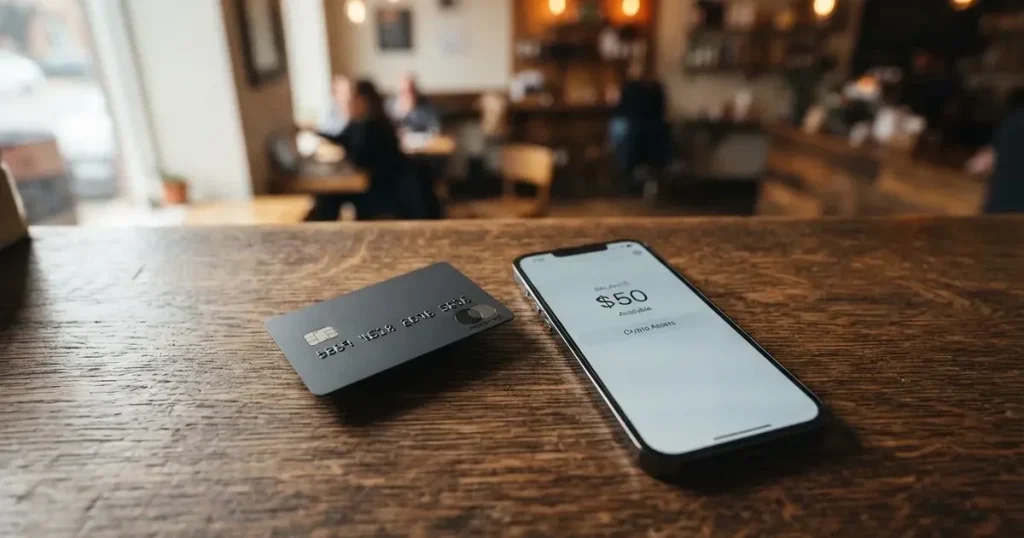
If you have tried to open an ordinary bank card and could not — because of where you live, what documents you hold, or what a bank’s compliance team thinks of your situation — then a prepaid crypto card is one of the few things still on the table. Bit.Store is one of those cards. It is virtual, it is funded from cryptocurrency, and it is meant to be added to your phone’s wallet and spent like any other contactless card. That is the pitch, and the idea is not unreasonable.
I spent my time on the card’s own public pages and on what other people report about it, and I have to be straight with you about the balance of that material. The card’s public pages do not publish the things you would need in order to plan with it: not a complete country list, not a fee schedule, not the identity checks, not the limits, not the top-up networks. Almost everything specific I can tell you comes from third-party reporting rather than from the card itself. On top of that, the physical card was discontinued in March 2026 after a regulatory event at the issuer, and the user record on Trustpilot is bad. My score is 5.0 out of 10.
That number is not a punishment for the card being dangerous. It is a reflection of a product that works in the narrow case it was built for and is surrounded by unanswered questions everywhere else. Read the sections below in order — they are arranged so that by the end you will know which of the open questions you personally need answered before you commit money.
*The conditions described here are current as of October 28, 2026.*
Verdict: 5.0 out of 10, and a card for a specific person
Bit.Store scores 5.0 / 10. That is the middle of the road, and the reason is not that the product is unusable. It is that the card is legible in only one direction: it is clear who it is for, and almost nothing else about it is documented.
| Criterion | Mark | Why, in short |
|---|---|---|
| Who can get it | 6 / 10 | 54 countries reportedly listed, with eight closed off — but no complete applicant-country list published |
| Cost | 5 / 10 | Issuance reported free, $1 a month on an old tariff, 2.5% to top up; FX and purchase fees depend on card type and are not fully published |
| Top-up options | 7 / 10 | More than 10 cryptocurrencies, including BTC, ETH, USDT, USDC, converted to card balance on loading; networks not named |
| Reliability and complaints | 2 / 10 | Operator is a Lithuanian company, not a bank or an e-money institution; the physical card was closed in March 2026; Trustpilot sits at 1.8 out of 5 |
| Everyday use | 5 / 10 | Virtual card, Apple Pay and Google Pay claimed since launch, no ATM, physical card gone |
The audience note is short and worth taking at face value: this is for users who want a small virtual card topped up with crypto. If that is you — you hold USDT or BTC, you want to spend a modest amount online or in shops without opening a bank account, you are comfortable treating the balance as money you could lose — then the fit is reasonable, and 5.0 is a fair place to land.
If that is not you, the score is low for good reasons. If you need an ATM, a physical card for a landlord or a car hire desk, a rewards programme, or a card you can load with tens of thousands at a time, this card does not offer those things. And if you are the kind of person for whom an unexplained pause in support would leave you stuck — because the money in the card is money you cannot easily reach any other way — the complaints record makes this a poor choice regardless of how the fee arithmetic works.
Will they give you the card?
The honest answer is: the card’s own public pages do not say. I could not find a stated list of eligible applicant countries, and I want to be clear that this is a gap in what the card publishes, not a claim that it refuses everyone.
What other people report is a partial picture. Third-party coverage from August 2026 lists 54 countries as available, with eight closed: Belarus, China, Cuba, Iran, North Korea, Russia, Syria and the United States. Russia and Belarus appear on that restricted list. No complete applicant-country list has been published, so the number of open countries and the restrictions on them are both things I am passing on rather than confirming.
The reason this gap matters more than it might sound: nationality and country of residence are screened separately in this industry, because sanctions lists and issuer risk policy are applied to citizenship and country of birth as well as to the address on your documents. A card can therefore be open to residents of a country whose citizens cannot register. If your situation is anywhere near that line, ask before you send a document.
How to get it
Again, the mechanics of sign-up are not published. What the card’s own materials have said at different times is thinner than you would expect, and it is worth reading the sequence rather than any single claim.
At launch in November 2023, coverage described a KYC-free Mastercard prepaid virtual card — a card you could create without identity verification. The virtual card page now speaks of a “Simple KYC verification” instead, and the minimum age is reported inconsistently: 18+ in one place, 16+ in the user agreement. Both of these are third-party readings of card materials as of August 2026, not statements I could confirm directly.
The card itself is virtual: a virtual Visa or a virtual Mastercard, depending on which card type you choose. The former physical card was a Mastercard issued through Paytend. Nothing is dispatched, so there is no delivery question, and there is nothing to activate in the usual sense — a virtual card number is normally what you add to your wallet.
Fees: what it really costs
No complete fee schedule is published, which means you cannot compute your own cost per purchase from what the card has told the public. Here is what is reported, with its source standing visible.

| Fee or limit | What is reported |
|---|---|
| Issuance | Free |
| Monthly fee | $1 under a previously published schedule (unofficial); annual $0 |
| Top-up fee | 2.5%, up from 1.5% earlier |
| Conversion and FX fees | Depend on the card type; no complete public schedule |
| Purchase fees | None on transactions up to $10,000 (unofficial 2023 coverage) |
| ATM | Not applicable to a virtual card; former physical card had a €2,000 daily limit (unofficial) |
| Monthly limit | Virtual card: $10,000 headline figure (unofficial), unclear scope |
| Other limits | Former physical card: €100,000 balance, €50,000 monthly load, €5,000 daily load (unofficial) |
| Tiers | None published |
The monthly fee needs a caveat attached. The $1 figure comes from a schedule published at some point in the past, not from a current tariff, and in 2023 the card was described as having no issuing, inactivity or annual fees at all. So the honest reading is that the monthly charge may or may not apply to you today, and the card’s own pages do not settle it.
Two of the limits above are the kind of figure that gets quoted and then misused. The monthly headline on the virtual card is described as unclear in its scope — whether it caps topping up, spending, or the balance you can hold. And every one of the more specific numbers in the table belongs to the physical card that no longer exists (all reported unofficially).
Now three ordinary payments, and which fees actually bite. All of this depends on a tariff the card has not published in full, so treat it as the shape of the cost rather than a quote.
- A subscription bought in euros while your card balance sits in dollars. This is the payment that costs the most and the one people notice least, because the extra is folded into the exchange rate. The card is reported to charge FX and purchase fees that vary by card type; no full schedule exists to tell you how much this will take.
- A $12 coffee. Small enough that a percentage fee looks trivial, but the conversion still applies to the same terms, and some merchants decline prepaid or foreign-issued card numbers because the card’s identifying prefix reveals the issuer and its country.
- Loading $200 of USDT to pay for all of it. Here the fee is explicit: 2.5%, up from 1.5% before. On-chain network fees for your deposit are charged by the blockchain itself, not by the card. So the visible cost of this card is not a monthly subscription — it is a percentage on every load.
That last line is the one to sit with. If you reload often, the top-up fee is the number that determines whether this card is cheap or expensive for you.
Top up: how the money gets in
The card’s pages do not describe the top-up flow. Third-party reporting from August 2026 describes more than 10 cryptocurrencies with BTC, ETH, USDT and USDC named, converted to a card balance when you load, with a fee of 2.5% and a $15 minimum in a previously published flow that should be confirmed at checkout. Which networks are supported is not stated anywhere I could find, and fiat routes are not stated either.
That missing detail is not a formality. Blockchain transfers are one-way: if you send on a network the provider does not support, or to an address belonging to a different network, the funds can be gone, or at best need a manual support recovery with no guarantee attached. And if you send USDT from an exchange, you may need a small amount of the network’s own coin to pay the transfer fee — ERC-20 transfers on Ethereum are paid in ETH, so a wallet holding USDT and nothing else cannot send at all. Tron-based transfers are paid through the network’s own resource system, often by burning TRX.
There is also no published information on withdrawing money out of a card balance, which for many people is the question that matters most. If a card is where your money sits, the way you get it back is not an afterthought.
Paying with it every day
Day-to-day this is a virtual card and a phone wallet, nothing more. Apple Pay and Google Pay have been advertised since launch, with the reported caveat that availability can depend on the card’s identifying prefix, your device region and the wallet itself. Blocked merchant categories are not stated — which leaves the usual category-level guessing games, since gambling, for instance, is blocked on many prepaid cards as a matter of issuer policy rather than law.
Here is what makes virtual-card spending different from a debit card, and where the friction actually appears. A card number begins with a short issuer code, and any merchant can look it up to see which institution and which country issued the card. That is why a card issued in one country can look foreign to a shop in another, and why some merchants decline prepaid or foreign-issued numbers outright. Address verification — the check that compares the street number and postal code you typed with the issuer’s records — is mostly a US, Canada and UK thing and is generally unavailable for foreign-issued cards, which causes declines.
Two more practical points. A declined online payment can leave a hold on your funds for several days, sometimes up to seven, so a failed attempt is not immediately your money back. And when you pay through Apple Pay, the real card number is replaced by a device-specific number held in the phone’s secure hardware with a fresh one-time code per payment — which is a genuine security improvement, but it does not protect you from the card account itself being suspended.
There are no published rewards, no detail on disputes or replacement fees, and nothing official about the app. For a card you may hold a real balance, none of that is a small gap.
What can go wrong
This is the section that moved the score down to 5.0 more than anything else, and it is the one I would want a reader in your position to read twice.
The physical card is gone. In March 2026, after a regulatory event at the issuer, Paytend, the physical card was discontinued. No official incident notice appears to have been published. Whatever happened, the effect on you is simple: there is one product now, and it is the virtual one.
Users report balances they could not move. From late 2024 through 2025, reports describe virtual cards suspended for “maintenance”, with balances unspendable or unwithdrawable, monthly deductions continuing while the card did not work, and slow support. Some balances were recovered; others were blocked for months.
The complaint score is very low. Trustpilot shows 1.8 out of 5 from 23 reviews, with 82% one-star. I did not read Trustpilot directly, so this is as reported to me in August 2026. The recurring themes are suspended virtual cards, blocked balances, deductions that continued, and slow support.
The operator is not a bank. The company behind the service is reported as Bitstore Europe UAB, a Lithuanian entity, company number 306465386, registered in 2024 as a virtual-currency exchange and depository-wallet operator. It is not reported to hold a bank or electronic-money licence, and it was not in the Bank of Lithuania’s e-money register as of August 2026. The physical card’s issuer was Paytend Europe UAB; the current virtual card’s issuer is not publicly named.
This last point is the one that generalises beyond this card. A crypto card usually depends on two separate regulatory pieces: a licence covering the crypto side — custody, exchange, transfer — and a licence covering the payment side, because a card is a payment service regulated separately. In the EU, e-money tokens may be issued only by a credit institution or an electronic money institution, and under MiCA providers operating under national law could continue only until 1 July 2026 or until they received or were refused authorisation, whichever came first. So asking who issues your card is not pedantry. It decides which regulator is watching the balance you are loading.
Your money sits with someone else. Custody is advertised through Cobo, and the 2023 launch mentioned an extra two-factor authentication layer. With a custodial wallet the provider holds the credentials, so you have to trust it completely. The alternative — a self-custody card — leaves the funds in your own wallet until the moment of payment, but then key loss, phishing and clipboard malware that silently swaps a copied address are entirely your problem. Transfers are typically irreversible, so a stolen key has no recovery path: the network cannot freeze or return funds.
Programmes close. This is not hypothetical in the category. Visa terminated its global agreements with FTX on 13 November 2022 and the FTX US debit card was wound down. WaveCrest, a Visa issuer that supplied crypto card brands, was suspended by Visa in Europe in 2018, closing all its Visa programmes. When that happens the pattern is usually the same: a notice period, then loading and spending stop, then you are asked to withdraw what is left. I saw one report of a 2026 closure where new loads ended 8 July 2026 and spending stopped 8 August 2026 — that is a single unconfirmed source, but it shows the shape of what you would be relying on.
One protection worth knowing: prepaid and virtual cards are also the least protected in disputes. US reversal rights under Regulation E apply to debit cards and Regulation Z to credit cards; prepaid coverage varies and should not be assumed.
What to take instead
If the reason you are here is that an ordinary card is hard to get, the sensible move is to compare rather than to accept the first option. Two of the alternatives below score below Bit.Store and one scores above it, which is itself useful information.
| Card | Score | Card and cost basics | Funding |
|---|---|---|---|
| Bit.Store | 5.0 / 10 | Virtual Visa or Mastercard; issuance free, $1 a reported monthly fee | 10+ coins including BTC, ETH, USDT, USDC; networks not stated |
| CardFlow | 4.9 / 10 | Virtual USD Mastercard, created in about 3 minutes, card creation free; monthly fee not stated; aimed at Nigeria | Bitcoin, USDT, ETH or a Naira bank transfer; networks not stated |
| HyperCard | 4.7 / 10 | Prepaid card, balance in USD or EUR; App Store says it works in more than 176 countries, which is about acceptance, not eligibility; no fees listed | Crypto such as USDT, BTC, ETH deposited in the app, converted to USD or EUR |
| Card.fi | 6.6 / 10 | Virtual Classic $49 and Virtual Premium $249 one-time, plus physical and metal versions; no monthly, annual, inactivity or minimum-balance fee | 32 coins across 5 networks, converted at market rate on arrival |
Card.fi is the one worth a look if you can use it. Its terms are published in a way Bit.Store’s are not: a top-up fee of 1.5% plus $1.00 on Classic and 1% on Premium, an FX fee of 3.5% on Classic and 2.5% on Premium, with the conversion fee shown before each top-up. Its catch is that it is explicit about who cannot use it — residents of, or orders from, a country subject to sanctions that would prohibit the service — and its headline cashback of 10% at coffee shops is capped at 10 USDT a month. The cards are issued “under licence from the relevant card schemes” without naming Visa or Mastercard.
CardFlow is the narrower option, built around Nigeria and Naira bank transfers. HyperCard publishes almost nothing at all about fees, which is the same problem Bit.Store has.
Who I would recommend it to
I would recommend Bit.Store to one person: someone who already holds USDT or BTC, needs a small virtual card rather than a physical one, is comfortable with 2.5% on every load, and can afford to treat the balance as money that might become temporarily inaccessible. If that is your situation, you are getting a card for its intended purpose and the score of 5.0 is not a warning so much as a description of a thin, sparsely documented product.
I would recommend it to nobody who is putting savings into it, who needs to withdraw on demand, who depends on the card for a payment they cannot retry, or who has already been burned by a platform freezing a balance. The complaints are not an anonymous smear — they are specific, they are recent, and they describe exactly the failure mode that hurts: money visible in an app, and no way to move it.
Before you commit, there are five questions only the card can answer: who issues the virtual card and under whose licence; the exact top-up networks; the current monthly fee and the full conversion and FX schedule; what the monthly figure actually caps; and what the withdrawal route is. If you get straight answers to all five, the score deserves a second look. If you get silence, that silence is itself the answer.
Frequently asked questions
What is the Bit.Store card?
Bit.Store is a prepaid virtual payment card that you fund with cryptocurrency rather than from a bank account. You load crypto, it converts to a card balance, and the card spends that balance. It is virtual only now: the physical card was discontinued in March 2026 after a regulatory event at its issuer. Apple Pay and Google Pay have been advertised since the launch in November 2023.
Is Bit.Store a bank?
No — and this matters. The operator is reported as Bitstore Europe UAB, a Lithuanian company registered in 2024 as a virtual-currency exchange and depository-wallet operator, without a bank or electronic-money licence and not in the Bank of Lithuania’s e-money register as of August 2026. The current issuer of the virtual card is not publicly named. Your money sits with a company, not a bank.
Who can get the Bit.Store card?
The card’s own pages do not publish a country list. Third-party reporting from August 2026 lists 54 countries as available, with Belarus, China, Cuba, Iran, North Korea, Russia, Syria and the United States restricted. Nationality and residence are screened separately in this industry, so if your citizenship and your address are in different places, ask before you upload documents.
Does the Bit.Store card require KYC?
The card’s public pages do not say. Its virtual card page refers to “Simple KYC verification”, while the 2023 launch described a KYC-free Mastercard prepaid card — so identity checks appear to have been introduced since. Reported minimum age is inconsistent too: 18+ in the FAQ, 16+ in the user agreement. All of this is as reported by third parties in August 2026.
How much does it cost to use the Bit.Store card?
Issuance is reported as free (unofficial), the monthly fee as $1 under a previously published schedule with a $0 annual fee (unofficial), and the top-up fee as 2.5%, up from 1.5% earlier. Conversion and FX fees depend on which card type you have, and no complete schedule is published, so you cannot calculate an exact per-payment cost. Network fees for your deposit are paid to the blockchain, not the card.
What are the fees and limits?
Reported figures: issuance free, $1 monthly on an old tariff, 2.5% to top up, no purchase fees on transactions up to $10,000 per 2023 coverage (all unofficial). The virtual card carries a monthly headline limit whose scope is unclear. The specific figures often quoted — a €100,000 maximum balance, €50,000 monthly load, €5,000 daily load — all belong to the discontinued physical card and no longer describe what you would hold (all reported unofficially).
Can I add the Bit.Store card to Apple Pay?
Reportedly yes: Apple Pay and Google Pay have been advertised since launch, and you add the virtual card number to your wallet. Two caveats come with it. Availability can depend on the card’s identifying prefix, your device region and the wallet. And because the number is a prepaid, foreign-issued one, some merchants decline it outright based on the issuer lookup alone.
How do I top up the Bit.Store card?
You send cryptocurrency — more than 10 coins are reported as supported, with BTC, ETH, USDT and USDC named — and it converts to a card balance on arrival, at a 2.5% fee. Check the network carefully: the supported networks are not stated publicly, and blockchain transfers are irreversible, so a deposit on the wrong chain can be lost or need a slow manual recovery. The minimum was reported as $15 in an earlier flow (unofficial).
Is the Bit.Store card safe?
Treat it as a custodial product, because that is what it is: custody is advertised through Cobo, so the provider holds the keys and you depend on it. Transfers are one-way, key loss has no recovery path, and stablecoins are not censorship-proof — Tether says it freezes funds tied to illicit activity. The category has a real closure history: Visa ended its FTX agreements in November 2022 and shut WaveCrest’s programmes in Europe in 2018.
Is the Bit.Store card worth it?
Worth it for one narrow case: you already hold stablecoins, you want a small virtual card, you will reload often enough to notice that 2.5% adds up, and you can sit out a temporary freeze. Not worth it if you are saving money on it, need to withdraw on demand, or cannot absorb a balance being blocked for months — which is the most common complaint in the record.
How do I withdraw money from Bit.Store?
That is one of my open questions, and the card’s public pages do not answer it. Nothing about withdrawal routes is published, and user reports through 2025 include balances that were unspendable and unwithdrawable at the same time. Treat that as a reason to keep only a working amount on the card rather than a reason to avoid it entirely.
Virtual cards: picking one for online use – cryptocardpicker
Content created by the «cryptocardpicker» team