
CasherCard promises a crypto card with no identity check. The fine print is where this card lives.
 Available in US

CasherCard sells a simple promise: a virtual card you can open with an email address, fund from crypto, and spend at any shop that takes cards — with no identity check at all. That promise is real in the sense that the signup flow asks for an email and nothing more, and the card exists almost immediately in a web dashboard. It is also, on the evidence I could find, a promise resting on very little public detail. The company’s own pages name no legal entity, no issuing bank, no regulator and no address. Its card is virtual only, its ATM story is silence, its Apple Pay support does not exist, and its one clearly stated running cost — 5% on every top-up — is the kind of number that quietly dominates your spending more than the $4 issuance fee ever does.
I scored it 5.5 out of 10. That is not a recommendation and not a rejection; it is an average of six marks that pull in opposite directions, and I explain each one below so you can see whether the average describes your situation. It suits one reader quite well: someone who already holds crypto, needs a payment card quickly, cannot or will not complete an identity check, and treats the balance as spending money rather than savings. It suits nobody who wants a card that keeps working next year, that they can name the provider of, or that is free to run.
The conditions described on this page are current as of October 28, 2026
Verdict: 5.5 out of 10
| Criterion | Mark | Why |
|---|---|---|
| Who can get it | 6 / 10 | Countries and citizenship are not named; payment methods “may vary over time and by location” |
| Cost | 4 / 10 | $4 per card issued, no subscription; funding the wallet costs 5% |
| Top-up options | 9 / 10 | Bitcoin, Ethereum, Solana, USDT, BNB, TRON, Polygon, Litecoin, Avalanche, Arbitrum; FAQ adds Bitcoin, ERC20, BEP20, TRC20 |
| Reliability and complaints | 5 / 10 | Legal entity and issuer unnamed; Trustpilot 4.1 out of 5 from 10 reviews, two complaints: alleged “no KYC” bait-and-switch, balance unavailable for weeks |
| Everyday use | 4 / 10 | Virtual only; Google Pay listed, Apple Pay not; no ATM |
| Total | 5.5 / 10 | A strong top-up story carrying weak standing and weak day-to-day convenience |
The pattern in that table is the whole review in miniature. The one thing CasherCard does exceptionally well is accept crypto: ten listed chains and named assets in the FAQ, which is more generous than most cards in this category and covers the three networks that matter most in practice. Everything else is thin. The card is virtual, so it exists as a number in a dashboard rather than a piece of plastic; there is no Apple Pay; the ATM position is simply not stated; and the two recurring complaint themes on the one review platform with any data are both about the promise itself — that “no KYC” was advertised and then something did not work, and that the balance could not be checked for weeks. When a product’s name is literally “Zero KYC”, a complaint about KYC is not an edge case. It is the product.
Two more things shape the verdict. First, the audience note that fits this card best is crypto holders who want an instant virtual card without identity checks — and that is exactly as narrow as it sounds. If you are reading this because your bank declined you, this card may genuinely help. If you are reading it because you want a cheaper way to spend Bitcoin, it will not help much: 5% on every top-up is not a discount. Second, the scoring that follows deserves to be read with a caveat I cannot resolve: with no named company, no issuer and no address on the public pages, I could not confirm who you are contracting with. That is a structural risk, separate from any fee, and it is why the reliability mark is a 5 rather than higher despite no official incidents being on record.
Will they give you the card?
The honest answer is that the card’s own terms do not tell me, and I would not want to guess for you.
What the terms say is that payment methods “may vary over time and by location”. That single sentence is the entire stated position on eligibility. No country list. No statement about citizenship. No exclusions for sanctioned regions, no note about residents of particular jurisdictions, no named issuing market. In practice that means two things at once: there is no published rule you can check before you spend ten minutes signing up, and the absence of a country list is not the same as permission everywhere. Providers in this category are typically explicit when they exclude a country, and silence usually reflects either a genuinely open policy, or a policy the company has not committed to in writing.
The terms also do not say who you must be, only what you must confirm. The signup asks you to confirm that you are at least 13 years old — a notably low floor, and one that cuts against the usual pattern. Prepaid and debit cards are generally available to adults, 18 and over, with some issuers setting higher limits; a 13-year-old minimum is far outside that norm, and it tells you something about how the product is positioned. It is not a mark of quality in either direction, but it is a genuine difference between this card and a conventional one, and worth holding in mind if you are deciding whether this is the tool you want to hand to a teenager.
One thing I could not find anywhere: any statement about what happens to a person in a country under sanctions. Several competitors in this space write that rule into their terms. CasherCard does not. If sanctions compliance matters to your situation — because of where you live, where your money comes from, or simply because you prefer products that say so — treat this as a question to put to support directly before you send any money.
How to get it
The flow is short, and short is the point.
Registration is by email. No phone number is requested, and no personal data — no name, no address, no date of birth, no identity document. The site advertises “Zero KYC” as a headline feature. The documented steps are: register with an email, fund the wallet with crypto, then issue a card from the dashboard. The card appears in the account rather than arriving in the post.
What the public pages do not say is as informative as what they do. Proof of address is not stated, because none is collected — consistent with the no-KYC positioning rather than an omission from it. KYC levels are not stated, for the same reason: there are no levels, only a single “zero” state. The minimum age is the one identity-adjacent assertion in the whole flow, and it is a self-confirmation.
The card itself is virtual only. The product is described as “Instant Crypto Funded Virtual Cards”, Visa appears on the card graphic, and Mastercard is not mentioned anywhere I could find. That last point is not a flaw — plenty of the market runs on one network — but it is one of the places where the marketing is more precise than the documentation, since the network is shown on artwork rather than stated in the terms. The card’s currency is not stated. For a card that exists to spend crypto converted into a spendable balance, the currency question is not a detail; it determines what your statement shows, what a foreign purchase costs, and whether you are exposed to a conversion charge you did not know about. You will need to confirm it after signup rather than before.
One practical note on ordering. Because the card is issued inside the dashboard after funding, the funding is the step that commits you. Nothing is issued, and nothing is spent, until crypto has arrived. That makes the top-up the moment to slow down and read the network name carefully — which is the next section, and the single place in this review where a mistake is genuinely expensive.
Fees: what it really costs
Two costs are stated plainly, and they point in opposite directions.
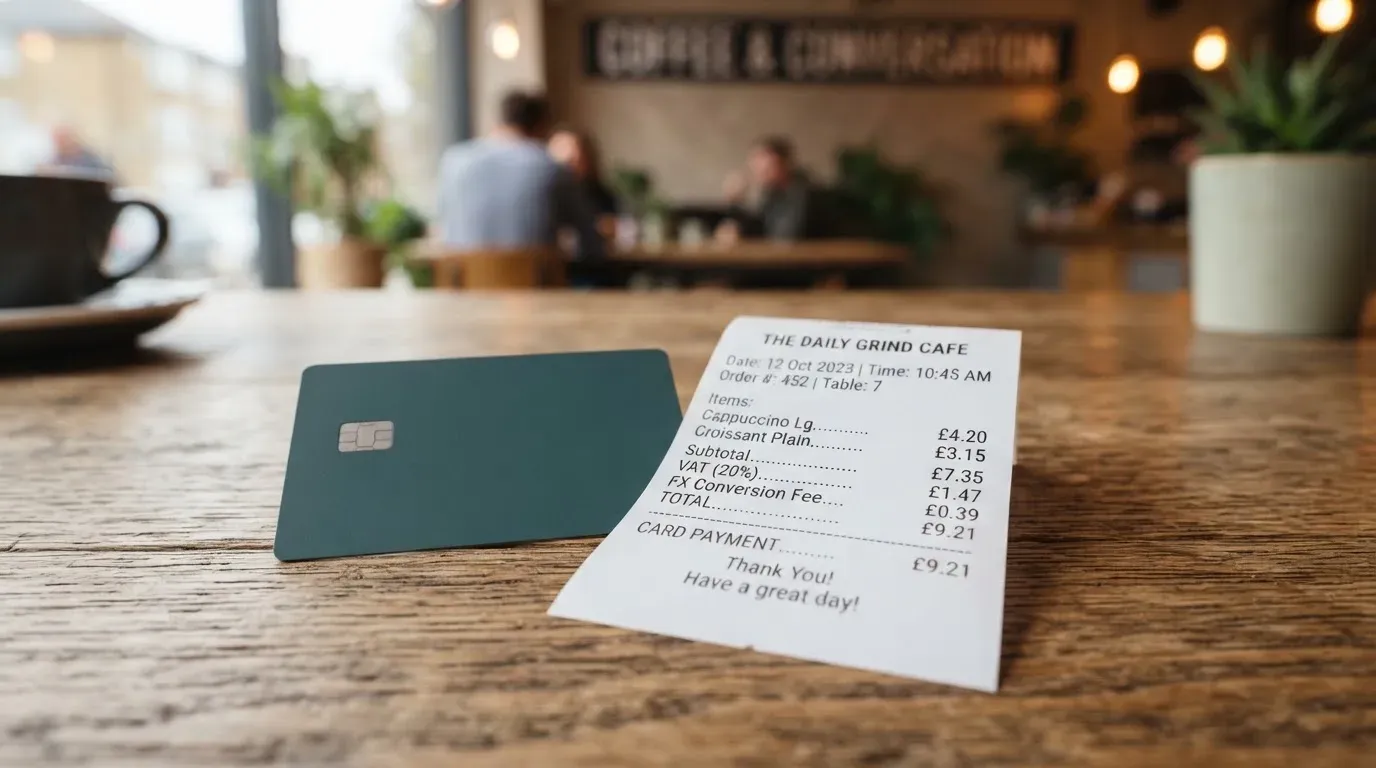
Issuance is $4 per card issued. There is no monthly subscription, no tiers, and some virtual card options are listed as free. Running the wallet costs 5% when funding the wallet, and the decline fee is 0%. That last one matters more than it sounds: a declined payment costing nothing means a failed online checkout doesn’t quietly burn a slice of your balance on top of the payment you didn’t make.
What is missing from that list is what would let me judge the card on a monthly statement. The crypto conversion fee is not stated. The foreign exchange fee is not stated. The ATM position is not stated — understandable for a virtual-only card, but it means I cannot tell you what happens if you want physical cash. The card currency is not stated. And the fee page adds a hedge that undercuts any attempt at arithmetic: fees and limits vary by “card program, provider availability, payment network, and account eligibility”. Four variables, none of them resolved on the pages, and all of them capable of moving a number after you have already funded the account.
Here is everything the card states, in one place, with the gaps left visible rather than filled in.
| Fee or limit | Value |
|---|---|
| Card issuance | $4 per card |
| Monthly fee | No monthly subscription |
| Tiers | No tiers (single tier) |
| Some virtual card options | Listed as free |
| Funding the wallet | 5% |
| Decline fee | 0% |
| Crypto conversion fee | Not stated |
| FX fee | Not stated |
| ATM | Not stated (virtual only) |
| Card currency | Not stated |
| Max per transaction | $5K |
| Max per month | $50K |
| Daily / weekly / total limits | Settable per card in the dashboard |
Note that the same table carries both fees and limits, because in this product they are the same decision. The card is prepaid: it spends a balance you have loaded, so it cannot overdraw, and the dashboard lets you set daily, weekly and total limits per card. The $5K per transaction and $50K per month are the ceilings. Your own limits can be set lower, and for anyone nervous about a virtual card sitting in a wallet, setting them lower is the cheapest risk reduction available.
Now let me take three ordinary payments and walk the numbers as far as the facts allow — and then show you exactly where they stop.
Coffee, roughly $4, in the card’s own currency. Issuance, if you buy a card, is $4 once. Declines cost 0%. But the coffee itself is funded by a 5% charge on the top-up it came from, so $4 of spending carried the cost of loading the balance that covered it. If you loaded $100, you paid $5 to do it. Spread across spending, the effective rate on every purchase is 5% before the conversion fee and the FX fee, neither of which is stated. This is the number to hold on to: your everyday cost of using this card is 5%, and everything else is an unknown on top of it.
A subscription, say $10 a month, paid online. Same 5% loading cost amortised across the balance that funds it. The unstated parts matter more here than for the coffee, because an online payment is where prepaid and foreign-issued cards most often get declined. Merchants can look up the card’s issuing institution and country from the number’s first six or eight digits, and some apply extra scrutiny — or refuse — when the issuer country differs from the billing address. Address verification, which compares the numeric parts of the address you type against the issuer’s records, is mainly offered in the US, Canada and the UK and is generally unavailable for foreign-issued cards. With no physical card, no stated billing address and no stated currency, a $10 recurring charge is exactly the transaction most likely to stumble.
A purchase abroad in a currency that isn’t yours. Here the card’s silence is at its most expensive. The FX fee is not stated, the crypto conversion fee is not stated, and the card currency is not stated. If the balance is denominated in one currency and you spend in another, a conversion happens somewhere — on the network, at the provider, or in the crypto conversion itself — and the card does not tell you where or at what rate. Combined with 5% on funding, this is the scenario in which a card that looked cheap at signup turns out to be the most expensive way you have ever paid a supermarket bill.
The comparison that matters: a conventional card from a regulated e-money institution in your own market typically charges a stated monthly fee, a stated percentage on conversion, and has a scheme chargeback process behind it. This card charges you 5% every time you load it and leaves the rest open. If you spend heavily, the loading fee alone can exceed a year of a normal card’s total cost.
How to Top up
Top-up is the strongest part of this product, and it is worth being precise about why.
The listed assets are Bitcoin, Ethereum, Solana, USDT, BNB, TRON, Polygon, Litecoin, Avalanche and Arbitrum. The FAQ narrows this into network terms: Bitcoin, Ethereum (ERC20), BNB Smart Chain (BEP20) and Tron (TRC20), with the assets BTC, ETH, USDT and USDC named. That is broad. Most cards in this category support a handful of stablecoins on one or two chains; supporting ten listed chains, including the Bitcoin network itself, means you are not rearranging your holdings to use the card.
Two facts about how the money moves. First, funds go to the wallet first, then from the wallet to the cards — it is not a card-to-merchant flow, it is a two-step. Second, and this is the one to internalise, crypto transfers are irreversible and have no built-in recovery. The network cannot freeze or return a misdirected payment. If a deposit goes to an address belonging to a different network than the one you sent it on, it can be lost entirely, or recovered only through a manual support process with no guarantee attached. Sending USDC to a TRC20 address when the provider expects ERC20 is a real, common and expensive mistake, and this product gives you no technical protection against it — the same is true of any card in this category, because the property comes from the blockchain, not from the card company.
Some stablecoin-specific traps are worth knowing before you fund anything. On Ethereum, fees (gas) are paid only in ETH, so a wallet holding USDT and no ETH cannot send it at all — a wallet that looks funded and cannot move. Tron prices transactions through bandwidth and energy resources, often burning TRX. And “USDC over TRC20” is not a native option: Circle stopped supporting USDC on Tron in February 2024. If you hold that particular combination, it is not the obvious route in.
Two more gaps in what the card states. The minimum top-up is not stated, which means you cannot plan a small first test. And whether network fees are on you or on them is not stated — as a rule of the category, on-chain gas for your deposit is charged by the blockchain, not by the card provider, so budget for it separately from the 5%. Fiat top-up is not stated; on the evidence available, this is a crypto-only route in.
On the way out, one sentence tells you what you need to know: “Unused balance is refundable”. How, at what fee, and what happens to a balance if you close the account are all not stated. That matters if you are treating this as a parked balance rather than a spend-as-you-go card.
Paying with it every day
Daily use is where the 4 out of 10 comes from, and it is mostly about what does not exist.
There is no physical card. The delivery position is not applicable — the product is virtual only, and no physical card is offered. If you are the kind of person who pays by tapping a terminal, or who needs a card that works when their phone is dead, this is not that card.
Google Pay is listed. Apple Pay is not mentioned at all — and that omission is a genuine practical loss, because tokenised mobile wallets are one of the safer ways to pay online: Apple Pay replaces the card number with a device-specific number stored in the Secure Element, never on Apple servers, and each payment carries a one-time dynamic code. Without it you are typing your virtual card number into checkout forms, which is precisely the situation where fraud attempts live. Some issuers also let them restrict the tokenised number’s use — blocking it on phone or website — but that is a protection you do not have here.
The ATM question is not stated, which for a virtual-only card means: no cash, or nothing promised about cash. If you need to withdraw money, plan around this.
Blocked merchant categories are not stated either. This is worth understanding as a category rather than a CasherCard detail. Each merchant is classified by a four-digit merchant category code; MCC 7995 covers gambling, and many issuers block it on specific cards by policy rather than by law — with a different blocked list per issuer. Since CasherCard’s list is not published, you cannot know in advance whether a given shop, service or transaction type will be refused.
Rewards: not stated. There is a referral programme at a referral address on the site, and cashback is not mentioned anywhere. Do not assume a referral link means a reward to you.
The app: no mobile app is mentioned. What exists is a web dashboard, plus a REST API for developers. There are no store ratings to check, because there is no store listing. This is not fatal — plenty of good services are web-only — but it removes a layer of independent feedback you would normally use to judge whether a company is real and responsive.
Disputes: this is the weakest area, and it is the one that bites hardest when something goes wrong. There is no general dispute process. The terms say that remedies relating to a vendor’s products or services “must generally be pursued with that vendor”. Delivered gift cards and codes are non-refundable. A defective item may be replaced or refunded after verification. Chargebacks are not mentioned. Set that beside the general picture: a chargeback is a refund ordered by the card issuer to settle a dispute, with reason codes such as fraud, duplicate billing or goods not received — and prepaid-card coverage varies and should not be assumed. If a shop takes your money and gives you nothing, the card’s own terms point you at the shop. That is a materially weaker position than any conventional card gives you, and for a large purchase it should decide the question.
Support exists, which is more than nothing: email addresses on the terms and on the contact page, a Telegram channel, a WhatsApp link, and a contact form, with a stated reply time of “Usually within 24 hours”.
What can go wrong
Let me separate the things I could verify from the things I could not.
No official incidents found. I searched for reviews, forum threads and scam reports and found nothing about CasherCard — no independent reviews, no discussion threads. That silence is not evidence of quality. It is more likely evidence of a small operation. A company with a short public history has not had time to accumulate a complaint record, in either direction.
What the one review platform with data shows. Trustpilot lists 4.1 out of 5 from 10 reviews, all within the last 12 months, read on 2026-10-21. Ten reviews is a very small sample, so treat any aggregate as decorative. The two substantive complaints are worth naming because they attack the core promise: on 28 August 2026, a 1-star review alleging the service advertised no-KYC cards and cheated customers; on 16 September 2026, a 4-star review saying prices were high and the balance could not be checked for weeks. Both are user reports, not verified findings, and there is no recurring theme beyond two complaints. But notice what they are about: not a bad fee schedule, not a slow support reply — the exact two things a “no KYC, instant, cheap” card is sold on.
The company question, which is the one I would think hardest about. CasherCard describes itself as “a registered technology company” and “not a bank or financial institution”. Card issuing and wallets come from unnamed regulated third-party providers and authorised Visa/Mastercard partners, which “may change”. No legal entity name, no registered address, no company number is given on the pages I could read.
That last set of facts deserves a moment of your attention, because it is not a technicality. A card programme sits on top of somebody’s licence: the card network routes messages and sets the rules, the issuer — a bank or e-money institution licensed to issue under the network’s licence — holds the programme, and a crypto brand is often only a programme manager or marketing front end. Here the front end describes itself as neither a bank nor a financial institution, and the licensed parties behind it are unnamed. The issuer can change. When it does, you are not a customer of a bank with a complaints procedure; you are a balance held by a company that was, until a moment ago, your card.
This is not hypothetical for the category. Visa terminated its global agreements with FTX on 13 November 2022 and the FTX US debit card was wound down. WaveCrest, a Visa issuer that supplied crypto card brands, was suspended by Visa in Europe in 2018, closing all WaveCrest-issued Visa programmes. Programme closures have a pattern: a notice period, then loading and spending stop, then users are asked to withdraw remaining balances. One 2026 closure reported by a secondary source had new loads ending 8 July 2026 and spending stopping 8 August 2026 — a single unconfirmed source, and I include it as a shape rather than a fact. The general rule is that a closure takes your card away on someone else’s timetable, and the promise that the issuer “may change” means you cannot plan around it.
Custody and security — mostly not stated. The custody model is not stated: funds sit in a CasherCard wallet, but who controls the keys is not described. Two-factor authentication is not mentioned. In-app card freeze is not mentioned. Safeguarding is not stated. What is stated is the limit system — per-card daily, weekly and total spending limits, and sub-accounts in the dashboard — which is real protection against a stolen card number, and thin protection against a provider-side problem. If you are holding more on this card than you would be willing to lose while a support ticket is unanswered for two weeks, that second complaint is the relevant scenario to think about.
Jurisdiction and where to check. In the EU, customer due diligence normally covers name, address, date of birth, nationality and identity documentation, a sanctions check, the purpose of the relationship, and politically exposed person screening; where due diligence cannot be completed, rules require the institution to refrain from the transaction or relationship. Here there is no due diligence at all, which is a fact about how the product works rather than a breach — but it means the usual protections attached to a verified customer relationship are not in play. Nationality is recorded and screened separately from residence in normal regulated business, precisely because sanctions screening often applies to citizenship and country of birth as well as address. CasherCard records neither. Separately, MiCA — the EU’s markets-in-crypto-assets regulation, which ESMA says took legal effect in June 2023 — governs the crypto side while card issuing is regulated separately, so a crypto card often depends on two licences; ESMA keeps a public interim register of authorised crypto-asset service providers that you can check a provider against, and I could not find CasherCard named on any such register.
Stablecoin risk is inherited, not created. Stablecoins aim to hold a stable value against a fiat currency, but despite the name they are not necessarily stable: TerraUSD collapsed in May 2022, and USDC temporarily lost its peg in March 2023 during the US banking crisis. Roughly 90% of stablecoin market capitalisation sits in Tether’s USDT and Circle’s USDC, per the BIS in July 2025; Circle describes USDC as 100% backed by cash and cash equivalents, mostly in an SEC-registered government money market fund, with monthly reserve attestations, and lists it as natively supported on 38 networks as of 16 September 2026. And stablecoins are not censorship-proof: Tether says it disables tokens in wallets on the OFAC sanctions list and has frozen funds tied to illicit activity. If your balance is denominated in a stablecoin, you carry that exposure on top of the 5% fee.
Tax is yours to work out. I am not a tax adviser and this page is not tax advice — but you should know the shape of it before you start. In the US the IRS treats digital assets as property, so exchanging them for goods, services or dollars generally produces a taxable gain or loss, measured in local fiat currency at fair market value on the date of the transaction, meaning each card payment funded from crypto may be a separate disposal. Holding a year or less makes it short-term. Your own country’s rules may differ, and this is exactly the kind of thing to take to a professional rather than to a card review.
What to take instead
None of these is a recommendation — the three below are simply the alternatives I looked at, with the same questions asked of them, so you can see the trade in front of you.
| CasherCard | CardFlow | HyperCard | Card.fi | |
|---|---|---|---|---|
| My score | 5.5 / 10 | 4.9 / 10 | 4.7 / 10 | 6.6 / 10 |
| Who it targets | Not stated; “may vary by location” | Nigeria-focused, “Nigerians and global users” | Country list not stated; App Store says works in “more than 176 countries” | Ships to “200+ countries”; bars sanctioned countries |
| Card | Virtual, Visa shown, Mastercard not mentioned | Virtual USD Mastercard, created in about 3 minutes | Prepaid “HyperCard”; network not stated on the App Store page | Virtual and physical, Classic and Premium, plus metal |
| Cost to start | $4 per card | “Creating a virtual card is completely free” | Not stated | Virtual Classic $49, Virtual Premium $249 |
| Running fees | 5% on funding; conversion and FX not stated | Not stated | Not stated on pages I could read | Top-up 1.5% + $1.00 Classic, 1% Premium; FX 3.5% / 2.5% |
| Funding | Ten listed chains; BTC, ETH, USDT, USDC in FAQ | BTC, USDT, ETH or Naira bank transfer | Crypto such as USDT, BTC, ETH; networks not stated | 32 coins across 5 networks |
| Rewards | Not stated (referral programme exists) | Not stated | Not stated | Cashback on spending: 0.8% Classic, 1% Premium, 1.2% or 2% Metal |
Three different strategies are visible in that table, and which one fits depends entirely on where you are.
CardFlow is aimed squarely at Nigeria and Nigerians plus global users, with a virtual USD Mastercard created in about 3 minutes and free to create. It is the most geographically specific of the three, and it takes a Naira bank transfer alongside crypto, which no one else here does. If you are in Nigeria, that is a real advantage no international card can replicate. If you are not, its fee structure is simply not stated anywhere I could read, which is a poor basis for a decision.
HyperCard is a prepaid card with a balance in USD or EUR, funded by depositing crypto in the app and converted onto the card. Its App Store page says it works in “more than 176 countries” — but that is a statement about acceptance, not eligibility, and it is worth being careful with that distinction, because a card that is accepted in 176 countries can still refuse to open an account for you. No fees are listed on the pages I could read, and the network is not stated on that page.
Card.fi is the most complete of the three on paper, and the closest to a conventional card product. It has virtual and physical options, a metal card, and a stated position on countries: it ships to “200+ countries” but bars residents of, or orders from, a country subject to sanctions that would prohibit the service — a clause this card does not have. It publishes its fees where CasherCard does not: one-time $49 for a Virtual Classic and $249 for a Virtual Premium, top-up of 1.5% plus $1.00 on Classic and 1% on Premium, FX of 3.5% and 2.5% respectively, and no monthly, annual, inactivity or minimum-balance fee. It supports 32 coins across 5 networks with a deposit address per card, converted at market rate on arrival. And it pays cashback on spending: 0.8% Classic capped at 10 USDT a month, 1% Premium, 1.2% or 2% on Metal against caps of 100/5,000 USDT and 250/20,000 USDT, plus a headline 10% at coffee shops capped at 10 USDT a month. Its costs are higher at the start and its running fees lower than CasherCard’s 5%; it warns that sending on the wrong chain risks permanent loss. It is still not a bank, and its own terms note the card schemes are not named.
If you take one thing from this comparison: run the arithmetic on your own spending. CasherCard’s 5% on funding is simple to compare against anything else. Do it before you commit, not after.
Who I would recommend it to
I would recommend this card in a fairly narrow band, and I would want to be honest about both sides of it.
It fits you if you already hold crypto and mostly stablecoins; you need a card number quickly rather than a relationship; an identity check is something you cannot complete or will not do; you spend in one currency and mostly online; you are comfortable treating the balance as spending money, not savings; and you are the kind of person who checks a provider’s legal entity before funding rather than after. Read the numbers twice: 5% on funding, $4 per card, $5K per transaction, $50K per month.
It does not fit you if any of the following is true. You want a physical card. You use Apple Pay. You need cash from an ATM. You shop internationally. You are putting money on this card you would be upset to lose for a month. You want chargebacks when a shop goes wrong. You want to know which legal entity you are contracting with, or to find the provider on a regulator’s register. You intend to hold a balance rather than spend one. Or you simply want a cheap card — 5% per load is not cheap, it is expensive wearing a small number.
My own verdict, if you want it in one line: the top-up breadth is genuinely good, and the absence of an accountable company behind it is not. Those two facts are the product.
The 5.5 reflects a card that works well on the one axis it chose and says almost nothing about the axes that protect you.
Frequently asked questions
What is CasherCard?
CasherCard is a virtual payment card funded from crypto. You register with an email address, send crypto to a wallet, and issue cards from a web dashboard that spend the balance you have loaded. It is virtual only — no physical card is offered — and the site advertises no identity check. It describes itself as a registered technology company, not a bank or financial institution.
Does CasherCard require KYC?
The site advertises “Zero KYC”, and the signup asks only for an email — no phone number, no personal data, no identity document. The one identity-adjacent assertion is a minimum age of 13, which you confirm yourself. No KYC levels are described because there are no levels. Proof of address is not collected. Keep in mind that “no KYC” is exactly what one 1-star Trustpilot review from August 2026 alleged was advertised falsely.
Is CasherCard a bank, and who owns it?
No — it says so itself, describing itself as “a registered technology company” and “not a bank or financial institution”. It does not publish a legal entity name, address or company number on the pages I could read. Issuing and wallets come from unnamed regulated third-party providers and authorised scheme partners that “may change”. That last clause is the one to remember: your card depends on parties you cannot name.
Which countries can I use it in?
The card’s terms do not say. The only statement is that payment methods “may vary over time and by location” — no country list, no citizenship rule, no exclusions. If eligibility matters to your situation, ask support directly before funding anything. Note also that acceptance and eligibility are different: a card can be accepted in many countries and still refuse to open an account for you.
How much does CasherCard cost?
Issuance is $4 per card with no monthly subscription and no tiers, though some virtual card options are listed as free, and the decline fee is 0%. The number that matters is the 5% charged when you fund the wallet. Crypto conversion fees, FX fees, the card currency and the ATM position are not stated, and the fee page says fees and limits vary by card program, provider availability, payment network and account eligibility.
How do I top it up, and what does it accept?
Listed: Bitcoin, Ethereum, Solana, USDT, BNB, TRON, Polygon, Litecoin, Avalanche and Arbitrum. The FAQ names the networks as Bitcoin, Ethereum (ERC20), BNB Smart Chain (BEP20) and Tron (TRC20), with BTC, ETH, USDT and USDC as assets. Funds go to the wallet first, then from the wallet to the cards. The 5% funding fee applies, the minimum top-up is not stated, and network fees are separate from that.
Can I use CasherCard with Apple Pay or Google Pay?
Google Pay is listed; Apple Pay is not mentioned anywhere on the card’s pages. That is a real loss of everyday convenience, and a real loss of protection: a tokenised mobile wallet replaces your card number with a device-specific number and generates a one-time code per payment, so you never type your virtual card into a checkout form. Blocked merchant categories are also not stated.
Is CasherCard safe, and what if a shop takes my money?
There is no general dispute process. The terms say remedies relating to a vendor’s products or services must generally be pursued with that vendor; delivered gift cards and codes are non-refundable, a defective item may be replaced or refunded after verification, and chargebacks are not mentioned. Custody model, two-factor authentication, in-app freeze and safeguarding are not stated either. What is stated is per-card daily, weekly and total spending limits plus sub-accounts in the dashboard.
What are the withdrawal rules?
The card says unused balance is refundable. It does not state the method, the fee, or what happens to a balance if you close your account. Treat the balance as spending money rather than a place to park funds, and confirm the exit terms in writing before you load anything you would want back.
Is CasherCard worth it?
It depends on your spending and your situation. For someone who already holds crypto, needs a card quickly, cannot complete an identity check and treats the balance as spend money, the ten supported chains are a genuine advantage. For anyone else, 5% on every top-up is expensive, there is no physical card, no Apple Pay, no stated ATM access, no chargeback process, and no named company behind it. Run the arithmetic on your own spending before you decide.
Virtual cards: picking one for online use – cryptocardpicker
Content created by the «cryptocardpicker» team