
A narrow-use crypto card with a clear European license but a thin public footprint
 Available in US
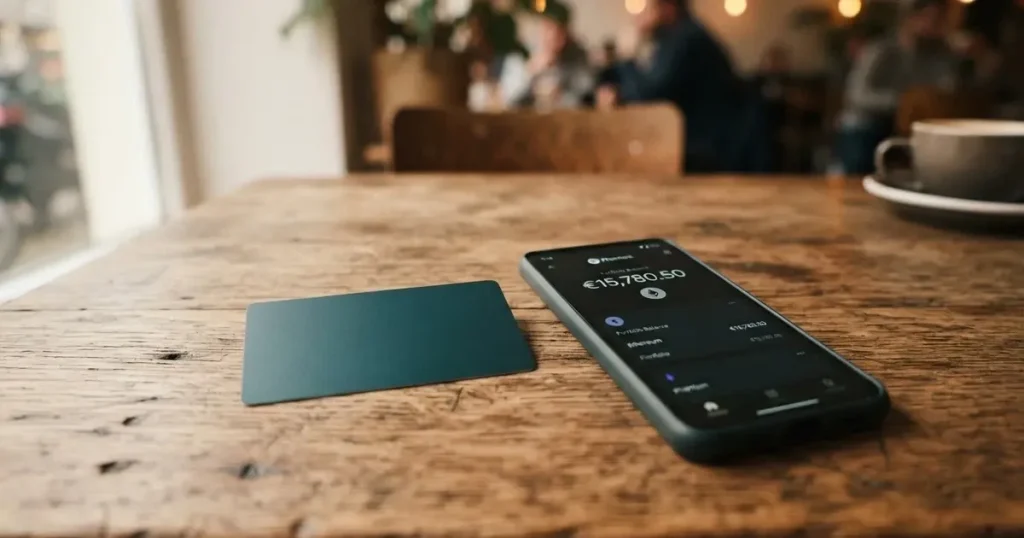
SharPay is a crypto-linked Mastercard debit card issued by a Lithuanian e-money institution and marketed through a Cyprus-based app. It targets people who hold crypto, want a Mastercard with Apple Pay and Google Pay, and either cannot or prefer not to get a standard bank card. The offer is functional but narrow: one tier, one card currency (EUR), and a pricing model that punishes card-to-card loading with a flat fee plus a percentage. If you are in a country where ordinary banking is hard, and you mostly spend in euros, the product will work; if you want rewards, multicurrency spending, or a low flat cost, it will feel thin.
Conditions are current as of October 28, 2026.
Verdict
SharPay scores 5.9 out of 10 in this review. That number reflects a card that does what it says, under a real EU e-money licence, but charges more than its closest peers for routine moves like loading, and offers no rewards or tier structure to offset the cost.
| Criterion | Mark | Why it scores here |
|---|---|---|
| Who can get it | 5/10 | A residence-based rule blocks residents of restricted and prohibited countries (a list that includes Russia and Belarus); crypto services are not offered to EU residents; the total country count is not published. |
| Cost | 3/10 | A 10 EUR account-opening fee, a 1 EUR card-issuance fee, a 3 EUR monthly service fee, a 2.00 EUR + 1.99 % card load fee, and a 2.99 % FX mark-up add up quickly. |
| Top-up options | 6/10 | EUR plus USDT, USDC, BTC, ETH, XRP, LTC, BCH, with DAI and TUSD on the price page; supported networks are not named in the FAQ; topping up USDC through Mastercard/VISA costs 4 %. |
| Reliability and complaints | 8/10 | The card is issued by UAB Walletto (Bank of Lithuania e-money licence no. 33) and payments are processed by SPEKA Payments Corp (FINTRAC MSB M22046940); no user complaints or reviews were found. |
| Everyday use | 9/10 | A virtual card activates immediately, the physical card arrives in about 15 working days, Google Pay and Apple Pay are supported, and ATM withdrawals are possible. |
The short version: SharPay is a reasonable fit for a non-EU resident who wants a Mastercard with Apple Pay and is comfortable paying a few euros a month plus percentage-based fees for the privilege. It is a poor fit for an EU resident (the crypto side is unavailable), for anyone who wants cashback, and for anyone who loads the card often from a bank card.
Who will they give you the card
SharPay decides eligibility by where you live, not by your passport. The rule is stated plainly on the card’s pages: you must not be a resident of a “restricted or prohibited” country. The exact list is not on the marketing pages; it lives in a SPEKA Payments Corp PDF and includes Russia, Belarus, and the regions of Crimea, DNR, LNR, Kherson and Zaporizhzhia, along with Iran, Cuba and Syria. If your country of residence is on that list, the door is closed before you can show ID.
A second line is drawn at the EU itself. Crypto services are “not to EU residents” — a phrase that is unusual in a European product and reflects the licence arrangement (the crypto side sits with a Canadian money-services-business registration, not an EU crypto-asset licence). A person living in, say, Germany or France can still open a payment account and order a card, but the crypto top-up and conversion features are not extended to them.
Citizenship is treated separately. Citizens of non-EU countries verify with a foreign passport; EU citizens can use either a passport or a national ID card. There is no published “we do not serve citizens of country X” rule, and the minimum age is not stated on the pages reviewed. In practice the residence rule does most of the filtering: if you are a citizen of a blocked country but live elsewhere, your residence governs.
How to get it
The sign-up path is a standard one for regulated crypto cards. You register with a phone number, an email and a password, then work through two verification tiers. Level 1 covers the basic crypto account; Level 2 is the additional check needed for a fiat account and a card, and it can take up to five days. The documents the card accepts: a full-page passport scan (cropped copies are rejected), recent bank statements in English, a short questionnaire about your expected turnover and source of funds, and a video selfie. The review notes common reasons a video selfie fails — poor light, hats, glasses, filters — because reviewers often flag those for re-submission.
You order the card from inside the app once Level 2 is cleared. Two versions are available: a virtual Mastercard, active the moment you order it, and a physical card, which takes about 15 working days to arrive. One account can hold up to five cards, per the App Store description and the homepage. The card is denominated in euros; the fee schedule is in euros too, so the headline numbers do not shift with FX swings.
The card’s identity matters here. The plastic is the “Flex Mastercard Debit card is issued by UAB Walletto”, a Lithuanian e-money institution under Bank of Lithuania licence number 33. That puts the programme inside the EU e-money regulatory perimeter — for the payment side. The crypto side sits with SPEKA Payments Corp., a Canadian money-services-business registered with FINTRAC as MSB M22046940, which is why the card is structured to keep crypto features away from EU residents.
What it really costs (Fees)
SharPay’s pricing is built around a small set of flat fees plus a percentage on each load, with an FX mark-up on foreign-currency purchases. There is one tier — no Classic, Pro or Max plan — and the cost of running the card is therefore what the fee schedule says, full stop.
| Fee or limit | Amount |
|---|---|
| Payment account opening | 10 EUR (one-time) |
| Crypto account opening | Free |
| Card issuing | 1 EUR |
| Virtual card replacement | 1 EUR |
| Monthly card service | 3 EUR per card |
| Chargeback handling | 40 EUR |
| Card load (card-to-card) | 2.00 EUR + 1.99 % |
| FX mark-up on personal card | 2.99 % |
| FX mark-up on payments | 1.00 % |
| USDC deposit via Mastercard/VISA | 4 % |
| USDC withdrawal via Mastercard/VISA | 3 % |
| Other coin network fee | Network fee (varies) |
| Card POS / e-commerce | 10,000 EUR daily, 30,000 EUR monthly |
| SEPA crypto transactions | 14,500 EUR / day max |
| Account closure (personal) | 25 EUR |
| Account closure (business) | 100 EUR |
Three everyday payments show how the schedule feels in practice. If you top up the card from a bank card for 200 EUR, the load costs 2.00 EUR + 1.99 % = about 5.98 EUR, so 206 EUR leaves the funding card. A 50 EUR coffee in a country that uses euros runs through without a conversion fee. The same 50 EUR coffee in a US-dollar country carries the 1 % payments FX mark-up, or about 0.50 EUR, on top of whatever the network rate is; the 2.99 % personal-card mark-up applies to direct card-to-card loads in another currency. The purchase-fee column on the fee page shows a dash for everyday spending, which is the part of the schedule that is genuinely friendly.
A few caveats the schedule itself does not explain. ATM withdrawals are possible — the page says “or to make ATM withdrawals” — but the fee and any free allowance are not listed on the fee page. The card opens in EUR; the FAQ says you can purchase in any currency you wish, but the spread on non-EUR purchases beyond the 2.99 % mark-up is not stated. Physical card replacement is also not priced. Where a line item is missing on a public fee page, treat it as “ask before you rely on it”, not as zero.
The cost of running SharPay for a year, if you pay the 3 EUR monthly service fee every month and load the card once a month with 200 EUR from a bank card, is roughly 36 EUR in service fees, 12 EUR in opening, 71.76 EUR in load fees, and 1 EUR for the card itself — about 120.76 EUR before any FX, ATM or inactivity cost. That is a number worth knowing before you commit.
How to top it up (Top up)
SharPay supports a working set of crypto assets: EUR, USDT, USDC, BTC, ETH, XRP, LTC and BCH on the FAQ, with DAI and TUSD added on the price page. The catch is that the FAQ tells you to “select the currency and network” but does not name the supported networks. That is a real gap. Crypto transfers sent on a network the issuer does not support can be lost or, at best, recovered only through manual support with no guarantee — a generic risk of any on-chain deposit that is sharper here because the supported list is not public.
XRP and Stellar deposits ask for a memo or tag — the field that tells the receiver which user to credit — and missing it sends the funds to a generic pool that is hard to retrieve. If you are funding SharPay with XRP from an exchange, copy the memo into the transfer, do not paste it into the address field, and double-check both before you sign.
Two funding paths have a fixed price. Card-to-card loads cost 2.00 EUR + 1.99 %. USDC deposits made through the Mastercard/VISA rails cost 4 %, and the same route for withdrawals costs 3 %. Other coins are subject only to the network fee. A crypto top-up in a currency other than EUR is “automatically exchanged at the system exchange rate”, which is a less favourable framing than “0 % conversion fee” and leaves the rate itself unpublished.
The minimum top-up is not stated on the page; the FAQ tells you to “read the information about the minimum… top-up amount in the top-up amount input field” — meaning the limit is shown in the app at the moment of loading, not on the marketing pages. The upside is that withdrawals are quick: transfers to SEPA, cards, e-wallets and crypto are processed “from 1 to 60 minutes” once submitted. Card-to-card transfers out require that the card was previously topped up, which prevents the account from being used as a free transfer rail.
Paying with it every day
A virtual card is available the moment you order it, which means a card number, expiry and CVC are ready in the app while the physical card is still in transit. The plastic follows in about 15 working days. Both forms support contactless payment, and both can be added to Google Pay and Apple Pay. The cardholder controls the card from the app: it can be blocked, unblocked, and replaced, and online payments are protected by 3-D Secure 2.0 (Mastercard’s Identity Check).
Some merchant categories are off-limits by policy, not by law. The SPEKA prohibited-activities list covers illegal gambling services (including online casinos and sports betting in many jurisdictions), adult content and similar lines. MCC 7995 (gambling) is the category most issuers block; SharPay inherits that posture. If a payment is declined, it is worth checking whether the merchant is on the blocked list before assuming the card is broken.
The everyday app experience is harder to gauge from the public pages. The SharPay Wallet app is on Google Play and the Apple App Store; the homepage claims “15k +” users. Store ratings and the number of ratings are not visible in the text reviewed, and that is one of the items to verify yourself before you sign up. The support channels are a phone number (+357 2503-09-49 for Cyprus), email (addresses obfuscated on the page), a website support widget and a presence on Facebook, X, Instagram and LinkedIn. The website is published in English, Ukrainian and German; support hours are not stated.
The “no rewards” line is worth pausing on. There is no cashback on the pages reviewed — SharPay’s pricing is the offer, not a programme. If a return on spending matters to you, this is a card that gives nothing back.
A second small print point: if the same payment debits your account twice, the duplicate is reversed automatically, per the FAQ. The general refund policy is in a linked PDF whose timeframes the FAQ does not spell out. If you dispute a charge, a 40 EUR chargeback-handling fee applies — so a chargeback is a last resort, not a first response.
What can go wrong
The card is custodial: the funds sit in a payment and e-money account at the provider, not in a wallet you control. The crypto you top up with becomes an issuer-side balance, and the private keys that protect it are held by the company. That is the standard trade-off for a regulated payment product, and it is the same trade-off any bank-issued debit card asks you to make. The mitigations SharPay describes on its pages are: one-time-passcode / two-factor authentication at login, the ability to block and unblock cards in the app, and 3-D Secure 2.0 at online checkout. The card may also ask for “Proof of funds” — a document showing the origin of the money being spent — which is a routine compliance step rather than a problem signal.
The licence stack is the more reassuring part. UAB Walletto holds Bank of Lithuania e-money licence number 33, which means the payment account and the card sit inside a regulated EU e-money institution with safeguarding obligations. SPEKA Payments Corp., which handles the crypto side, is registered with FINTRAC as money-services-business M22046940. The fact that crypto services are explicitly not offered to EU residents points to a structure that keeps crypto activity outside the EU regulatory perimeter — a structural choice that limits the product’s reach in Europe.
The complaint picture is unusually quiet. No dedicated review pages for SharPay exist on platforms like Trustpilot or Reddit, and reports regarding the brand are limited to mentions of unrelated services such as Shop Pay, OnePay, Shieldpay and b-sharpe, with no patterns of user complaints identified. This can mean the user base is small or that feedback is simply not public — either way, it is a “thin public footprint,” not “no problems.” If you want reassurance beyond the licence, the steps are the same as for any regulated card: check the Bank of Lithuania register for UAB Walletto’s current status and read recent posts in any SharPay-tagged community before moving serious money.
Safeguarding and insurance of customer funds are not stated on the pages reviewed. E-money funds are not the same as bank deposits and are not covered by deposit guarantee schemes; that is true across the industry, not specific to SharPay. Treat the balance on the card as a payment float, not as savings.
What to take instead
Three alternatives in the same general space, each with a different emphasis.
| Card | Score | What it does well | Where it is more expensive or limited |
|---|---|---|---|
| International Visa Card | 6.7/10 | Free in-currency spending in USD, plans from free to $19/month, USDC/USDT deposits at 1:1 into a USD account. | Virtual only for now, $5 issuance, 2 % FX fee, residents of a long list of countries (Belarus, mainland China, North Korea, Cuba, India, Iran, Israel, Russia, Syria, Ukraine, Venezuela, Vietnam and others) are not served; purchases are blocked in North Korea, Cuba, Iran, Russia, Syria, Ukraine and Venezuela. |
| UNi Card | 6.1/10 | Mastercard, “no annual fee or foreign transaction fee”, assets converted at “live OTC rates”, Spend-to-Earn rewards up to 3 %. | Eligibility, physical/virtual form and funding details are not stated on the pages reviewed; “no hidden exchange fees” is a stronger claim than most cards make. |
| Morse | 7.5/10 | “Zero foreign exchange fees or markups”, real-time Visa rate, free contactless and online spending, self-custodial wallet, free USDC/USDG/EURC on Solana. | Fully virtual for now, fees are stated in the Cardholder Agreement rather than on the card page, an invite code is needed in a number of countries (Australia, Hong Kong, Japan, New Zealand, Singapore, Switzerland, Thailand, Türkiye, the UK and others), and the card is “available only in certain countries” without a published list. |
If multicurrency spending with no FX mark-up matters most, Morse is the strongest of the three on the rate and the free in-network stablecoin funding, with the trade-off that the card is virtual-only for now. If a free-to-run USD card with a real cashback-free plan ladder is the priority, International Visa Card fits, at the cost of a 2 % FX fee and a long restricted-country list. If a multicurrency Mastercard with cashback is the goal and you are willing to accept that some details are not on the public pages, UNi Card is the one to investigate further.
Who I would recommend it to
SharPay is the right card in a narrow set of situations. If you are a non-EU resident, you hold a small set of mainstream crypto assets, you want a Mastercard that works with Apple Pay and Google Pay, you are happy to pay a few euros a month for the privilege, and you do not need cashback, then SharPay does the job. The licence is real (UAB Walletto under Bank of Lithuania supervision), the card is in your wallet inside minutes as a virtual and inside a few weeks as plastic, and the app covers the basics.
SharPay is the wrong card if you live in the EU (the crypto features are explicitly not offered there), if you load the card often from a bank card (the 2.00 EUR + 1.99 % load fee adds up), if you want to be rewarded for spending (there is no cashback), if you want a multicurrency card that holds balances in dollars or pounds (the card is EUR-denominated and converts on the way in or out), or if you need a published list of supported networks and minimums before you commit. The complaint record is thin rather than negative, but it is thin.
Before you sign up, run through this short checklist. Confirm the country you live in is not on the restricted or prohibited list, and confirm the crypto side is available in your country of residence. Decide whether the 3 EUR monthly fee and the load fee are worth it for the volume you expect. Check that your main funding coin (and its network) is one SharPay actually supports — by contacting support, since the FAQ does not name the networks. Read the Bank of Lithuania register for UAB Walletto’s current status, and look for recent user posts in any SharPay-tagged community. If those checks come back clean, the card is a workable, if unspectacular, option.
Frequently asked questions
What is the SharPay card?
SharPay is a Mastercard debit card tied to a crypto-friendly payment account. The card is issued by UAB Walletto, a Lithuanian e-money institution under Bank of Lithuania licence number 33, and the app is operated by GTM Exchange Ltd in Cyprus. You can fund it with euros or a range of crypto assets, and spend the balance at contactless terminals, online and via Apple Pay or Google Pay.
How does the SharPay card work?
You register, complete Level 1 and Level 2 verification, and order a card in the app. The virtual card is available immediately; the physical card arrives in about 15 working days. You top up the card in EUR or with supported crypto, the issuer converts the balance to fiat at the time of spending, and the card draws on that balance like a prepaid debit card.
Is SharPay a bank?
No. SharPay is operated by GTM Exchange Ltd, a Cyprus-based company, and the card is issued by UAB Walletto, an e-money institution in Lithuania, not a bank. Customer funds are safeguarded under e-money rules, not protected by a bank deposit guarantee scheme.
Who owns SharPay?
The app and website are designed and operated by GTM Exchange Ltd in Cyprus. The card programme is run by UAB Walletto in Lithuania, and the crypto-side payments are handled by SPEKA Payments Corp. in Canada, registered with FINTRAC as money-services-business M22046940.
Is the SharPay card available in my country?
SharPay decides by residence, not by citizenship. Residents of “restricted or prohibited” countries (a list that includes Russia and Belarus, plus Crimea, DNR, LNR, Kherson, Zaporizhzhia, Iran, Cuba and Syria) are not served. Crypto services are not offered to EU residents. The full country list is not published on the marketing pages, so the practical step is to register and see what your address triggers.
How do I get a SharPay card?
Register with a phone, email and password; complete Level 1 verification with a passport and a video selfie; complete Level 2 (up to 5 days) for fiat and the card, with bank statements in English and a short questionnaire; then order the card in the app. The virtual card is active immediately; the physical card arrives in about 15 working days.
Does the SharPay card require KYC?
Yes. You submit a full-page passport scan (cropped copies are rejected), recent bank statements in English, a turnover and source-of-funds questionnaire, and a video selfie. Level 2 — needed for the fiat account and the card — adds an extra review that can take up to five days. Document review for Level 1 takes from 1 to 72 hours.
How do I top up the SharPay card?
In the app, you can load the card from a bank card for a fee of 2.00 EUR + 1.99 %, or transfer supported crypto (EUR, USDT, USDC, BTC, ETH, XRP, LTC, BCH, with DAI and TUSD also listed) to the deposit address shown in the app. The FAQ tells you to “select the currency and network” but does not name the supported networks; the minimum top-up is shown in the top-up input field rather than on the public page.
How do I add the SharPay card to Apple Wallet?
Open the card in the SharPay Wallet app, follow the “Add to Apple Wallet” prompt, and complete the issuer’s verification step on the iPhone. The tokenised card number is stored in the device’s Secure Element, not on Apple servers, and each Apple Pay payment uses a one-time dynamic code. The same flow works for Google Pay on Android.
Is the SharPay card safe?
The card is custodial, so the provider holds the funds and the keys. The stated safeguards are OTP / 2FA at login, in-app card blocking, and 3-D Secure 2.0 at online checkout. The issuer is regulated in the EU (UAB Walletto, Bank of Lithuania e-money licence no. 33) and the crypto side sits with a Canadian MSB (SPEKA Payments Corp., FINTRAC MSB M22046940). Safeguarding and insurance of customer balances are not stated on the pages reviewed, and e-money balances are not covered by deposit guarantee schemes.
App and neobank cards: when one suits you – cryptocardpicker
Content created by the «cryptocardpicker» team