
The feature list is short and neat; the missing numbers are the problem
 Available in US
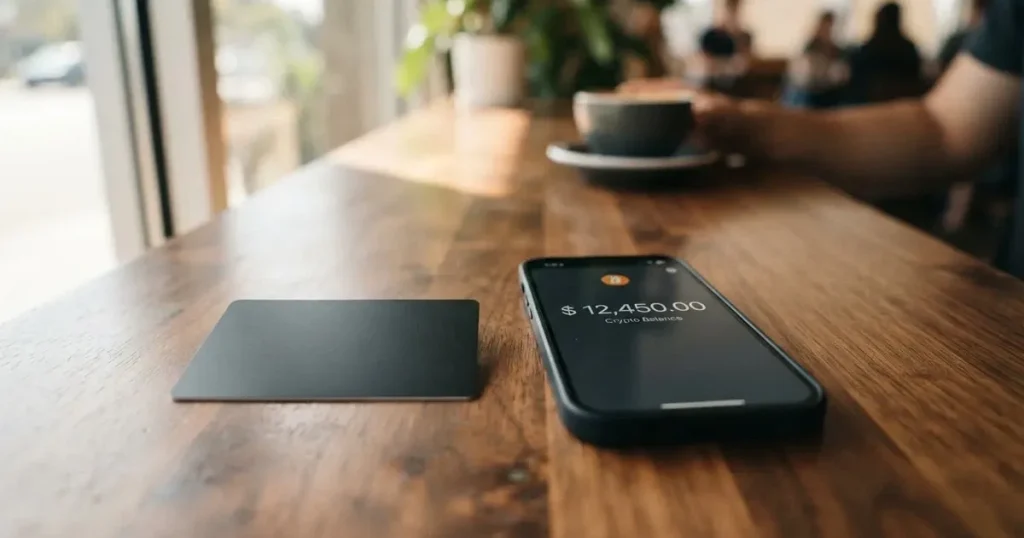
If you have been trying to get an ordinary bank card and the usual doors keep closing — no local branch, no fixed address on paper, a residence the bank will not accept, a salary paid in dollars that never touched a local account — then a card that turns a crypto balance into something you can swipe in a shop is genuinely attractive. That is the promise WebitPay makes, and in the narrow sense it delivers: a Visa card, physical and virtual, that spends from stablecoins you send from your own wallet. The card exists, the app exists, the support email and Hong Kong phone number are published, and the iOS app carries a 5.0 rating.
The difficulty is everything around that. I went through the card’s public pages looking for the numbers a reader needs most, and a large number of them are simply not there. The fee schedule is described as something that “will be made available on our website” — and is not. The list of countries where the card can be obtained is not published. The currency the card holds is not stated. Whether there are tiers, daily limits, monthly limits, a minimum top-up, a deposit fee, a free ATM allowance — all unstated. What *is* stated about ATM use is a 1% currency conversion fee plus “a separate ATM fee” whose amount the card does not show.
That is the whole story of this review, and I want to be straight about it up front rather than burying it. This is not a bad card. It is an unfinished disclosure. Whether that is fatal for you depends entirely on where you live, how much you plan to spend, and whether you can tolerate a fee you cannot look up. I score it 6.0 out of 10 — a mid-range number that reflects a service with real, usable features sitting on top of a documentation set that a careful reader will find frustrating.
All conditions described here are current as of October 28, 2026.
What the score is made of
Here is the mark I gave each area, with the reason behind it, so you can disagree with any single line rather than with the whole verdict.
| Criterion | Mark | Why |
|---|---|---|
| Who can get it | 5 / 10 | The list of countries is not published; the terms ban users under sanctions, and the FAQ refers to a list of closed countries and regions without showing it |
| Cost | 5 / 10 | Fee schedules are described as coming “later on our website”; the only number published is a 1% ATM currency conversion fee plus a separate ATM charge, amount not given |
| Top-up options | 5 / 10 | USDT or USDC straight from a wallet; the networks, the minimum and any top-up fee are not disclosed |
| Reliability and complaints | 7 / 10 | Webit Information Technology Limited, Hong Kong; issuer Reap Technologies Limited with no licences named; 2FA via Google Authenticator; no incidents or complaints found; App Store 5.0 from 2 ratings |
| Everyday use | 9 / 10 | Physical and virtual Visa, virtual card works in Apple Pay and Google Pay, ATM withdrawals on the physical card |
Total: 6.0 / 10.
The shape of that table tells you something useful. The last row is nearly full marks — this is a card you would enjoy *using*. The three 5s are all the same 5: things not disclosed. If the card’s operators published the eligibility list, the fee table and the top-up parameters tomorrow, I would expect the overall mark to move up materially without anything about the product changing. That is how a card earns or loses its score through documentation rather than through features.
So: who is this for? Someone who wants a Visa card funded with USDT or USDC, who has already worked out independently whether their country is even eligible, and who is comfortable paying a 1% conversion fee at cash machines without being able to check what else they will be charged. If you are that person, keep reading — there is genuinely good stuff here.
Who is it not for? If your main worry is *cost predictability*, this card cannot currently give it to you, and you should look at an alternative that publishes its fees. If you need proof that your money is held in a safeguarded account, that is not stated either. If you cannot complete a facial-recognition check through a third-party provider, the card will not work for you and, on the card’s own account, refusing the check can lead to suspension.
Will they give you the card
Short answer: probably, if you are not in a restricted place — but the card will not tell you whether you are. The published terms say that users must not be subject to sanctions. The FAQ mentions a list of prohibited countries and regions. That list is not shown. So the honest answer to “can I get a WebitPay card in my country?” is: check with support before you upload anything, because the public pages will not settle it.
This matters more than it first appears, and not just for compliance reasons. In this corner of the market, the issuer’s country of registration tends to determine how the card behaves at the till. Merchants can look up the issuer from the first six or eight digits of a card number and apply extra scrutiny when that country differs from the billing address on the payment. Hong Kong-issued cards are exactly the kind of card that reads as “foreign” in a shop in Manchester, Mexico City or Lagos. That is not a legal barrier — it is a practical one, and it shows up as declines rather than refusals.
One thing the card is clear about: you must not be subject to sanctions. That is a firm line, and it is stated in the terms rather than left to a help-centre article. If you are in a sanctioned person or region, stop reading; there is no version of this that works for you.
How to get it
The short version: identity verification through an automated third party, then a card. The long version matters more, because this is where most applications actually stall.
Verification is handled by Shufti Pro, an automated identity provider. The process uses facial recognition and data matching, and the card’s own description allows for possible manual review on top of that. There is a version of this flow that finishes in a few minutes and a version that sits for days; which one you get is not something the card commits to in advance.
Three things the card does not state, and I would want to know before I started:
- Which documents are accepted. Identity document type is not published, and neither is proof of address.
- What age threshold applies. Prepaid and debit cards are generally issued to adults at 18, and some issuers set higher limits for their own reasons, but WebitPay does not say.
- How long it takes, and why an application would be refused. Processing time is not stated. Rejection reasons are not stated.
The last point is the one that will bother you most if you have been turned down elsewhere. If your previous rejection was for a document mismatch or an address that does not look conventional, you will want the reason in writing *before* you start, and there is no published list to ask against.
One warning that is worth repeating: the card states that refusing to complete KYC can lead to suspension. You are not being asked casually. Refusing the face check is not a neutral act, it is a decision about your account. If a biometric check is not something you are willing to do, decide that now and look elsewhere, because there is no partial path.
And the thing you may be most disappointed about: delivery is not stated. There is a physical card as well as a virtual one, and the card does not say how or where the plastic is posted, how long it takes, or what it costs. If you are outside Hong Kong, or outside wherever the programme sends from, that is a live unknown.
What it really costs
Here is the honest answer: you cannot compute this from public information. The card’s fee schedule is described as something that “will be made available on our website”. A “WebitPay Card Service Fees” FAQ page exists, but its contents are not shown to a reader. What that leaves is one published figure — the ATM conversion fee — and a list of things that are not stated at all.
| Fee or limit | What the card says |
|---|---|
| Issuance | Not stated |
| Monthly fee | Not stated; the fee schedule is promised for the website |
| Crypto conversion fee | Not stated |
| General FX fee | Not stated |
| ATM withdrawal fee | A separate ATM fee is charged, amount not shown |
| ATM currency conversion | 1% |
| Free ATM allowance | Not stated |
| Daily limit | Not stated |
| Monthly limit | Not stated |
| Tiers (physical / virtual / premium) | Not stated; the card line-up is physical and virtual only |
| Card currency | Not stated |
| Top-up fee | Not stated |
| Minimum top-up | Not stated |
| Fiat top-up options | Not stated |
| Withdrawal from the card balance | Not stated; the terms describe no withdrawal process and say remaining funds “may be returned under applicable law” on closure |
Read that last row again. The terms do not describe a withdrawal process, and on closure the language is that remaining funds “may be returned under applicable law”. That is not a promise that you get your balance back promptly and in full. It is a phrase that lets the card keep options open.
Let me put three ordinary payments against that table, so the gaps become concrete.
A coffee in a local currency. You swipe the physical card. The merchant’s acquirer passes the transaction to Visa, the issuer converts whatever is in your card balance into the merchant’s currency at whatever rate that issuer applies on that day, and your balance is debited. Which of those steps charges you a fee, and at what rate, is not stated. On this payment you cannot predict your own cost. On a coffee the absolute number is small; over a month of coffees it is a habit that quietly costs more than a card that publishes a conversion fee, because a known fee can be checked and an unknown one can only be discovered.
A subscription in dollars. Same mechanism, and here the trade rate moves against you more often. The card is described as offering multi-currency payments across international platforms, but its own currency is not stated, so you do not even know what you are being converted *from* before you ask what you are being converted *to*.
Withdrawing cash at an ATM. This is the only path with a published number, and it is two fees, not one: 1% for currency conversion, plus a separate ATM fee of unstated amount. Whether there is a free allowance before those apply is not stated. So a withdrawal of any size costs at least 1% plus an unknown. This is the case where you know the worst of it and it is still not the whole of it.
The general lesson, which applies to every crypto card and not just this one: on-chain network fees for a deposit are charged by the blockchain, not by the card. Whatever it costs you to move USDT or USDC to the provider is added on top of everything above.
My advice is arithmetic, not moral. Before you commit anything, open the fee page yourself on the day you sign up and screenshot it. If the numbers are still absent a week later, assume the total cost is worse than you were hoping and size your use accordingly.
How to top it up
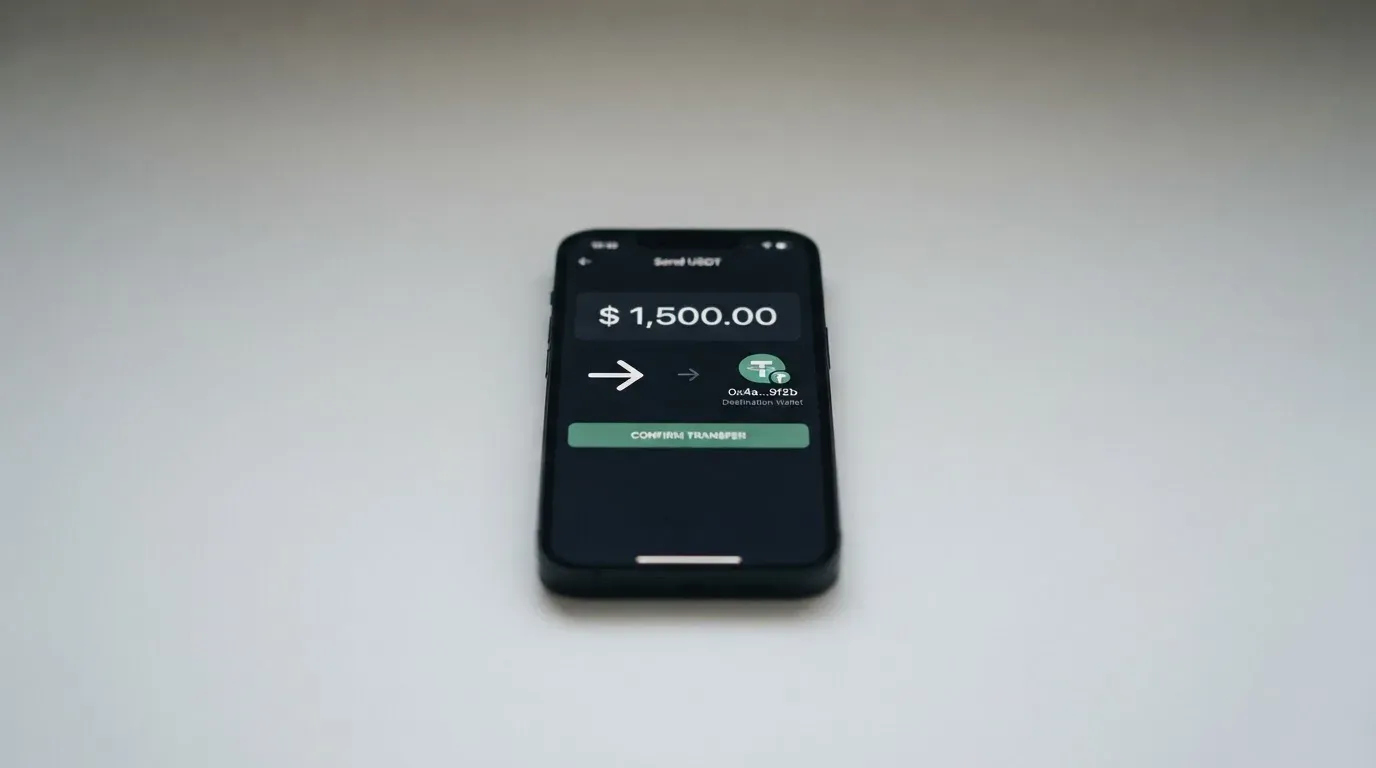
Top-up is the simple part of this card, and I want to give it its due: you send USDT or USDC directly from your wallet. No bank transfer in the pre-steps described, no exchange detour, no waiting for an internal transfer to clear. For a person whose money already sits in a stablecoin, that is a genuinely good design. It is also, notably, the design of a card that only works for a person whose money already sits in a stablecoin — there is no fiat rail described at all.
What is not stated is the part that actually matters operationally: the networks. Not one line of the public pages tells you whether USDT arrives over Tron, Ethereum or Solana, or whether USDC arrives over Base or Polygon. That single omission is the most likely cause of a lost deposit I can see in this card, and it is worth dwelling on because the failure mode is unusually bad.
Blockchain transfers are irreversible. If you send on a network the provider does not support, or to an address belonging to a different network, the funds can simply be gone — or recoverable only through a manual support intervention with no guarantee attached. This is not a scare story about a shady operator; it is a property of how these networks work. And there is a specific trap around USDC on Tron: Circle stopped supporting USDC on that network in February 2024, so “USDC over TRC20” is not a native option for the token’s issuer any more.
So the practical sequence is: ask support which network and which address, get the answer in writing, send a small test amount first, then send the rest. That is not a workaround; it is what anyone sending an irreversible transfer to an unfamiliar counterparty does. The card also states that top-ups must originate from legitimate sources — another reason a test transfer from an exchange-linked account is sensible, and another reason not to route money through anything you cannot explain.
Two related items sit in the same silence. There is no stated deposit fee and no stated minimum, so small top-ups may or may not be viable and may or may not be charged. And withdrawal from the card balance is not described — if the card is a spend-from-stablecoin device rather than a two-way account, understanding that before you load it matters more than any fee.
Paying with it every day
This is the section where the card is strongest, and if your priorities are *paying* rather than *saving*, start here.
The cards themselves. A physical card and a virtual one, both Visa. The app’s own description points at the reason this matters — “millions of Visa-supported merchants”. Visa is the network that a shop clerk will recognise, and that recognition is the whole ballgame when the card is issued from Hong Kong and being used somewhere else.
The phone wallets. The virtual card works in Apple Pay and Google Pay. The card states there is no extra Webit fee for Google Pay, though network fees, third-party charges or the issuer’s charges may still apply. For most people this is the feature that matters most, because it turns a card number into a tap at the counter with the real card left in a drawer. Apple Pay handles this well: it replaces your card number with a device-specific number stored in the phone’s secure hardware, never on Apple’s servers, and each payment carries a one-time code that cannot be replayed.
Cash machines. The physical card supports ATM withdrawals, at the costs described above.
What you will not find. Blocked merchant categories are not stated. This matters because in this category of card, gambling is the merchant class people ask about, and it is also the class issuers most often block — a four-digit code (MCC 7995) covers casinos, betting and lotteries, and many issuers block it as policy rather than by law, with the list differing from issuer to issuer. WebitPay does not say whether yours applies. If you intend to use this card for anything of that nature, you will be guessing.
The app. Version 1.4.5 as of the app store listing, iOS, rated 5.0 from two ratings as read on 2026-10-21. Two ratings is not a signal in either direction; it is simply nothing to go on. The release history is more informative and reads like a product being steadily improved: 1.1.3 in May 2025 brought a statement download and ATM improvements, 1.2.1 added a WhatsApp one-time code and an anti-phishing code, 1.2.3 added balance alerts, and 1.4.5 arrived in September.
When something goes wrong with a payment. The card’s process: contact the merchant first; if that does not resolve it, raise a claim with WebitPay, which then liaises with the issuer and the card networks “subject to eligibility and timelines”. Read that last clause. It means a reversal is not guaranteed. In the United States, debit card reversal rights come from Regulation E and credit card rights from Regulation Z, and prepaid-card coverage varies by scheme and should not be assumed — which, for a card in Hong Kong terms, is doubly uncertain. Treat a disputed charge as something you may have to absorb.
What can go wrong
Nothing alarming has surfaced. That is worth saying plainly before the longer list: no official incidents were found and no user reports were found. A Trustpilot page for WebitPay could not be found either. Now the list of what that silence does and does not prove.
The unnamed issuer. The card is issued by Reap Technologies Limited. Webit Information Technology Limited, with an office at Room 2706, 27/F, Everbright Centre, 108 Gloucester Road, Wan Chai, Hong Kong, is described as the programme provider — the brand, the app and the front end. The site says it holds “necessary financial licenses” but names none, and no licence or issuer news was found. The terms are governed by Hong Kong law. I want to be careful here about what this does and does not mean: “no licences named on the public pages” is not the same as “unlicensed”. It means you, as a reader, cannot verify the claim. In this category that distinction has cost real people real money, because Visa and Mastercard do not issue crypto cards themselves — they license issuers, and they can suspend programmes. Visa terminated its global agreements with FTX on 13 November 2022 and the FTX US debit card was wound down; Visa also suspended WaveCrest in Europe in 2018, closing every Visa programme it had issued. Programme closures follow a pattern: a notice period, then loading and spending stop, then users are asked to withdraw remaining balances. One 2026 closure reported by a secondary source ended new loads on 8 July 2026 and spending on 8 August 2026 — a single unconfirmed source, offered as a shape rather than a fact.
Custody. Your account is described as an electronic money account. Whether customer funds are safeguarded — segregated in dedicated accounts or insured — is not stated. That is not a technicality. An electronic money institution is generally required to safeguard customer funds, but safeguarded e-money is not a bank deposit and does not carry deposit-guarantee protection. Read the account description in your own app and find out what category your money sits in before you leave anything significant on it.
Operational risk of the whole model. Control of crypto belongs to whoever holds the private key. With a custodial setup — which is what a card that converts your balance and spends it for you implies — you are trusting the provider completely, because transfers are irreversible and a lost key has no recovery path. This is not theoretical for the sector: Mt. Gox lost roughly US$350 million as reported between 2011 and 2014, Coincheck about US$400 million in 2018, and Ronin Network US$625 million in 2022.
Stablecoin risk. USDT and USDC are dollar-pegged, and the BIS put roughly 90% of stablecoin market capitalisation in these two as of July 2025. But “stablecoin” is a name, not a guarantee. USDC temporarily lost its peg in March 2023 during the US banking crisis, and TerraUSD collapsed outright in May 2022. Circle says USDC is 100% backed by cash and cash equivalents with monthly reserve attestations by a Big Four firm and redeemable 1:1 for USD, and Tether says USDT is backed 1-to-1 across multiple blockchains — those are issuer statements, and holders of stablecoins are trusting them. Also worth knowing: Tether says it disables tokens in wallets on the OFAC sanctions list and has frozen funds tied to illicit activity. Stablecoins are not censorship-proof, in either direction.
Payments that decline for structural reasons. Address verification — which compares the numeric parts of your billing address against the issuer’s records — is mainly available in the US, Canada and the UK and is generally unavailable for foreign-issued cards. That causes declines. Some merchants decline prepaid or foreign cards outright once the issuer lookup tells them what they are dealing with. And a declined authorisation can leave a hold on your funds that stays for days, typically up to seven.
Getting shut out. With refusal of KYC leading to suspension, and no published list of prohibited countries, the realistic risk is not fines or prosecution — it is that an account is frozen for a reason you cannot see, and the money on it is on the other side of an irreversible rail.
Support, for what it’s worth. Email at [email protected], a Hong Kong phone number (+852-96958088), Monday to Saturday 8:00–18:00, and a help centre on Zendesk. That is a real, published, reachable support operation, which is more than several comparable services offer.
What to take instead
If you have read this far and concluded the missing numbers are a deal-breaker, that is a reasonable conclusion, and there are alternatives that publish theirs. Here is how the three most comparable options line up against this card, using only what each publishes.
| WebitPay | International Visa Card | UNi Card | Morse | |
|---|---|---|---|---|
| Score | 6.0 / 10 | 6.7 / 10 | 6.1 / 10 | 7.5 / 10 |
| Network and form | Visa, physical and virtual | U.S.-issued Platinum Visa, virtual only | Mastercard, multicurrency | Visa prepaid debit, fully virtual for now |
| Issuance / monthly cost | Not stated | $5 one-time virtual; Classic free, Pro $9.00/month, Max $19.00/month | No annual fee; issuance not stated | Not stated — “see Cardholder Agreement” |
| Currency costs | 1% ATM conversion plus unstated ATM fee; other fees not stated | USD use free; foreign currency “Visa exchange rate + 2% FX fee” | “No foreign transaction fee”; live OTC rates, “no hidden exchange fees” | “Zero foreign exchange fees or markups”; paying online and contactless is free |
| Top-up | USDT or USDC from wallet; network not stated | USDC or USDT 1:1, plus USD, EUR, SEPA, SWIFT, FedNow | Not stated | Debit card, stablecoin transfer, bank rails; USDC, USDG and EURC via Solana free |
| Eligibility | List not published | Explicit exclusion list by residence or registration | Not stated | By residence, 18+, over 140 countries, some closed-beta |
International Visa Card is the closest in spirit — a virtual Visa you fund with USDT or USDC — and it is the most transparent of the group about both price and access. It publishes a full exclusion list by residence or legal registration (Belarus, mainland China, North Korea, Cuba, India, Iraq, Iran, Israel, Myanmar, Nepal, Nicaragua, Russia, Syria, Turkey, Ukraine, Venezuela, Vietnam, with FATF grey-list countries handled case by case), and it publishes the fee: $5 to issue, no maintenance fee on the free plan, and a flat 2% foreign currency fee on top of the Visa exchange rate. It also blocks purchases in a named set of countries. Its limitation is the same one that trips people up elsewhere: the rule follows residence or registration, not citizenship.
UNi Card is the one to consider if your priority is *not paying a currency fee*. It states plainly that there is no annual fee and no foreign transaction fee, converts assets at live OTC rates, and claims no hidden exchange fees. It runs on the Mastercard network and spends from the UNi.Global balance, and it offers spend-to-earn rewards up to 3%. Where it falls down is the same place — eligibility is not stated, top-up methods are not stated, and whether you get physical or virtual is not stated.
Morse has the highest score in this comparison at 7.5, and on the two things that matter most — cost clarity and custody — it is the strongest. It states zero foreign exchange fees or markups at the real-time Visa rate, and that paying with the card online and contactless is free. Its wallet is self-custodial, which removes the counterparty risk described above entirely. It is by residence rather than citizenship, 18+, and claims availability in over 140 countries with local add and withdraw in more than 70, though some countries are closed-beta and need an invite code — the card page does not publish the full list, which is its own version of WebitPay’s silence. It is fully virtual for now, so if you want plastic in your hand, this is not it.
My reading of the comparison: WebitPay is not the worst-priced card here and not the most transparent either. It sits between the explicit disclosure of the International Visa Card and the open questions of the others, with the physical card as its one genuine advantage. If your money is already in USDT or USDC and you want plastic, WebitPay is currently one of the few options in this group offering it at all.
Who I would recommend it to
I would recommend WebitPay to someone who already holds USDT or USDC, has confirmed with support that their country is eligible, wants a physical Visa as well as a virtual one for phone wallets, and treats the card as a spending tool rather than a place to keep money. Check the fee page on the day you sign up; if the numbers are still missing, keep your balance small enough that the unknown costs cannot hurt you. Run a test top-up on a small amount before committing the rest.
I would not recommend it to anyone optimising for cost — Morse states zero FX fees and publishes more of its terms; and the International Visa Card publishes a flat 2% FX fee, which at least lets you calculate. I would not recommend it to anyone who needs a clear answer about where their funds are legally held, because the safeguarding position is not stated. I would not recommend it to anyone who cannot or will not complete a biometric check through a third party, since refusal can mean suspension. And I would not recommend it as the only card you have, if you have any choice at all, because a Hong Kong-issued card is a card that some merchants will look at twice.
If you have been told that no ordinary bank card is available to you, this is a real option rather than a fantasy — the app works, the wallets work, the card works. Just go in knowing that you are buying a working product on incomplete paperwork, and decide whether that trade suits your situation.
Frequently asked questions
What is WebitPay card?
WebitPay is a Hong Kong-based crypto card service that gives you a Visa — physical and virtual — spending from a balance you fund with USDT or USDC sent directly from your own crypto wallet. Webit Information Technology Limited runs the programme, and the card itself is issued by Reap Technologies Limited. The card works in Apple Pay and Google Pay, and the physical card supports ATM withdrawals.
How does WebitPay card work?
You sign up, complete identity verification, send stablecoins from your wallet to the card’s address, and the card spends that balance like a prepaid card. Unlike a normal debit card there is no bank account behind it — the crypto is the account, converted to fiat at the point of sale. The exact conversion fee is not published, so your real cost per payment cannot be calculated from public information.
Is WebitPay a bank?
No — it presents itself as a programme provider, not a bank. Webit Information Technology Limited is the programme provider and fronts the card; the issuer is Reap Technologies Limited. The site’s claim to hold “necessary financial licenses” names none, and your account is described as an electronic money account, which is a different thing from a bank deposit and does not carry deposit-guarantee protection.
Who owns WebitPay?
WebitPay is operated by Webit Information Technology Limited, whose listed office is Room 2706, 27/F, Everbright Centre, 108 Gloucester Road, Wan Chai, Hong Kong. The card’s terms are governed by Hong Kong law. Support is at [email protected] and on a Hong Kong phone line, Monday to Saturday, 8:00–18:00.
Is the WebitPay card available in my country?
The card does not publish its list. The terms say users must not be subject to sanctions, and the FAQ refers to a list of prohibited countries and regions without showing it. Because eligibility determines whether your card will also behave well at foreign tills, contact support and get the answer in writing before you upload identity documents or send any funds.
How do I get a WebitPay card, and does it need KYC?
Yes, KYC is mandatory. Verification runs through an automated third-party provider, Shufti Pro, using facial recognition and data matching, with possible manual review. The card does not state which documents are accepted, whether proof of address is needed, or your age threshold. Declining to complete verification can lead to suspension, so there is no partial application path.
How do I top up the WebitPay card?
You send USDT or USDC straight from your wallet — that is the whole documented method. No network is specified anywhere in the public pages, which is the single biggest operational risk: transfers are irreversible, so a deposit on the wrong network can be lost. Ask which network and address to use, get it in writing, test with a small amount, then send the rest.
Is the WebitPay card free?
You cannot tell from public information. The fee schedule is described as coming “will be made available on our website” and is not published, and a fees FAQ page exists without showing its contents. The one published figure is a 1% ATM currency conversion fee plus a separate ATM fee of unstated amount. Issuance, monthly, crypto conversion, FX and top-up fees are all unstated.
Is the WebitPay card safe?
No incidents and no user complaints were found, but absence of reports is not proof. What is missing is structural: the issuer’s licence is not named, whether customer funds are safeguarded is not stated, and the account is an electronic money account rather than a bank deposit. Safeguards that *are* documented include Google Authenticator 2FA, an anti-phishing code, WhatsApp OTP and a freeze for a lost physical card.
Is the WebitPay card worth it?
If you already hold USDT or USDC and want a Visa — including a physical one — it is one of the few options offering both, and using it is a 9 out of 10. The 5 out of 10 areas are all disclosure: eligibility, fees and top-up parameters. It is worth it as a spending tool kept lean, not as a place to hold money, and only after you have read the fee page yourself on the day you sign up.
App and neobank cards: when one suits you – cryptocardpicker
Content created by the «cryptocardpicker» team