
Tevau card review: a USDT-funded Visa that suits a narrow audience
 Available in US
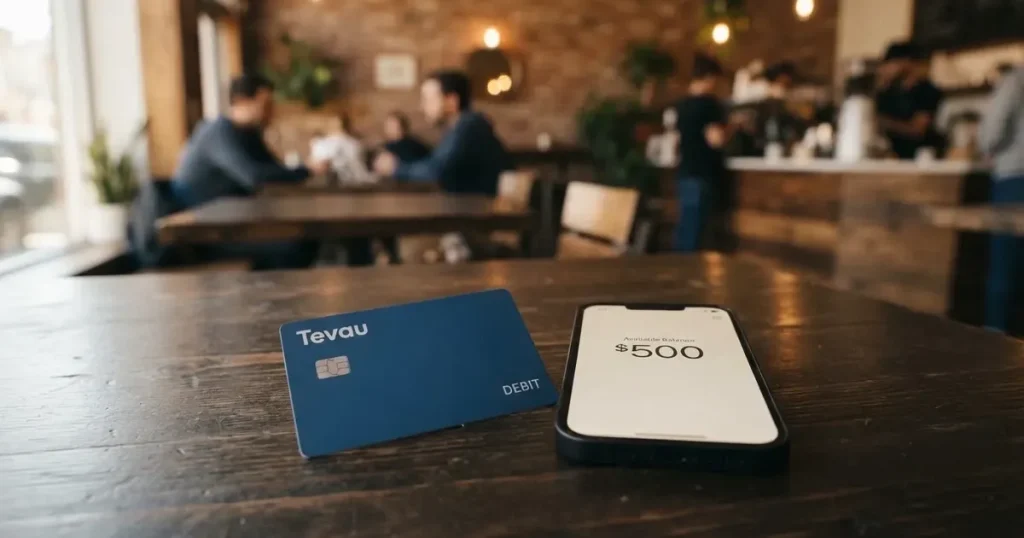
Tevau is one of the more specialised crypto-to-card products on the market today. It does not try to be a general-purpose bank replacement. Instead, it positions itself as a Visa that you fund in USDT, aimed at people who already hold Tether and want a card to spend that balance in the real world. The pitch is honest about that narrowness, but it also means the card will simply be wrong for a large share of people who land on the Tevau page expecting something more flexible.
I went through the card’s public material, the published FAQ on the tevau.co site, the app store listing, and the few independent sources that mention the company. The picture that emerges is consistent: a young Hong Kong-based product, launched in 2024, that offers four card types (Virtual, Plastic, Metal, 24K Gold), requires a full identity check, and converts your USDT into fiat at the moment of payment. There is no USD or EUR card balance to manage. There is no bank account tied to it. You top up, you spend, and any leftover balance can be withdrawn at an ATM or returned to the wallet when you close the card.
This review is written for someone who already has, or is comfortable buying, USDT, and who is choosing between crypto card options rather than between a crypto card and a normal bank account. If that is not you, the verdict will still be useful, but the recommendation at the end may not be.
The conditions described in this article are current as of October 28, 2026.
Verdict
Tevau earns a 6.0 out of 10 in my scoring. That places it firmly in the middle of the field: usable, but with rough edges that you should know about before paying for a card. The breakdown is below.

| Criterion | Mark | Why it scores this way |
|---|---|---|
| Who can get it | 9 / 10 | The card claims availability in 200+ countries with regional variations, and the KYC flow is a single step rather than a multi-tier system. The reason it does not get a full 10 is that the company has not published a country list or exclusions. |
| Cost | 4 / 10 | The headline numbers (issuance from $20 for the virtual card, $0 monthly, no annual fee) look friendly, but the actual spending chain is more expensive than competitors: a 1% top-up fee, a $0.20 + 0.5% fee on USD payments, 1.2% on non-USD payments, 1.9% at ATMs, and a $3 inactivity charge after 90 days. Note that fee figures like $0.20 are per unofficial third-party sources (tevau.co, not confirmed by the card). |
| Top-up options | 4 / 10 | USDT only. The app shows you which network to use but the public pages do not name the supported networks, and a wrong-network deposit is not recoverable. Fiat top-up is not advertised. |
| Reliability and complaints | 4 / 10 | Based in Hong Kong; the card issuer is not named on public pages. The site states a PSP registration with the Bank of Canada was approved in August 2026, but I could not verify this independently. I found no Trustpilot page, no Reddit thread, and no independent review. |
| Everyday use | 9 / 10 | Apple Pay and Google Pay on all four card types, ATM on the three physical cards, no merchant-category restrictions published beyond the OpenAI billing exclusion. The deduction here is for the lack of cashback and the unclear blocked-merchant policy. |
| Total | 6.0 / 10 |
Tevau is best suited to a USDT holder who wants a virtual card for online spending, or someone who specifically wants a metal or 24K Gold card paid for once and then used as a wallet-like spending tool. It is not well suited to anyone who needs to top up with bank transfers, who wants to spend in multiple currencies from multi-currency balances, or who needs a card issuer with a long public regulatory record in a major Western jurisdiction.
Who will they give you the card
The card’s own pages say Tevau is available in “200+ countries” with availability that “varies by region.” The company has not published a country list and has not published a list of excluded jurisdictions. That is the single biggest gap in the public material: when you visit the FAQ, the answer is “we are available in 200+ countries.” If your country is not on the published network maps for major card programmes (Visa or Mastercard) at all, Tevau is unlikely to work either, but you will not find that out until you try to sign up.

KYC is mandatory. The flow is a single step: one government ID, which can be a passport, driving licence or national ID, plus a selfie in the app. The minimum age is 18. There are no KYC tiers: it is one level for everyone. Processing time is not published as a policy, and the FAQ notes that blurry photos are the usual reason for re-submission, so the practical advice is to take the document photos in good light with all four corners visible.
What the public pages do not say is worth flagging. They do not state the documents required for proof of address, which is unusual because most regulated card programmes ask for at least one proof-of-address document at some point. They do not state the difference between eligibility and acceptance. “Available in 200+ countries” may mean the app installs and KYC can start in your country; it does not necessarily mean a physical card will reach your address or that every Visa-accepting merchant will take the card. Independent sources do not contradict the 200+ figure, but they also do not confirm it.
For practical purposes: if you are in a country where Visa prepaid programmes from other issuers already work, and if you are not on a sanctions list, you should pass KYC. The card’s launch year was 2024, and as of August 2026 the company claimed 500,000 users. None of those figures are independently audited.
How to get it
The sign-up path is app-first. You install the iOS or Android app, you start the KYC, you get verified, you choose a card, you pay the issuance fee, and the card is provisioned. A virtual card is issued instantly in the app once approved. For a physical card, the FAQ states that card shipping and replacement are free, but it does not state which countries Tevau ships to, nor a delivery time. If a physical card has not arrived within 14 days, the FAQ says you should check the tracking code and then contact in-app support.
The four card types, in order of price, are:
- Virtual ($20 one-time) — app only, no in-store contactless, no ATM. Per-transaction limit: 3,000,000 USD (limit unofficial/third-party).
- Plastic ($100 one-time) — physical Visa with contactless, ATM access. ATM limits: $3,000 per day, $10,000 per month, with a cap of 3 withdrawals per day and 30 per month (limit data per unofficial third-party sources, tevau.co).
- Metal ($199 one-time) — physical metal card. Per-transaction limit drops to 80,000 USD (limit data per unofficial third-party sources, tevau.co).
- 24K Gold ($499 one-time) — physical gold-plated card, refunded if you spend $100,000 within 3 months. Comes with 2 virtual and 5 physical cards, and a top-up discount (the FAQ text and the fee table on the same site disagree on the exact mechanic: the table mentions “5 waivers per month” while the fee section says “50% discount on up to 5 top-ups per month”). Per-transaction limit: 80,000 USD (all limits per unofficial third-party sources, tevau.co).
Cards are valid for 3 years. Closing a card costs $2 (per unofficial third-party sources, tevau.co) and returns the remaining balance to your in-app wallet. A virtual card with no transactions for 4 consecutive months is closed automatically.
Card currency is not stated. In practical terms the card settles in the merchant’s currency at checkout, and the network applies a spread; the card does not hold a multi-currency wallet. If you want to think of it as a USD card that converts on the way out, that is close to the reality.
What it really costs
This is where Tevau is weakest. The headline numbers (no monthly fee, low issuance cost for the virtual card) hide a fee stack that adds up quickly on small, frequent purchases. I have laid out the published numbers below, then walked through what they mean for three common payments.
| Fee or limit | Amount |
|---|---|
| Virtual card (one-time) | $20 |
| Plastic card (one-time) | $100 |
| Metal card (one-time) | $199 (unofficial) |
| 24K Gold card (one-time) | $499 (unofficial) |
| Monthly fee | $0 |
| Annual fee | Not stated |
| Close-card fee | $2 (unofficial) |
| Inactivity fee | $3 after 90 days without a transaction, then $1 every 30 days |
| Wallet deposit | No fee |
| Top-up fee (USDT to card balance) | 1% (Gold: 0.5% on up to 5 top-ups per month) (unofficial) |
| USD payment | $0.20 + 0.5% (unofficial) |
| Non-USD payment | 1.2% |
| Small authorisation (up to $3) | First 5 per month free, then $0.20 each (unofficial) |
| Declined transaction | First 3 per month free, then $0.50 each (unofficial) |
| ATM withdrawal | 1.9% (virtual not supported) |
| ATM operator fee | May apply, set by the ATM |
| Per-transaction limit | 3,000,000 USD (Virtual, Plastic); 80,000 USD (Metal, Gold) (unofficial) |
| Daily and monthly spend (non-ATM) | 3,000,000 USD across all card types (unofficial) |
| Card validity | 3 years |
| Wrong-network top-up | Not recoverable |
Now, three concrete payments. Imagine you top up your Plastic card with $500 of USDT.
Coffee at a local café, paying in local currency (non-USD), tapping the physical card. The total chain of fees is: 1% to move your $500 USDT to the card balance ($5), then 1.2% on the payment for the conversion to local currency. On a $5 coffee, that 1.2% is six cents, plus the 1% you already paid when you topped up. The proportional cost of the top-up fee is high on small balances: if you top up $50 to cover a week of lunches, the $0.50 top-up fee is the same proportion of your spend as a 1% foreign-transaction fee, and you have already paid it before you have bought anything. (Fee details per unofficial third-party sources, tevau.co).
Online subscription in USD, paying with the virtual card. The chain is 1% top-up, then $0.20 + 0.5% on the USD payment. On a $9.99 monthly subscription, the conversion is small, but the $0.20 fixed fee is meaningful: 2% of the transaction on its own. If you are funding the virtual card with a small top-up per subscription, the per-transaction fixed fee will dominate. (Fee details per unofficial third-party sources, tevau.co).
$200 ATM withdrawal in a country where the local currency is not USD. The chain is 1% top-up, 1.9% ATM fee (so $3.80 on $200), and any operator fee the ATM owner charges. The FAQ notes that USD ATM withdrawals in local currency have no FX fee from Tevau’s side but are subject to the local bank’s rate, which is a separate cost you should ask about before travelling.
The inactivity fee deserves its own paragraph. After 90 days with no transaction, you are charged $3, then $1 every 30 days. For someone who treats the card as a backup and only uses it occasionally, this is a slow leak. For someone whose main spending is in USDT and who uses the card regularly, it is irrelevant.
A separate note: the FAQ says fees “can differ by card type, campaign, and region.” Treat the table above as the best published picture, not as a guarantee. If a number matters to you, check it in the app before you transact.
How to top it up
Top-up is USDT only. The app shows you the network to send on, but the public pages do not name which networks are supported. That is an important detail. If you are used to a card product that publishes its supported chains (Ethereum, Tron, Solana, Arbitrum, and so on) on its website, Tevau does not do that. You open the app, you copy the address, and you read the small text on the deposit screen to see which network to use.
The risk of this design is real. If you send USDT on a network Tevau does not support, the FAQ states that the funds are not recoverable. Stablecoin transfers are irreversible by design, and Tevau does not promise any support-assisted recovery for wrong-network deposits. The right habit is to send a small test amount first, then the rest, and to copy the address and the network from inside the app rather than from your own address book.
The fee structure on top-ups is the 1% (or 0.5% on the Gold card’s discount) mentioned above (per unofficial third-party sources, tevau.co). Wallet deposits, which is to say moving USDT into your in-app wallet before you load the card, are free. Fiat top-up, meaning topping up with a bank transfer in USD, EUR, IDR or anything else, is not stated. The app does link a “Withdraw to bank (IDR supported)” guide, but no top-up equivalent. In practice this means: if you do not already hold USDT on a supported network, Tevau is not the card for you.
The minimum top-up is not published. There is no published difference between a “wallet balance” and a “card balance,” and the FAQ is clear that once a balance is on the card it can only be spent on the card or withdrawn at an ATM. To get it back to the wallet, you close the card (paying the $2 close-card fee per unofficial third-party sources, tevau.co).
If you want a card that lets you fund with a bank transfer, hold a multi-currency wallet, or top up with a stablecoin other than USDT, this is the section where Tevau stops being a fit.
Paying with it every day
In day-to-day use, Tevau behaves like a standard prepaid Visa. The four card types all support Apple Pay and Google Pay, including the virtual card (you add it from the app, and the tokenised number lives in your phone’s Secure Element rather than on Tevau’s servers). For the three physical cards, contactless tap-to-pay works at any Visa-accepting terminal, and ATM withdrawals work at “supported ATMs” — a list Tevau does not publish.
There is no cashback. The FAQ does not mention a rewards programme on any of the four tiers. If you are choosing between Tevau and a card that offers 1-2% back on spending, you have to put the cashback on one side of the ledger and the 1% top-up fee plus 0.5% USD payment fee on the other (fee data per unofficial third-party sources, tevau.co). For small, frequent purchases the fees almost always win; for large, infrequent purchases a competitor’s cashback can outweigh.
There is no published list of blocked merchant categories, beyond two specific points: OpenAI billing is not supported, and merchants who decline prepaid or crypto-funded cards will decline Tevau by extension. In practice this means a small share of online merchants — mostly subscription services that use Address Verification Service checks against US, Canadian and UK billing addresses — can decline the card. AVS is generally unavailable for foreign-issued cards, so a Tevau card with a Hong Kong BIN can look “foreign” to a US subscription service and be sent through extra friction or a hard decline. This is not unique to Tevau; it is a property of how prepaid Visa works.
The iOS app is published as “Tevau” by Tevau Technology Limited, with a 4.4/5 average from 7 ratings as of 20 October 2026 and a latest version 2.0.010 dated 11 September 2026. The Android listing exists (play.google.com/store/apps/details?id=uni.UNI2317D55) but a rating is not shown. With a sample that small, the app store rating is not meaningful. The most you can take from it is that the app is on both stores, the iOS version is being updated, and no one has flagged a functional problem severe enough to drive a 1-star review.
Disputes and chargebacks are not described in the public material. The FAQ notes that “declines and refunds can occasionally be delayed,” which is standard issuer language, and that merchants blocking prepaid or crypto-funded cards will decline. There is no description of the dispute process, the time window, or the documentation Tevau asks for. This is one of the things I would want to see in writing before relying on the card for a high-value purchase.
What can go wrong
The risk picture has three layers: company risk, platform risk, and category risk.
On the company side, Tevau is headquartered in Hong Kong, launched in 2024, and states that its Payment Service Provider registration with the Bank of Canada was approved in August 2026. I could not verify that registration independently. The card issuer is not named on the public pages, which is unusual: most regulated card programmes identify the issuing bank or e-money institution on the card itself and in the cardholder agreement. The card’s own disclaimer says Tevau is not a bank licensed in Japan, the US or the EU, and that home-country deposit protection may not apply. The fact that the company is not a licensed bank in any of those three jurisdictions is the key thing to internalise: your USDT is held by a custodian (Tevau and its partners), and that custodian is not the same as a bank.
I searched for complaints and found none of substance. There is no Trustpilot page, no Reddit thread, and no independent review. That can mean two things: either the product is too small to attract complaints, or there is not enough public history yet to have generated them. With a launch year of 2024, the answer is probably the latter. The other thing to notice is the gap in the public material: with a 500,000-user claim, the absence of any independent review is itself a signal.
On the platform side, the FAQ describes assets as “stored with licensed custodians,” with a cold/hot wallet separation claimed. Two-factor authentication and insurance are not stated. The recommended response to a stolen or leaked card is to lock it in the app and then close it. A frozen account has to be re-verified personally via support. A security update on suspicious transactions and risk-control upgrades was published on 21 August 2026, and a USDT card guide on 27 August 2026. These are routine maintenance posts rather than incident disclosures.
The category risks are the ones that apply to any custodial crypto card, not just Tevau. Stablecoins can depeg. USDT is not a regulated money-market fund with monthly attestations; its reserves are described by the issuer rather than audited to the same standard. Blockchain transfers are irreversible, so a wrong-network deposit is gone. Card networks can suspend programmes: Visa’s 2018 suspension of WaveCrest closed every WaveCrest-issued Visa programme in Europe, and in November 2022 Visa said it had terminated its global agreements with FTX. There is no public guarantee that any crypto card programme will exist in 12 months’ time, and that is true of Tevau as well.
Support is in-app chat first, with a bot, then a live agent on request during undefined “business hours.” There is a Help Center at /faqs/, a Telegram community at t.me/tevau_community, and an X account at @tevau_official. The website is offered in 17 languages including Russian, but the support-channel languages are not confirmed.
What to take instead
Tevau is not the only USDT-funded card on the market, and depending on what you need, two of the alternatives below may suit you better.
| Tevau | CardFlow | HyperCard | Card.fi | |
|---|---|---|---|---|
| Score | 6.0 / 10 | 4.9 / 10 | 4.7 / 10 | 6.6 / 10 |
| Network | Visa | Mastercard (USD virtual) | Not stated on public pages | Visa/Mastercard (not named) |
| Card types | Virtual, Plastic, Metal, 24K Gold | Virtual (free), created in ~3 min | Prepaid HyperCard | Virtual Classic, Virtual Premium, physical Classic, Premium, metal |
| Card currency | Not stated (settles in merchant currency) | USD | USD or EUR | Not stated |
| Funding | USDT only | BTC, USDT, ETH, Naira bank transfer | USDT, BTC, ETH in app | 32 coins across 5 networks (USDT, USDC, ETH, BNB, SOL, KAANCH, others) |
| Issuance | $20 / $100 / $199 / $499 (unofficial) | Free (virtual) | Not stated | $49 (Virtual Classic), $249 (Virtual Premium)* |
| Top-up fee | 1% (Gold: 0.5% on 5 top-ups) (unofficial) | Not stated | Not stated | 1.5% + $1 (Classic), 1% (Premium)* |
| FX fee | 1.2% (non-USD) | Not stated | Not stated | 3.5% (Classic), 2.5% (Premium) |
| Cashback | None | Not stated | Not stated | 0.8% (Classic, cap 10 USDT/mo) up to 2% (Metal, cap 250 USDT/mo) |
| Eligibility | “200+ countries” | Nigeria + “global users” | “more than 176 countries” (acceptance) | “200+ countries,” sanctions bar |
| Issuer | Not named | Not stated | Not stated | “Issued under licence from the relevant card schemes” |
*Data unofficial/third-party.
CardFlow is aimed primarily at Nigeria and “global users” with USD virtual Mastercard issuance. The headline feature is free virtual card creation, and it accepts Bitcoin, USDT, ETH, or a Naira bank transfer. The score is lower than Tevau’s because the published material is thinner: no country list, no fee schedule, no rewards. If you are in Nigeria and want a USD virtual card fast, CardFlow is worth a look; if you want clarity on fees, Tevau is the more transparent of the two.
HyperCard is a prepaid card whose public page does not name the network or the issuing bank, but the App Store says the card is accepted in “more than 176 countries.” Card balance is held in USD or EUR, and you fund it by depositing USDT, BTC, or ETH in the app. The score is the lowest of the four because the fee schedule is not stated on the pages I could read. If you want to fund with multiple coins and do not care about Apple Pay on a metal card, HyperCard may be a fit; if you want a published fee table, it is not.
Card.fi is the strongest of the three on paper. It supports 32 coins across 5 networks, ships cards to “200+ countries” (with a sanctions carve-out), and offers cashback on spending: 0.8% on the Virtual Classic up to a 10 USDT monthly cap, and up to 2% on the Metal card up to a 250 USDT monthly cap and 20,000 USDT lifetime. The trade-off is the fee stack: 1.5% + $1 on Classic top-ups, 3.5% FX on Classic (2.5% on Premium), and a $49 entry price for the cheapest virtual card. If you spend a meaningful monthly volume in USDT and value the cashback, Card.fi can come out ahead of Tevau; if you spend small amounts occasionally, Tevau’s lower top-up fee and $0 monthly fee may be the better deal.
Who I would recommend it to
After going through the material, the picture I have is this. Tevau is a clean, narrow product that does one thing reasonably well: turn USDT into a Visa you can tap, add to a wallet, or use online. The fee stack is the biggest reason to hesitate, particularly if you make small, frequent payments: the $0.20 (per unofficial third-party sources, tevau.co) fixed fee on USD payments is more punishing on a $5 coffee than on a $500 purchase. The 1.2% non-USD fee is in line with competitors. The inactivity fee is a slow drip that will hit you if you forget about the card.
I would recommend Tevau to:
- A USDT holder who wants a virtual card for online subscriptions and Apple Pay or Google Pay, and who is comfortable with a 1% top-up fee and a small fixed fee per USD transaction.
- Someone who specifically wants a metal or 24K Gold Visa paid for once, with no monthly fee, and who is willing to pay $199 or $499 (per unofficial third-party sources, tevau.co) for the privilege.
- A user in a region where the alternatives (CardFlow, HyperCard) have even thinner public documentation than Tevau does, and where Tevau’s 200+ country availability is in fact true.
I would not recommend Tevau to:
- Anyone who needs to top up with a bank transfer or a stablecoin other than USDT. The fiat path is not there, and USDC, DAI, and BUSD are not on the list.
- A high-volume spender who would benefit from a competitor’s cashback. Tevau has no rewards programme.
- A user who needs a named, regulated card issuer in a major Western jurisdiction. Tevau has not published the issuer’s name, and the company itself is not a licensed bank in the US, EU or Japan.
- Anyone who plans to keep the card idle for long stretches. The inactivity fee is a $3 charge at 90 days, then $1 every 30 days.
If you are choosing between Tevau and Card.fi, the deciding question is volume. If you spend more than a few hundred USDT per month and want cashback, Card.fi is the better product. If you spend less, want a cheaper entry, and do not want a monthly fee, Tevau is the better deal.
Frequently asked questions
What is the Tevau card?
Tevau is a Visa prepaid card funded by USDT. You load the card by sending Tether from a crypto wallet to the address shown in the Tevau app, and you spend the balance at any Visa-accepting merchant or ATM. The card is offered in four types: Virtual, Plastic, Metal, and 24K Gold, with one-time issuance fees of $20, $100, $199, and $499 respectively (per unofficial third-party sources, tevau.co).
How does the Tevau card work?
You install the Tevau app, complete KYC with one government ID and a selfie, choose a card, pay the issuance fee, and top up with USDT. At payment, Tevau converts the USDT balance into the merchant’s currency. There is no USD or EUR card balance to manage; the conversion happens at checkout. Spending is supported through contactless, online, Apple Pay, and Google Pay, depending on the card type.
Is Tevau a bank?
No. Tevau states that it is not a bank licensed in Japan, the US, or the EU, and that home-country deposit protection may not apply. The company is headquartered in Hong Kong, and the public pages state a Payment Service Provider registration with the Bank of Canada approved in August 2026, which I could not independently verify. The card issuer is not named on the public pages.
Who owns Tevau?
Tevau is operated by Tevau Technology Limited, based in Hong Kong. The company launched in 2024 and, as of August 2026, claimed 500,000 users. The card issuer, the equity ownership, and the regulatory registrations outside Hong Kong are not fully disclosed in the public material I reviewed.
Is the Tevau card available in my country?
The card’s pages say Tevau is available in “200+ countries” with availability that “varies by region,” but the company has not published a country list or a list of excluded jurisdictions. The card is a Visa prepaid product, so it works wherever Visa prepaid is accepted, but local restrictions on crypto cards may apply in some markets. The only way to be sure is to install the app and start the KYC.
Does the Tevau card require KYC?
Yes. KYC is mandatory. The flow is a single step: one government-issued ID (passport, driving licence, or national ID) plus a selfie in the app. The minimum age is 18. There are no published KYC tiers. Processing time is not stated as a policy; blurry photos are the most common reason for re-submission.
How do I top up the Tevau card?
You top up by sending USDT from your own crypto wallet to the deposit address shown in the Tevau app. The app tells you which network to use; the public pages do not name the supported networks. Top-up fee is 1% on Standard, Plastic, and Metal cards, and 0.5% on up to 5 top-ups per month on the 24K Gold card (per unofficial third-party sources, tevau.co). Wrong-network deposits are not recoverable, so send a small test first.
Is the Tevau card safe?
Tevau describes the platform as custodial, with assets held by licensed custodians and a cold/hot wallet separation claimed. Two-factor authentication and insurance are not stated in the public material. The category risks apply: stablecoins can depeg, custodial platforms have a record of failures, and card networks can suspend programmes. Treat any custodial crypto card balance as a hot-wallet balance, not a savings account.
How do I add the Tevau card to Apple Wallet or Google Pay?
You add the card from inside the Tevau app. On iOS, the option to add to Apple Wallet appears once the card is provisioned; on Android, the equivalent option adds the card to Google Pay. All four card types (Virtual, Plastic, Metal, 24K Gold) support both wallets, and the tokenised card number lives in your phone’s Secure Element rather than on Tevau’s servers.
How do I delete my Tevau account?
You can close a card from inside the app. Closing a card costs $2 (per unofficial third-party sources, tevau.co) and returns the remaining balance to your in-app wallet. A virtual card with no transactions for 4 consecutive months is closed automatically. The public material does not describe a separate “delete account” path; closing all of your cards and contacting in-app support is the practical route. Once a card is closed, it cannot be restored, and the issuance fee is not refunded.
Virtual cards: picking one for online use – cryptocardpicker
Content created by the «cryptocardpicker» team