
The Rizon Visa card priced and stress-tested: fees, top-ups, eligibility and the gaps in its own pages
 Available in US
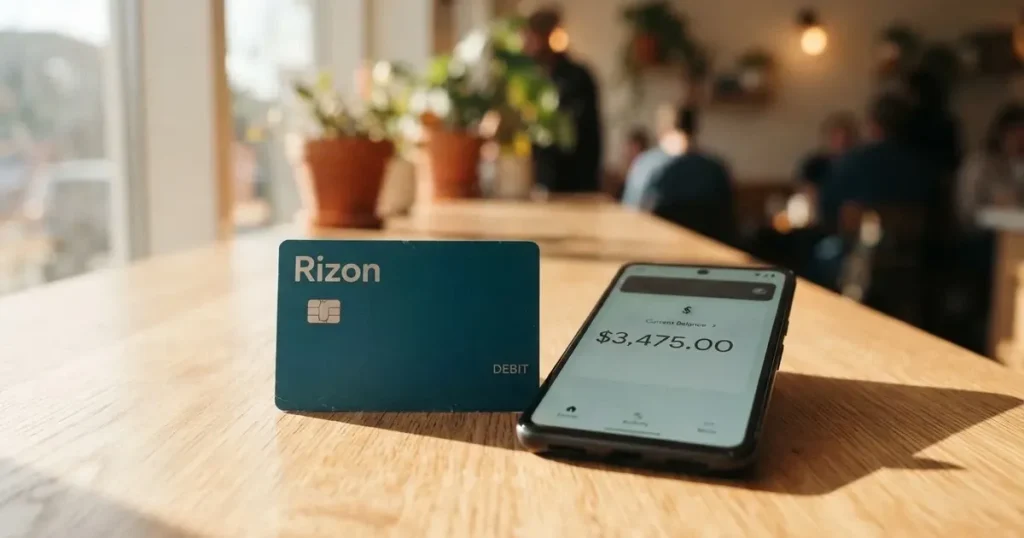
If you have trouble getting an ordinary bank card — a blocked application, a country your bank will not serve, a payroll account you cannot open — then the Rizon card is exactly the kind of thing you have probably already googled. It is a Visa card that spends a crypto balance, it promises a metal version, it advertises a long list of countries, and on paper the fees look either free or cheap. That combination is exactly why it is worth writing down what is actually established about it, and what is not.
I went through Rizon’s own card page, help centre and fees pages, and compared them against what reviewers and user reports say. My honest headline: the parts Rizon publishes are unusually clear about how the card works day to day, and unusually silent about who exactly can hold it, what the card itself costs, and what happens when something goes wrong. Both of those things matter to you.
Conditions and details here are current as of October 28, 2026.
Verdict: 6.7 out of 10
Rizon scores 6.7 / 10 overall. That is a card with a genuinely good core — spending, top-ups and everyday payment behaviour score well — wrapped in an eligibility story the card’s own pages contradict, and a complaints picture that is small in volume but consistent in theme.
Let me be specific about who this suits. If you hold a Latin American or Asian passport, you want a card that spends a stablecoin balance without a monthly fee, you top up on-chain, and you want to pay in dollars for nothing at all — Rizon is built for you, and on those three points it is one of the better options in this category. What you are accepting is a card whose price is not published, whose currency is not stated, and whose support is an email and a help centre rather than a phone line.
Who it does not suit: anyone whose eligibility turns on where they live rather than what passport they hold, because the card’s help centre and its card page disagree on that exact point. Anyone who plans to hold a balance for weeks and wants a published number for what a card costs. Anyone who needs a chargeback route in writing, because Rizon’s help centre does not appear to publish one.
| Criterion | Mark | Why |
|---|---|---|
| Who can get it | 6 / 10 | Availability by citizenship (passport), 44 supported nationalities including the US, Japan, Singapore, UAE, Brazil, Mexico; the card page claims 122+ countries by residence — the two statements do not agree |
| Cost | 6 / 10 | Servicing and top-up free, USD spend free, non-USD 1.7% + $0.1; ATM $1 + 0.65%; card price “Check app for the price”; Emerald from $5.59 per month |
| Top-up options | 9 / 10 | On-chain top-up via Arbitrum, Solana, Base, Polygon, Optimism, Avalanche, BSC with no fee; unofficial: USDC and USDT |
| Reliability and complaints | 5 / 10 | Issued by Signify Holdings and Nimbus LLC (Rain); Trustpilot shows 8 reviews, mostly one-star; unofficial complaints: a fee before KYC, manual review beyond 24 hours |
| Everyday use | 9 / 10 | Virtual and physical Visa Platinum, Apple Pay and Google Pay, ATM up to $250 per withdrawal |
| Total | 6.7 / 10 | Strong mechanics, weak published transparency on eligibility and pricing |
Will they give you the card?
This is the part that should make you pause, because Rizon tells you two different things and never reconciles them.
The card page says the services are “intended for people who live in and are domiciled in” the U.S. or LATAM countries, and may be restricted elsewhere — a residence-based rule. It also claims 122+ countries are supported. On the same page, that is a fairly broad promise.
The help centre says something different and narrower: availability is based on citizenship (passport), not residence, and it lists 44 supported nationalities. Antigua and Barbuda, Argentina, Australia, Bahamas, Barbados, Bangladesh, Belize, Brazil, Cayman Islands, Colombia, Costa Rica, Dominica, Dominican Republic, Ecuador, Egypt, El Salvador, Ghana, Grenada, Guatemala, Guyana, Honduras, Japan, Malaysia, Mexico, Morocco, New Zealand, Pakistan, Panama, Paraguay, Peru, Philippines, Saint Kitts and Nevis, Saint Lucia, Saint Vincent and the Grenadines, Senegal, Singapore, Suriname, Thailand, Turks and Caicos Islands, Uganda, UAE, United States, Uruguay, Zambia. Russia and Belarus are not on the list.
So if you are sitting somewhere outside the US and Latin America, with a passport from one of those 44 countries, the citizenship rule is what the support team will apply. If your passport is not on that list, the 122+ countries claim on the marketing page is not going to help you at the application screen. This is the single most useful thing on this page for anyone outside the US, and it comes from the help centre, not the advertisement.
Why the two rules exist at all is not a mystery: nationality is screened separately from residence because sanctions screening and issuer risk policy are applied to citizenship and country of birth as well as to the country of your address. A card that lets you hold a dollar balance is attractive to people who should not have one, so the issuer screens the passport first and the address second. That is standard practice, not a Rizon quirk.
How to get it
The card comes in three forms: virtual, physical, and a metal version marked “Coming Soon” — as of now, still not available. Both live versions are Visa Platinum. The card currency is not stated on the pages; USD and EUR accounts exist, which tells you the accounts come in two currencies but not necessarily which one the plastic runs on. That is worth asking support before you rely on spending abroad.
Delivery is where the two pages part company again. The card page says physical cards are delivered globally with an average of 3 days. The help article is narrower: physical cards are available in 49 countries and territories, naming the US, Australia, Japan, Singapore, Brazil, Mexico, South Africa and the UAE among them, and for the US, only 31 states. Delivery cost and replacement cost are both “not stated” — the card’s own wording is “Check app for the price”.
On identity checks, the card page simply does not state its KYC requirements, so I will not invent them. What the help centre does say: KYC is required, availability follows citizenship rather than residence, and there are two possible outcomes in the app, and they mean very different things.
- KYC Declined — you were flagged by the KYC/AML provider. This is final, and Rizon cannot override it.
- Verification Incomplete — a typo, an unclear document photo, or a poor selfie. You can retry.
Processing time is not stated officially. Unofficial reporting from spendnode.io in October 2026 describes passport verification with a selfie being cleared in two minutes in the reviewer’s own test. Against that, cryptocards.so reports manual KYC running beyond 24–48 hours in some cases. Both can be true at once — an automated fast path and a manual fallback — and that gap between “two minutes” and “two days” is the single biggest source of the complaints I found later on.
What it really costs: Fees
The clearest part of the whole card, and the part where you can actually plan. Maintenance is free. Top-ups are free with no limit. Spending in USD is free. Spending in anything else is 1.7% plus $0.10. The trading fee is 1.7%. Withdrawals cost $1 plus 0.65% of the amount, up to 3 per 24 hours and $250 per withdrawal.
| Fee or limit | Amount |
|---|---|
| Account maintenance | Free |
| Deposit | Free, no limit |
| Card spend in USD | Free |
| Card spend in non-USD | 1.7% + $0.10 |
| Trading fee | 1.7% |
| ATM withdrawal | $1 + 0.65% of the amount |
| ATM limits | Up to 3 withdrawals per 24 hours, $250 max per withdrawal |
| Virtual / physical / additional / replacement card | “Check app for the price” |
| Deposit, card spend and sends | No limit |
Now three ordinary payments, because a fee schedule on its own does not tell you what a Tuesday costs.
Coffee in your own country, card charged in USD. Free. The card’s headline promise is real: dollar spending carries no fee.
A subscription billed in euros. 1.7% plus $0.10. On an unofficial $10 monthly service price, this is roughly $0.27; on a $100 one, about $1.80. It is the price of using a dollar card outside the dollar zone, and there is no way around it other than the paid tier.
Cash from an ATM in a country you are visiting. $1 plus 0.65%, capped at $250 per withdrawal, three a day. Taking $250 out costs $1 plus 0.65% of 250. On a low-fee banking holiday you are paying roughly the same as a normal bank’s foreign ATM charge, which is the fair way to read this: it is not a bargain, but it is not outrageous either.
Two things about the paid tier, because the numbers conflict. Rizon’s own fees page says Emerald starts at $5.59 per month and cuts FX, trading and transaction fees by 50%. On the card page the Emerald FX figure is listed as 1.02% but the text is garbled, so treat it as needing verification; unofficial reporting gives Emerald around 1.02% on international spend and 0.85% on trading. The card page also mentions unnamed “higher tiers” that unlock premium benefits as you spend, without pricing them.
The card price itself is the gap I find most annoying. Official: “Check app for the price”. Unofficial, from spendnode.io in October 2026, claims: Standard virtual $10 one-time, Gold and Emerald virtual free, physical Standard $49.99, physical Gold $24.99, physical Emerald included; plans Standard free, Gold $3.99/month, Emerald $6.99/month with a three-month minimum. Note that this contradicts the official Emerald price of $5.59/month. I would not plan around any of those numbers — I would open the app and look. Unofficial international fee figures also disagree with each other, ranging from 1.7% plus $0.10–0.30 on Standard to about 1.275% on Gold, with one source noting the terms themselves are inconsistent between 1.7% plus $0.30 and 1.5% plus $0.30.
How to top it up
Top-ups are where Rizon scores 9 out of 10, and for a simple reason: the deposit is free, unlimited, and does not need your bank’s approval.
The official fees page states the deposit fee is free with no limit, and lists on-chain deposits via Arbitrum, Solana, Base, Polygon, Optimism, Avalanche and BSC — described as Solana and EVM-compatible chains. There is no fee for the deposit itself.
What is not stated: which coins are accepted, what the minimum is, and who pays the network fee. That third one matters more than it sounds. On-chain network fees are charged by the blockchain, not by the card provider, so a deposit can cost you a small amount in gas that Rizon will not reimburse. If you are on Ethereum mainnet holding only a token and no ETH, you cannot send at all — the fee is paid in ETH. On Tron, fees are paid through bandwidth and energy and often burn TRX.
Unofficial, from spendnode.io in October 2026: USDC and USDT on Polygon, Optimism or Arbitrum, plus US bank transfer and credit card. The official help centre lists more chains than that, so treat the chain list as the reliable part and the coin list as probable but unconfirmed. The card page also says you can “deposit money multiple ways” without specifying the methods on the page itself.
Two warnings that belong here rather than in the risk section, because top-ups are where mistakes happen. First, pick the network twice: once for what the app expects, once for what the token actually is. USDC and USDT exist on many chains, and a deposit sent on a network the provider does not support, or to an address of a different network, can be lost or need manual recovery with no guarantee. Transfers are irreversible; the network cannot freeze or return funds. Second, note that Circle stopped supporting USDC on Tron in February 2024, so “USDC over TRC20” is not a native option — if your only route to USDC is TRC20, you have a problem before you start.
Sending money out works like this: on-chain withdrawal costs the network fee plus 0.1%, an international send costs the network fee plus 0.1%, a send to another Rizon user is free. What happens to your balance if you close the account is not stated, and given that this card’s whole model is a stored balance, that is a question worth an email before you ever fund it.
Paying with it every day
Everyday use scores 9 out of 10, and this is where Rizon is least likely to disappoint you.
You get a virtual card and a physical one, both Visa Platinum. Apple Pay and Google Pay are supported on the virtual card — unofficial reporting says virtual cards provision immediately, so you can add one to your wallet and start paying in minutes. Whether any merchants are blocked is not stated anywhere I could find, which means you do not know in advance whether a given shop will work; that is a small but real gap, since prepaid and foreign BINs get declined more often than ordinary cards for reasons that have nothing to do with you.
Then there is the part that surprises people: why a card issued in one country can look foreign to a shop in another. A card number starts with a 6 or 8 digit issuer identification number, and merchants can look it up to see which institution and country issued it. If the issuer country differs from your billing address, some merchants apply extra scrutiny. Address verification — which compares the numeric parts of your billing address against issuer records — is mainly offered in the US, Canada and the UK, and is generally unavailable for foreign-issued cards. So a decline at an online store may have nothing to do with you at all.
The rewards offer is 2.5% back on eligible purchases, online, in stores and at ATMs, redeemable from a cashback balance, plus RizPoints on spending. The payout currency is not stated. Here is the caution: unofficial sources conflict sharply. The card page says 2.5%; a Medium review says 2.5%; spendnode.io in October 2026 says 1% capped at the plan fee on Gold. I would plan on the lower number until the app shows you otherwise, because a cashback rate that changes between pages is not a rate you can budget on.
The apps are iOS and Android, linked from the card page. The card page shows no ratings and the store listings were not read for this review. Unofficial figures, from coincodecap.com, date unknown and older: Google Play “RIZON: Stablecoin Finance” (com.rizon.app) at about 4.3/5 from about 3,500 ratings, and the App Store at 4.0 from 144 ratings. Fewer ratings on iOS tells you something about who is actually using this, and it is not a reason on its own to skip it.
One more thing nobody will tell you unless you look: declined authorisations can leave a hold on your funds for several days, typically up to seven. And a card payment from a crypto balance may be a taxable event depending on where you live — I am not going to advise you on that, but I will tell you it is not automatic that spending a token is the same as spending money, and that the question deserves an answer from a professional in your own country.
What can go wrong
Official incidents: not stated. There is no disclosed outage, licence action or enforcement event I could find, and nothing dated on licences, issuer changes or fines through 2025–2026. That silence is not the same as a clean record, but it is not a black mark either.
The user reports, however, cluster on a small number of themes. They come secondhand through an aggregator, cryptocards.so, and the underlying threads were not opened — so I am treating them as unverified signals, not facts. A fee of around $3.50 for a virtual card being charged before eligibility or KYC was completed. Manual KYC review running past 24 hours against advertised minutes. Slow recovery on a wrong-network deposit. Refund requests stuck looping in the chatbot. The aggregator says Rizon acknowledged the onboarding flaw and planned to add a country-selection step.
The Trustpilot detail is worth repeating with its own caveat attached: a profile for Rizon at about 2.4/5 from 8 reviews, mostly one-star. Eight reviews is nothing. The name also collides with an unrelated IRC network, so make sure you are looking at the right profile — there is no Trustpilot page for the card itself. Trustpilot scoring 5 out of 10 for reliability and complaints is really a reflection of consistency rather than volume: the same four complaints appear in multiple places, which is worse than a single angry review and better than a pile of unrelated ones.
Now the structural risks, which are the ones that could hurt you badly.
Where your money sits. Rizon describes itself as non-custodial: you keep full control and you are responsible for the recovery phrase. That is a real advantage over custodial platforms, which have a documented history of failure — Mt. Gox at roughly $350 million reported stolen between 2011 and 2014, Coincheck at about $400 million in 2018, Ronin Network at $625 million in 2022. The flip side of non-custody is that if you lose your seed phrase, typically 12 to 24 unencrypted words, anyone who obtains it can restore the wallet and spend the funds, and there is no built-in recovery. The network cannot freeze or return anything.
Who actually issues the card. Rizon Technologies, UAB makes the products available; the card itself is issued by Signify Holdings Inc. and its subsidiary Nimbus LLC (Rain). Medium and aggregators name Third National as the issuing bank, unverified. So the company whose app you install is not the institution that carries your balance. That is normal for this category — the card network routes messages and sets rules, the issuer holds the programme, and the crypto brand is often just a programme manager and front end — but it is worth knowing when you are deciding who to email.
Programmes can end. Visa does not issue crypto cards to consumers; it licenses issuers and can suspend a programme. It terminated its global agreements with FTX on 13 November 2022, and WaveCrest, a Visa issuer that supplied several crypto card brands, was suspended in Europe in 2018, closing all WaveCrest-issued Visa programmes. Closures typically follow a pattern: a notice period, then spending and loading stop, then you are asked to withdraw remaining balances. One 2026 closure reported by a secondary source had new loads ending 8 July 2026 and spending stopping 8 August 2026 — single source, unconfirmed, but the shape of it is what you would face.
Refunds and disputes. Whether Rizon offers chargeback, and under what conditions, is not stated; the help centre has articles on card limits and card use but no dispute or chargeback article I could find. A chargeback is a refund ordered by the issuer with reason codes such as fraud, duplicate billing or goods not received. US reversal rights come from Regulation E for debit cards and Regulation Z for credit cards, and prepaid-card coverage varies and should not be assumed. If a purchase goes wrong, your first tool is the email address, not a policy page.
Support. A help centre at intercom.help/rizon and a contact email that is obfuscated on the page. No phone or live chat mentioned, no hours stated. For a card where the known failure mode is a stuck refund, that is thin.
Sanctions and freezing. Tether says it disables tokens in wallets on the OFAC sanctions list and has frozen funds tied to illicit activity. Stablecoins are not censorship-proof. Nothing to plan around in normal use, but it does mean “self-custody” and “unstoppable” are not the same claim.
What I did not find, and will not pretend to: any mention of two-factor authentication beyond biometric login, any insurance, any formal security documentation. The security features that are stated are biometric login, “smart fraud protection”, and the ability to lock and unlock a physical card in the app.
What to take instead
Three alternatives, all of which I have scored on the same scale. Rizon is 6.7; MetaMask is 7.1; KAST is 6.1; TokenPocket is 5.8. None of them is a clear winner over Rizon — they trade one set of gaps for another, and the right choice depends on which gap you can live with.
| Card | Score | Card type | Who it is for | The catch |
|---|---|---|---|---|
| Rizon | 6.7 / 10 | Visa Platinum, virtual and physical | Holders of Latin American or Asian passports; free USD spend; fee-free on-chain top-up | Card price unpublished; eligibility rules contradict themselves; thin support |
| MetaMask | 7.1 / 10 | Mastercard, virtual then metal | 45 listed countries with proof of residency; you already live in a self-custody wallet | Metal is $199/year; US and UK sign-ups temporarily closed |
| KAST | 6.1 / 10 | Visa Platinum / Infinite, virtual and physical | Up to 10 cards, several metal designs, published limits and fees | Non-USD FX fee 0.5%–1.75%; country list shown only at KYC, not published |
| TokenPocket | 5.8 / 10 | Visa/Mastercard debit, virtual only | European and Asia-Pacific residents; runs on Arbitrum | 1% deposit fee; narrower country coverage; no physical card |
MetaMask is the one that scored highest, and the reason is that it publishes more. Sign-up is open in 45 listed countries and territories — Andorra, Argentina, Brazil, Canada, Mexico, Germany, France, Spain, Uruguay among them — with proof of residency required; other regions join a waitlist, and the citizenship rule is not stated. Ineligible regions limit sign-ups, not spending. US and UK sign-ups are temporarily closed per their FAQ, which is worth knowing. It is a Mastercard: a virtual card issued instantly, Metal pre-orderable in-app after Virtual approval, one card per user, issuer Monovate, card provider Crypto Life. Virtual is free with no annual or maintenance fee; Metal is $199/year. Fees are described as “minimal” per transaction with the amount not stated on the pages read, no additional MetaMask fees, and no foreign transaction fee — the Mastercard rate is used. It spends directly from your connected wallet on Linea, Base, Monad and Solana, with tokens named including mUSD, wETH, EURe, GBPe, USDC and USDT; Solana-only wallets cannot withdraw credit. Cashback is paid in mUSD into the Money Account at 1% on Virtual and a headline 3% on Metal, though the footnote caps Metal at 3% on the first $10,000 spent and 1% after.
KAST is the transparency champion on fees and the mystery on geography. Virtual and physical, up to 10 cards per user, Visa Platinum on Standard, Visa Infinite metal on Premium, Visa Infinite gold plated on Private, plus Pengu, Solana and Bitcoin designs. Annual membership is 0 USD for Standard, 1,000 USD/year for Premium, 10,000 USD/year for Private, billed annually upfront with no monthly option. Extra virtual card 2 USD, Standard physical card 0 USD plus 40 USD delivery, 1 USD/month inactivity fee after 12 months. Fees: stablecoin top-up 0%, USD spend 0%, transaction fee 0%, Apple and Google Pay 0%, non-USD FX 0.5%–1.75% depending on your country and the transaction country, non-USD transactions under 25 USD cost 0.10 USD, a declined transaction for insufficient balance costs 0.50 USD. Cashback in USD: 1.5% on the first 2,000 USD/month Standard, 2% on the first 10,000 Premium, 3% on the first 40,000 Private. The problem is eligibility: the residence list is shown only at KYC and not published, and holding an ID from a restricted region can make you ineligible even if you live in a supported country — a VPN does not bypass it, and an account created in an unsupported country stays locked at KYC.
TokenPocket is the simplest and the most limited. A Visa debit for a list of European countries and territories such as Germany, France, Spain and Switzerland, and a Mastercard debit for Australia, Canada, Hong Kong, Japan, Taiwan, New Zealand, Singapore, South Korea and the UK, with the Americas planned for Q2 2025. It runs on Arbitrum, its Fiat24 cards are virtual with no physical card mentioned, and balances are in EUR24 and USD24. An NFT creation fee is partly covered by TokenPocket and you pay “a small portion”, the amount not stated; apart from that, no additional fees — except a 1% fee on depositing cryptocurrency, which it says is refunded later through rewards and reduced transaction fees. No cashback is stated.
Two questions decide it. If your problem is “no ordinary bank card, and I hold a listed passport”, Rizon is the most direct answer and costs nothing to keep. If your problem is “I want a card whose fees and rules are written down”, KAST publishes the most and MetaMask is close behind, and you should accept their narrower eligibility lists in exchange.
Who I would recommend it to
I would recommend Rizon to you if all four of these are true. You hold a passport from one of the 44 listed nationalities. You can already get crypto onto a wallet that supports Arbitrum, Solana, Base, Polygon, Optimism, Avalanche or BSC, and you are comfortable picking the network yourself. You spend mostly in dollars, so the free-USD promise actually pays off for you. And you can live with opening the app to find out what a card costs.
I would point you elsewhere if any of these are true instead. You are relying on the 122+ countries claim while holding a passport that is not on the citizenship list. You plan to keep a meaningful balance on the card for a long time and want a published chargeback process. You need a phone number to call. Or you are in the US or UK and want MetaMask’s feature set, accepting its waitlist.
The honest summary is this. Rizon is a competently built card with excellent top-up mechanics and genuinely free dollar spending, published by a company that is upfront about its fee schedule on everything except the one number you most want to know. Its complaints are few but they cluster, its support is thin, and its two official pages disagree about who can even apply. If you fall inside the eligibility box, that is a reasonable card to hold. If you are anywhere near the edge of it, send two emails — one asking which rule governs your country, one asking what the card costs — before you move money.
Frequently asked questions
What is the Rizon card?
Rizon is a Visa Platinum payment card that spends a crypto balance. You load it on-chain, and it behaves like a prepaid card rather than a debit card linked to a bank: the card can only spend what is on it. Available versions are virtual and physical; a metal card is listed as “Coming Soon”. Rizon Technologies, UAB makes the products available, while the card itself is issued by Signify Holdings Inc. and its subsidiary Nimbus LLC.
How does the Rizon card work?
You deposit crypto, and it converts to a spendable balance that the Visa card draws on. Spending in USD is free; spending in other currencies costs 1.7% plus $0.10. Deposits are free and unlimited, and on-chain withdrawals or international sends cost the network fee plus 0.1%. Because it works as a pre-loaded balance, the card cannot overdraw.
Is Rizon a bank?
No. Rizon is a card programme manager and front end; the issuer is Signify Holdings Inc. with its subsidiary Nimbus LLC (Rain). Visa and Mastercard do not issue crypto cards to consumers themselves — they license issuers. So Rizon markets the card, and a licensed issuer carries the programme, which means your agreement with the bank behind the card is the one that matters at claim time.
Who owns Rizon?
Rizon Technologies, UAB is the company named on the card page as making the products available. Some unofficial sources and Medium posts name Third National as the issuing bank, which is unverified. Rizon is not a listed company as far as this review could establish, and there is nothing dated on licences, issuer changes or fines through 2025 and 2026.
Can I get the Rizon card in my country?
It depends on your passport, not your address. The help centre states availability is based on citizenship with 44 supported nationalities, including the US, Japan, Singapore, UAE, Brazil and Mexico; Russia and Belarus are not on the list. The card page separately claims 122+ countries by residence. Because those two statements conflict, check your passport against the help centre list before you apply.
Does the Rizon card require KYC?
Yes. The card page itself does not state its KYC requirements, but the help centre confirms KYC is required and that eligibility follows citizenship by passport. Two outcomes appear in the app: “KYC Declined”, which is final and cannot be overridden by Rizon, and “Verification Incomplete”, which means a typo or unclear photo and can be retried.
How long does Rizon KYC take?
Official processing time is not stated. Unofficial testing by spendnode.io in October 2026 cleared passport-and-selfie verification in two minutes, while other sources report manual review extending beyond 24 to 48 hours. Both appear to be real, which means you may be minutes or days away from an answer and should plan your first purchase accordingly.
What does it cost to use the Rizon card?
Spending in USD is free, and account maintenance and deposits are free. Non-USD spending costs 1.7% plus $0.10, the trading fee is 1.7%, and ATM withdrawals cost $1 plus 0.65%, up to 3 per day and $250 each. The Emerald tier starts at $5.59 per month and halves several fees. The card price itself is officially “Check app for the price”.
How do I top up the Rizon card?
On-chain, free and with no limit, via Arbitrum, Solana, Base, Polygon, Optimism, Avalanche or BSC. Unofficial sources add USDC and USDT on Polygon, Optimism or Arbitrum, plus US bank transfer and credit card. Check the network twice before sending: transfers are irreversible, and the network charges its own gas fee, which Rizon does not cover.
Is the Rizon card safe, and what about refunds?
Rizon describes itself as non-custodial, so you keep control of the keys and bear the risk of losing your recovery phrase. Security features stated are biometric login, “smart fraud protection” and app-based card locking; two-factor authentication and insurance are not mentioned. On disputes, no chargeback policy is published, support is an email and a help centre with no phone line, and some unofficial user reports describe refunds looping in the chatbot.
Wallet cards: who should pick one – cryptocardpicker
Content created by the «cryptocardpicker» team