
A narrow but plausible card for Nigeria, with more blanks than answers
 Available in US
Ecstasy is a virtual dollar card aimed at Nigerian users who want to pay for things online — mostly subscriptions — in USD from a crypto balance. The idea is straightforward: you send crypto, the app converts it to Naira, and a dollar wallet inside the app is what the virtual Visa card spends. That is a real use case, and Ecstasy serves it.
My problem is with everything around that idea. The card’s public pages say almost nothing about who can open an account, what it costs, what the limits are, or how withdrawals work. The app itself is rated 2.7 out of 5 from nine ratings in the App Store, with recent reviews complaining about freezes after updates and login problems. There is no physical card, no ATM, and no mention of Apple Pay or Google Pay. It scores 3.6 out of 10 on my criteria.
If you live in Nigeria, hold USDT, and only want a card that tops up your own subscriptions in dollars, the shape of the service may be enough. If you want to know what a payment will cost before you make it, or you need a card that works at a shop terminal, this is not the card for you — and not because it is a scam, but because almost none of the information you would need is published.
The conditions described here are current as of October 28, 2026.
Verdict: 3.6 out of 10
| Criterion | Score | Why |
|---|---|---|
| Who can get it | 2 / 10 | Nigeria only in practice — the issuer is Ecstasy Data Nigeria Limited and the app converts crypto into Naira. No country list, no citizenship or residence rule published. |
| Cost | 5 / 10 | No issuance fee and no top-up fee disclosed anywhere I could read; no pricing published at all. |
| Top-up options | 4 / 10 | USDT on TRC20 converted to Naira in the app, then the dollar wallet is funded. Fees, minimums and other fiat routes not stated. |
| Reliability and complaints | 4 / 10 | Issuer named, licences not. App Store 2.7 out of 5 from 9 ratings; reviews cite freezes after updates and login problems. |
| Everyday use | 3 / 10 | Virtual USD Visa cards for online payments and subscriptions only. No Apple Pay or Google Pay mentioned, no ATM, no physical card. |
That is a card for one job in one country. The 3.6 is not a verdict on the idea — crypto-funded dollar cards are useful — it is a verdict on how little the public pages tell you before you commit.
Will they give you the card?
Here is the short answer: the card points at Nigeria and nowhere else. The developer name in the App Store is Ecstasy Data Nigeria Limited, and the app’s central job is converting crypto into Naira, the Nigerian currency, which only makes sense if the balance sits on the Nigerian side. There is no published country list beyond that, and no citizenship or residence rule. Nothing I read says anything specific about Russian or Belarusian users, either way.
So the honest position is this: Ecstasy is built for Nigeria, and outside Nigeria you are guessing. If you are in Lagos or Abuja, or a Nigerian resident holding USDT who wants to pay for a streaming service or an advertising platform in dollars, the country question is answered for you. If you are anywhere else, you would be relying on the app accepting you, and nobody has published how that decision is made.
One more thing to know before you start: the card’s public pages say nothing about identity verification. Whether KYC is required, and at what level, is not stated. What the App Store privacy section does say is that the app collects payment information, name, email, phone number, and photos or videos. That tells you what data the app wants on its phone. It does not tell you what the issuing partner requires to open the account.
How to get it
The short answer: there is an iPhone or iPad app and a Google Play app, and that is the whole published signup story. There is no application form, no eligibility checklist, no document list, no waiting time and no delivery estimate to quote you.
What the app listing tells us is concrete enough to be useful. The app collects payment information, your name, email, phone number, and photos or videos — a fairly heavy set of personal data for a card whose fees are unpublished. The card you get is virtual and dollar-denominated, VISA-branded according to the app description. No physical card, no metal card, nothing that arrives in the post. Delivery, if you can call it that for a virtual card, is instant in the sense that nothing ships — but the pages do not say when the card becomes usable after you sign up.
Identity verification levels are not stated either. Some crypto apps let you start with a small balance and ask for documents later, when you hit a limit. Others ask for everything up front. Ecstasy’s pages say nothing, so if being asked for a passport or a selfie on day one matters to you, find out before you load money rather than after.
Fees: what it really costs
The honest answer is that Ecstasy does not publish its fees. Not the issuance fee, not the top-up fee, not the conversion spread, not the monthly fee, not the ATM fee, not the limits. I looked for a pricing page and there isn’t one in what I could read. That is not the same as “it is expensive” — it means you cannot know what a payment will cost before you make it, which is a real problem when the whole point of the card is to spend dollars you got from crypto.
| Fee or limit | What Ecstasy publishes |
|---|---|
| Issuance fee | Not stated |
| Monthly fee | Not stated |
| Conversion fee (crypto to Naira) | Not stated |
| Foreign exchange fee | Not stated |
| ATM fee | Not stated — virtual card, online and subscription payments only |
| Daily limit | Not stated |
| Monthly limit | Not stated |
| Tiers or plan levels | Not stated |
| Card currency | USD; the Naira side is handled inside the app |
So what does that mean for three everyday payments?
A streaming subscription in dollars. This is the card’s home turf. You fund the dollar wallet, the card spends it, the merchant sees a USD Visa. Whether a currency conversion fee rides on top, and how much, is not stated — but note that if you funded the wallet from crypto, you already crossed one conversion (crypto to Naira) inside the app, and then the dollar side may cross another. Neither price is published.
An online store priced in dollars. Same shape as the subscription. A virtual card is designed for exactly this, and the main question is whether the merchant’s decline rules catch you — which I cover under everyday use.
Anything at a physical terminal. This is not the card. There is no physical card, no ATM, and no mobile wallet mentioned, so in-person payment is out of scope by design rather than by accident.
The absence of published limits is the part I would not tolerate. A card with no stated daily or monthly ceiling can be a genuine problem if you are loading money and a merchant puts a hold on it, or if the card is compromised. Treat the undisclosed limit as unknown, and keep only what you are willing to lose track of on the card.
Top up: how the money gets in
The short answer: you convert crypto to Naira inside the app, and that value funds a dollar wallet, which is what the card draws from. The specific route described is USDT on the TRC20 network.
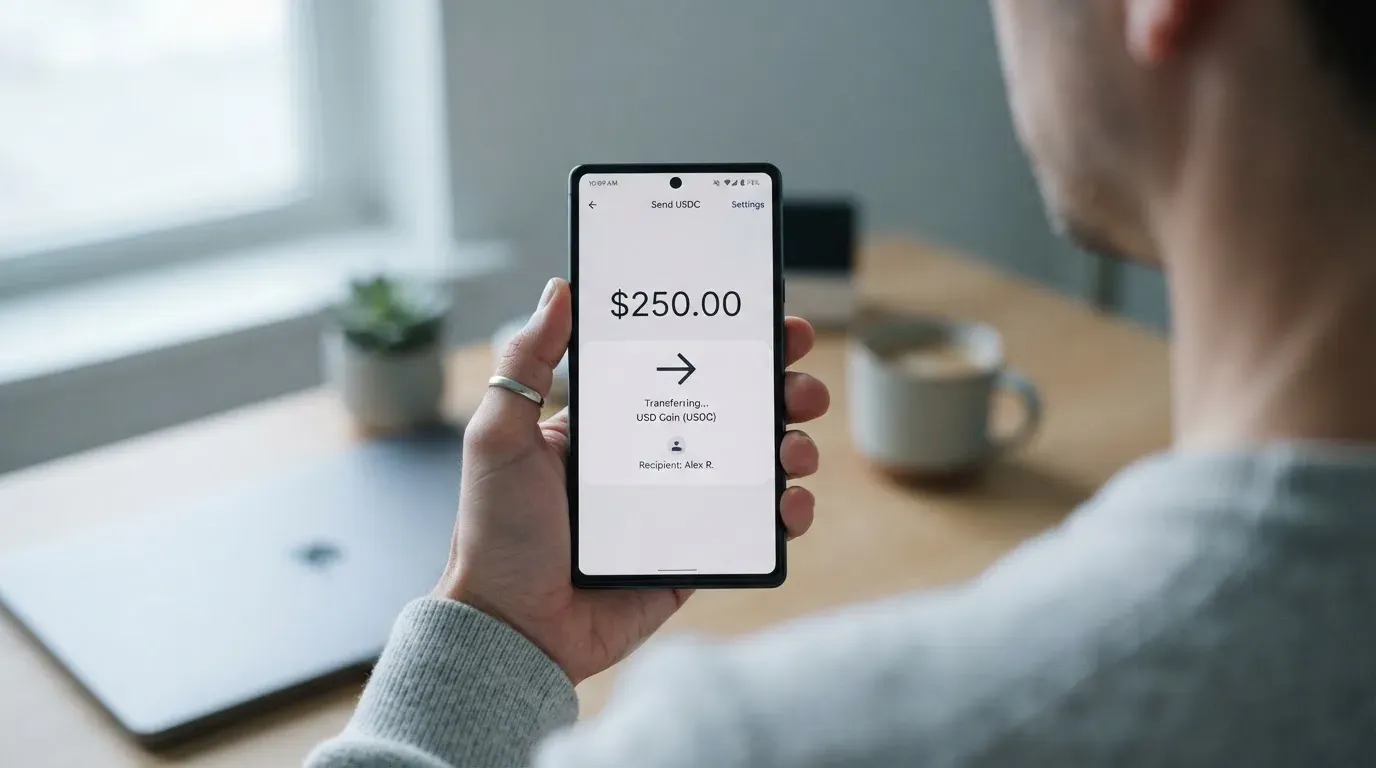
The dollar wallet itself has top-up, transfers and transaction history — the three things you would want to see. What it does not have, on paper, is a fee schedule, a minimum top-up amount, or a list of fiat options. So in practice the loop is: send USDT to the app, let the app convert it to Naira at whatever rate it applies, then move that into the dollar wallet and use the card. That is two steps you can see and one number you cannot.
A few practical warnings about this route, which are general to the category rather than to Ecstasy. USDT on Tron is real and widely used, but blockchain transfers are irreversible — a transfer to the wrong network, or to an address the provider does not support, can be lost outright or need manual support recovery with no guarantee. On-chain network fees for your deposit are charged by the blockchain, not by the card provider, so a TRC20 transfer is cheap but not free. And one subtlety worth knowing: Circle stopped supporting USDC on Tron in February 2024, so “USDC over TRC20” is not a native option — if you were planning to send USDC that way, it will not work the way you expect.
Whether you can take money back out is not stated. Withdrawals are one of those items crypto card pages leave quiet, and it matters: if the card is your only route to spending, you are trusting the balance to stay there.
Paying with it every day
The answer is that this is not an everyday card. It is an online card. Virtual, USD, VISA-branded, built for online payments and subscriptions. No physical card, no ATM, and Apple Pay and Google Pay are not mentioned — so if your phone wallet is how you usually pay, you would be entering card details by hand every time.
That narrowness has real consequences for merchants. A card number starts with an issuer identification number of 6 or 8 digits that identifies the issuing institution; merchants can look it up and see which institution and country issued the card. Some apply extra scrutiny when the issuer country differs from the billing address, which is why a foreign-issued card can look “foreign” at checkout. A Nigerian-issued card used on a US-facing site is exactly that shape. On top of that, address verification service — which compares the numeric parts of your billing address with issuer records — is mostly a US, Canada and UK thing and is generally unavailable for foreign-issued cards. That combination is a plausible reason a payment might be declined at checkout, even though the card is fine.
Other category-level things worth knowing, because they apply to any card like this. A declined payment can leave a hold on your funds for several days, sometimes up to 7. And gambling merchant category 7995 is blocked by many issuers as a matter of policy rather than law; whether Ecstasy blocks it is not stated.
On rewards: the app has a referral scheme, and no cashback rate is published. Treat any referral value as a bonus, not a reason.
The app itself deserves a look before you trust it with money. The App Store rating is 2.7 out of 5 from 9 ratings, latest version 2.8.2 released 24 September, read on 21 October. An unofficial third-party snapshot put it at 3.5 out of 5 from 54 ratings on an older version — treat that one as unofficial and unconfirmed, and note that it disagrees with the App Store page. Two recent App Store reviews cite freezes after updates and login problems. On a card that holds a converted balance, “the app froze after the update” is not a small complaint.
What can go wrong
The short answer: the biggest risk is not fraud, it is opacity — plus the general risks of holding crypto with a provider.
No published incidents. I found no official incident involving Ecstasy, and no Ecstasy-specific complaint threads in one pass through Trustpilot and Reddit. That is thin reassurance: there is no Trustpilot page for the brand either, which reads the same as “too small to have a profile” as it does “no complaints.”
The issuer and its licences are not named. The company is Ecstasy Data Nigeria Limited, per the App Store developer name. The issuing bank or partner, any licences, any registration are not stated. For a company that holds your converted balance and issues a Visa card, knowing who is licensed to do that is the first question, and the public pages do not answer it.
Support is thin. There is no support link in the App Store listing — only Apple’s billing support. The developer site is ecstasynigeria.com, with a privacy policy at ecstasynigeria.com/privacy, and the listing language is English. If something goes wrong with a conversion or a payment, the route to a human is not clear from the listing.
History. The app was first released 24 May 2023; version 2.8.2 came on 24 September. So the product is a few years old, which is something, but a young app with a 2.7 rating is still a young app.
The general crypto risks are not switched off by the card. Security details are not stated. And the category carries real history: custodial platforms have failed before — Mt. Gox (about US$350 million reported stolen 2011–2014), Coincheck (about US$400 million in 2018), Ronin Network (US$625 million in 2022). Blockchain transfers are irreversible by design; there is no built-in recovery if a key is lost. And stablecoins can depeg — TerraUSD collapsed in May 2022, and USDC temporarily lost its peg in March 2023.
Programme shutdown is a real category risk. Card programmes do close. Visa terminated its agreements with FTX on 13 November 2022 and the FTX US debit card was wound down; WaveCrest, a Visa issuer that supplied crypto card brands, was suspended in Europe in 2018 and all its Visa programmes closed. When that happens the sequence is typically a notice period, then spending and loading stop, then you are asked to withdraw. Because Ecstasy’s withdrawal terms are not stated, you do not know how fast you could get money out if the programme ended.
Disputes. Whether Ecstasy supports chargebacks, and how a prepaid card’s dispute rights work, is not stated — and prepaid-card coverage varies and should not be assumed.
What to take instead
If any of the above makes you uneasy, the alternatives are not close to Ecstasy on the score. Here is how they line up against each other and against Ecstasy, on what is published.
| Ecstasy | CardFlow | HyperCard | Card.fi | |
|---|---|---|---|---|
| Score | 3.6 / 10 | 4.9 / 10 | 4.7 / 10 | 6.6 / 10 |
| Who it’s for | Nigeria, in practice | Nigeria (“Nigeria’s smartest fintech card platform”, “Nigerians and global users”); no country list or exclusions | Acceptance in “more than 176 countries”; no eligibility list | Ships to “200+ countries”; sanctions-based restriction in terms |
| Card | Virtual USD Visa | Virtual USD Mastercard, about 3 minutes | Prepaid, USD or EUR balance; network not stated | Virtual and physical, Classic and Premium, metal option |
| Issuing cost | Not stated | Virtual card free (site FAQ) | Not stated | Virtual Classic $49, Virtual Premium $249; physical/metal not listed; no monthly fee |
| Top up | USDT TRC20 to Naira in app | BTC, USDT, ETH or Naira bank transfer | Crypto deposit (USDT, BTC, ETH) | 32 coins on 5 networks; deposit address per card |
CardFlow is the closest thing to a like-for-like: Nigeria-focused, virtual dollar Mastercard, free to create. Its fees are also not stated, so you inherit some of the same opacity, but at least the card is free to open and the funding routes are broader.
HyperCard is the more international of the two, but its pages tell you about acceptance (“176 countries”) rather than eligibility, which is the opposite of useful if you are trying to work out whether you can open one. Card balance in USD or EUR, crypto deposited in-app.
Card.fi is the one to look at if you want the numbers on the page. It publishes real prices — $49 and $249 for the virtual cards — and real fees: top-up fee of 1.5% plus $1.00 on Classic, 1% on Premium; FX fee of 3.5% on Classic, 2.5% on Premium; a conversion fee shown before each top-up. It also publishes its cashback, and its restrictions are stated in terms rather than implied. The trade-off is that it is a broader product with more moving parts, not a Nigeria-specific dollar card.
The honest comparison: Ecstasy is the narrowest and least transparent of the four. If the narrowness is exactly what you need, fine — but you are choosing it over alternatives that publish more.
Who I would recommend it to
I would recommend Ecstasy to a specific person: someone in Nigeria, holding USDT, whose spending is almost entirely online subscriptions in dollars, and who is comfortable with a small app and an undisclosed fee. For that person, the card does one thing, and the crypto-to-Naira route is the point.
I would not recommend it if you need to know what a payment costs, if you pay in person, if you use your phone’s wallet for payments, if you want to take money back out, or if you are outside Nigeria and hoping the app will let you in anyway. Those are not edge cases — they are the reasons the score is 3.6 and not higher.
The most useful thing you can do before committing money is ask the three questions the pages leave open: what does a top-up and a conversion cost, what are the limits, and how do I get my balance back out. If the answers are clear when you ask, this card may serve you well. If they are not, that tells you something too.
Frequently asked questions
What is the Ecstasy card?
Ecstasy is a virtual dollar card built around a Nigerian flow. You convert crypto into Naira inside the app, and that value funds a dollar wallet inside the app, which the virtual Visa card spends. The card is for online payments and subscriptions in USD. No physical card is mentioned, and the issuing company is Ecstasy Data Nigeria Limited.
How does the Ecstasy card work?
You top up the dollar wallet, the card spends that balance, and the balance is funded from crypto converted to Naira in the app. The described route is USDT on the TRC20 network. The card is VISA-branded and dollar-denominated. Apple Pay and Google Pay are not mentioned, and there is no ATM or physical card.
Is Ecstasy a bank?
Not on the published information. The company behind the app is Ecstasy Data Nigeria Limited. The issuing bank or partner, and any licences or registration, are not stated on the pages I could read. So treat Ecstasy as an app and card programme rather than a bank, and check who is actually licensed to hold your balance.
Who owns Ecstasy?
The App Store developer name is Ecstasy Data Nigeria Limited, a Nigeria-based company. The developer site is ecstasynigeria.com, with a privacy policy at ecstasynigeria.com/privacy. Beyond the company name, the ownership structure, issuing partner and licences are not stated publicly.
Can I use the Ecstasy card in my country?
It depends where you are, and the honest answer is that the card does not publish an eligibility list. The app is built around Nigeria, converting crypto to Naira. The App Store says the listing language is English. If you are outside Nigeria, you would be relying on the app accepting you, and nothing published explains how that decision is made.
Does Ecstasy require KYC?
The card’s public pages do not say. Whether identity verification is required, and at what level, is not stated. What the App Store privacy section does say is that the app collects payment information, name, email, phone number, and photos or videos. That is what the app handles, not necessarily what the issuing partner requires.
How do I top up the Ecstasy card?
You convert crypto to Naira in the app — the route described is USDT on TRC20 — and that funds a dollar wallet which the card uses. The wallet has top-up, transfers and transaction history. Fees, minimum amounts and any other ways to add money are not stated on the pages I could read.
Is Ecstasy card free?
Nobody will say. There is no published pricing — no issuance fee, no monthly fee, no top-up fee, no conversion fee, no ATM fee — none of it is stated. Free to open would be nice, but you should assume there is a fee somewhere until the company tells you otherwise, and you cannot tell what a payment will cost in advance.
Is the Ecstasy card safe?
There is no evidence of an incident, and no Trustpilot profile either. But the company does not name an issuing partner or licences, support is thin (no support link in the App Store listing), and the App Store rating is 2.7 out of 5 from 9 ratings, with recent reviews citing update freezes and login problems. Treat the balance as money held with a provider, not as a bank deposit.
Is Ecstasy card worth it?
For a Nigerian user whose spending is online USD subscriptions and whose only other option is paying a crypto exchange directly, the convenience could be worth it. For everyone else — especially if you need to see fees, use a physical card, add money to a phone wallet, or withdraw — the lack of published costs, limits and withdrawal terms makes it hard to call worth it. Ask about fees, limits and withdrawals before you load money.
Virtual cards: picking one for online use – cryptocardpicker
Content created by the «cryptocardpicker» team