
CasperCard reviewed: a crypto Visa with a 7.5% top-up fee and a lot of not stated
 Available in US

CasperCard is a crypto card that turns a stablecoin or coin balance into ordinary card spending. You load it yourself, you spend what is loaded, and the interesting part is not the card so much as the price list attached to it: the monthly fee on the entry tier is zero, while topping up costs 7.5% and converting at payment costs another 1.75%–2.00%. That combination is the single most important thing to understand about this card, and it is the reason my score lands in the middle rather than near the top. A card you pay nothing to hold is not a card you pay nothing to use.
I scored it 5.0 / 10. The number is not a shrug. It reflects a service that clearly does some things well — a genuinely free monthly tier, Apple Pay and Google Pay, one-tap freezing, and a coin list that includes Monero and XRP, which very few competitors offer — sitting on top of a set of public pages that leave too much blank. The issuing bank is described only as a “licensed issuing partner”. The registration country is not stated. The FAQ asks which countries can apply and then does not answer. There is no Trustpilot page. There is no news of a licence or an issuer. And the home page says you do not need to verify your identity to access the services, while the blog describes identity verification as a one-time step at sign-up — the two statements are flatly different, and only one of them can be describing your experience.
Who this suits: someone who already holds crypto, already knows which network they are sending on, and wants to spend a stablecoin balance without opening a bank account anywhere. Who it does not suit: anyone who wants to know which institution stands behind the card, anyone for whom a 7.5% top-up fee on the basic tier is more than a rounding error, and anyone who needs Monero or XRP support from a provider with a published track record.
| Criterion | Mark | Why |
|---|---|---|
| Who can get it | 6 / 10 | Offered “subject to eligibility, identity verification and availability”; no country list anywhere |
| Cost | 2 / 10 | Whisper is €0/month, but the top-up fee is 7.5% (Phantom 6%, Wraith 4.5%) plus 1.75%–2.00% conversion |
| Top-up options | 8 / 10 | USDT, USDC, BTC, ETH, XRP, SOL, XMR; networks are not named |
| Reliability and complaints | 5 / 10 | Issuer described only as a “licensed issuing partner”; registration country not stated; no reviews or complaints found |
| Everyday use | 5 / 10 | Virtual Visa only, plus Apple Pay and Google Pay; ATM situation not disclosed |
| Total | 5.0 / 10 | A capable product with a price problem and a disclosure problem |
The conditions described here are current as of October 28, 2026.
Will they give you the card?
Short answer: probably yes to an account, but the card itself is conditional and nobody will tell you the conditions. CasperCard’s own product pages say card products are “subject to eligibility, identity verification and availability”. That is three separate gates, and the page then leaves all three of them undefined. There is no country list, no exclusion list, no stated residence test, no stated citizenship test.
This matters more than it sounds. In this category, who gets a card is rarely decided by the crypto brand at all. The brand is usually a front end or programme manager; the entity that actually decides is the bank or e-money institution holding the card programme licence. Nationality is recorded and screened separately from residence, because sanctions screening and issuer risk policy are often applied to citizenship and country of birth as well as to the country you live in. So even if you live somewhere perfectly ordinary, an issuer’s internal policy can still turn you down. With CasperCard, that issuer is not even named, so there is no way to find that policy in advance.
There is one data point that may reassure you slightly, and one that may not. The reassuring one: prepaid and debit cards are generally available to adults aged 18 or over, and some issuers set higher limits. The unsettling one: age is close to the only eligibility rule stated anywhere in the public material.
So what would I do? Ask the support email directly before you plan a trip around this card, and treat silence as a no. Get a written answer to three questions: which countries can apply, is my country of residence accepted, and is my citizenship a problem. Then check whether that provider appears on ESMA’s interim register of authorised crypto-asset service providers, which is public and kept by the EU regulator. If the answer to the country question never arrives, this card is not something to depend on.
How to get it
Getting an account is the easy part: sign-up is with an email address, and a virtual Visa is displayed to you right after you register. There is no plastic in the picture — the site is explicit about “no waiting for plastic”. Whether a physical card exists at all is not stated; the FAQ does not answer it, and I would treat virtual-only as the working assumption.
The identity question is where the public pages contradict themselves, and it is worth slowing down here. The home page states: “You do not need to verify your identity to access our services”, with verification possibly requested later for specific card features, higher limits, or to meet a provider’s requirements. The blog, by contrast, describes identity verification as a one-time step during sign-up taking minutes, and says that access to the full card number and CVV requires a verified identity.
Both cannot be the whole picture. The reading I would test: registration without documents, then verification later when you want the details that make a card usable, or when a limit or a feature requires it. That is a common pattern in this category and it matches both sentences. But it is a reading, not a statement from the company. Note also that the level of verification is not stated — no indication of whether a document, a selfie, or both are involved, or how long a review takes.
If you need the full card number and CVV, which you do for most online-only spending, then plan on verification happening. Do not treat “no KYC at sign-up” as “no KYC ever”. And do not plan around a deadline you have not confirmed: one of the stated reasons verification can be demanded is meeting a provider’s requirements, which is the kind of phrase that can change without notice.
Fees: what it really costs to use this card
The monthly fee is the easy number and the least important one. Whisper costs €0/month, Phantom €50/month, Wraith €500/month, and no separate issuance fee is listed. The free tier is genuinely free. Everything expensive happens after that.
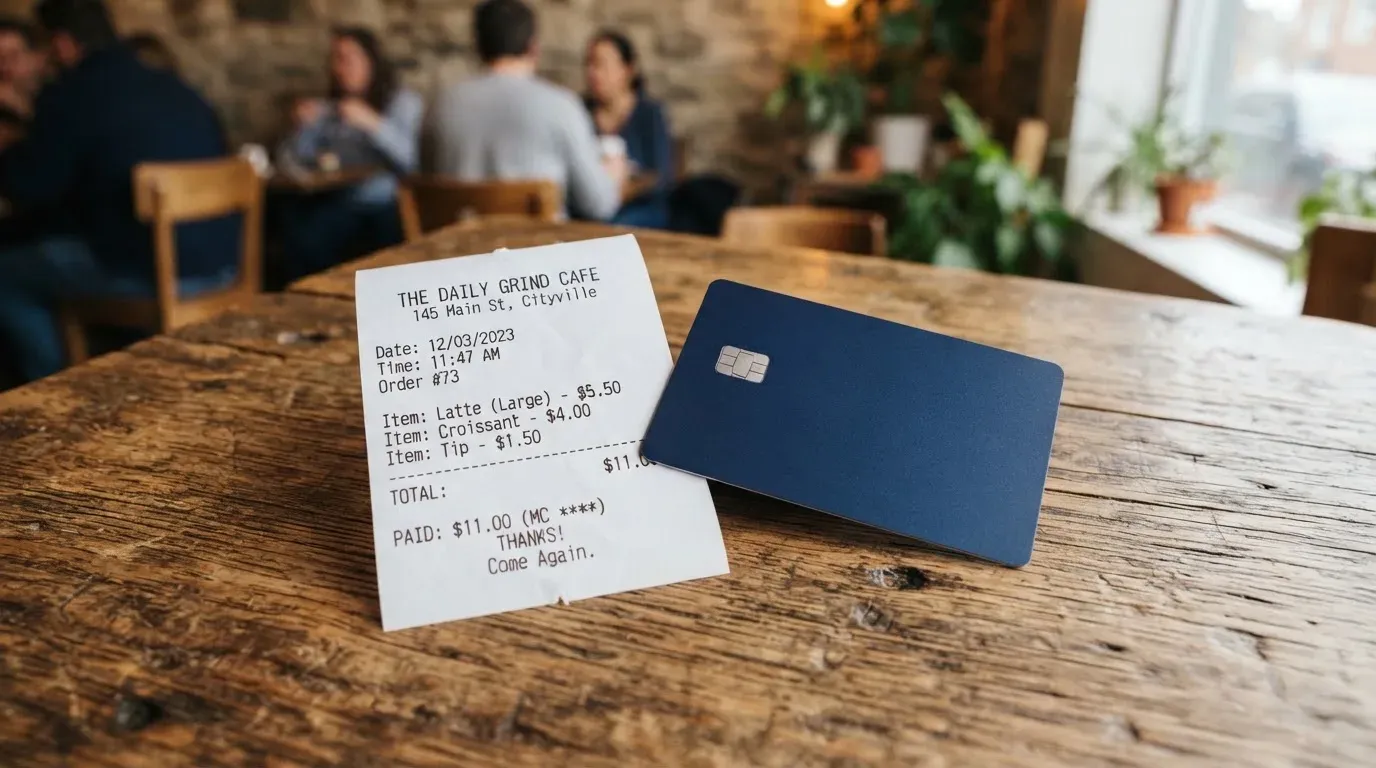
The stablecoin top-up fee is 7.5% on Whisper, 6% on Phantom, 4.5% on Wraith. Then, on top of that, a conversion fee of 1.75%–2.00% applies on all tiers, set by the issuing bank, charged in addition to the top-up fee. Crypto is converted to local currency at the moment of payment. So the total cost of getting value onto the card and then spending it is the 7.5% top-up fee plus a 1.75%–2.00% conversion fee on the free tier, and I am not counting the blockchain’s own network fee, which is separate again.
| Fee or limit | Whisper | Phantom | Wraith |
|---|---|---|---|
| Monthly fee | €0 | €50 | €500 |
| Stablecoin top-up fee | 7.5% | 6% | 4.5% |
| Conversion (FX) fee at payment | 1.75%–2.00% | 1.75%–2.00% | 1.75%–2.00% |
| Virtual cards per month | up to 1 | up to 3 | up to 20 |
| Monthly spend limit | €25,000 | €70,000 | €100,000–€500,000 custom on request |
| Separate issuance fee | not listed | not listed | not listed |
| Daily spend limit | not stated | not stated | not stated |
| ATM withdrawal terms | not stated | not stated | not stated |
| Card currency | not stated | not stated | not stated |
Now, three everyday payments, so this stops being abstract.
Buying a €20 lunch. You load the card with stablecoins to cover it. The top-up costs 7.5% on Whisper, and the conversion at payment adds 1.75%–2.00% set by the issuing bank. That is about €1.90 to €1.95 of cost on a €20 purchase, nearly a tenth of the meal. On Wraith, at 4.5% plus conversion, the same lunch costs the 4.5% top-up fee and the 1.75%–2.00% conversion fee — but you are paying €500 a month for the privilege.
Paying a €300 online invoice in a currency that is not your own. Here the conversion fee is doing the work, and it applies on all tiers at 1.75%–2.00%. Roughly €5.25 to €6.00 on top of whatever the exchange rate does on the day, before you have paid anything to load the balance. The card currency is not stated, so you cannot tell in advance which currency the merchant will bill you in.
Paying a €15 subscription. A recurring payment from a crypto-backed balance is the worst case for this price structure, because you pay the top-up fee and the conversion fee again on every renewal unless you keep a balance already converted. Whether you can hold a converted balance between payments, and whether that idle balance is free, is not stated.
The honest summary: if you convert once and spend many times, the fees amortise; if you top up per purchase, they compound. The design pushes you toward the top tier, which is €500 a month — a bar only paid by people for whom the coin list matters, and Monero and XRP are exactly the coins that would put someone there.
Top up: how the money gets onto the card
You send crypto from your own wallet. The supported coins are USDT, USDC, BTC, ETH, XRP, SOL and XMR — seven assets, which is the best part of the product. Notably, that includes Monero and XRP, two coins most card programmes do not touch, and if you hold either, that alone may be your reason to look at this card.
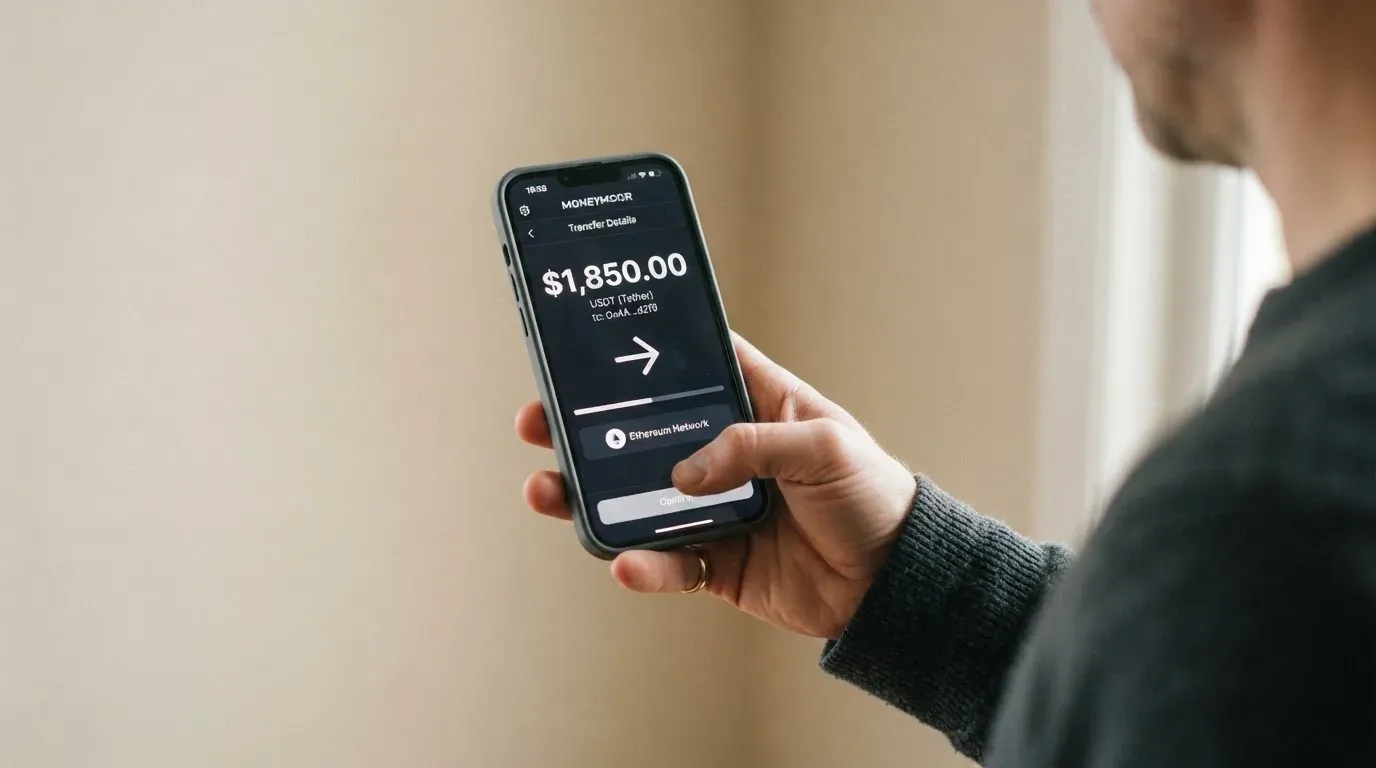
And then the sentence that should make you stop and read twice: the networks are not specified. The coin list is given; the network list is not. This is not a pedantic complaint. Blockchain transfers are irreversible, so a deposit sent on a network the provider does not support, or sent to an address belonging to a different network, can be lost entirely or need manual support recovery with no guarantee. The crypto world is full of USDT — the token exists on Ethereum, Tron, Solana, Polygon, Avalanche and others. Sending the right coin down the wrong network is the single most common expensive mistake in this category, and this is precisely where you want a published list.
A second gap: minimum top-up amounts and fiat top-up are not stated. There is also no mention of withdrawing money back out — not stated at all. If you cannot withdraw, then loading the card is a one-way street, and the only exit is spending.
On fees, the structure is what I described above: the stablecoin top-up fee applies per tier, and network fees go to the blockchain network rather than to CasperCard, so they are outside their control and outside their price list. That is honest, at least — you are not being charged twice for the same thing, you are just paying a third party whose fee is not quoted anywhere.
Before your first transfer, my advice is blunt: get the supported network per coin from support in writing, match it to your wallet’s network, and start with an amount you would be willing to lose. If they cannot give you that list, that is your answer about whether to proceed.
Paying with it every day
Day to day, the mechanics are good. It is a Visa, which is the network most shops accept. You can add it to Apple Pay on iPhone, Apple Watch and Mac, and to Google Pay on Android and in web checkout. That covers the two ecosystems and, more importantly, covers the case where a merchant simply refuses a card entered by hand. The mobile wallet token stores a device-specific number in the phone’s secure hardware rather than the real card number, and every payment carries a one-time code — so using it this way is meaningfully better than reading out the number.
Freezing is one tap from “the app”, and you can review transactions as they happen. Which platforms the app runs on, and what its store ratings are, are not stated. Card number and CVV are shown only to a verified identity — which loops back to the contradiction above.
Three things are missing that you would want in an everyday card. Cash: ATM terms are not stated, and given the card appears virtual-only, I would assume there is no cash at all until told otherwise. Blocking categories: which merchant types are refused is not stated, which matters because a card that refuses your local shops is not an everyday card. Disputes: how a chargeback works, who to contact, what evidence is needed — not stated.
There is a reward scheme, and it is narrow. Partner-shop cashback: 10% at Ledger, 20% at EncryptedOS, when you shop through CasperCard and pay with the CasperCard Visa, credited to the CasperCard wallet. The currency, the caps and the minimums are not stated, so 20% may be 20% of a small fixed amount. Treat it as a reason to visit two shops, not as a reason to hold a balance.
One more thing worth understanding about any virtual card. Merchants can look up the BIN — the six or eight leading digits that identify the issuing institution — and see both the issuer and its country, and may apply extra scrutiny when that differs from your billing address. Some shops decline prepaid or foreign-issued cards for exactly this reason. Address verification, which compares the numeric parts of your billing address against issuer records, is mainly offered in the US, Canada and the UK and is generally unavailable for foreign-issued cards, which can cause declines. With the issuing country not stated, I cannot tell you how often this will bite you. Expect the occasional refusal, and know that a declined authorisation may leave a hold on your funds for several days.
What can go wrong
Start with the empty space. The card is “issued by a licensed issuing partner” who is not named; the registration country is not stated; no licences are stated. The site footer reads © 2026 CasperCard. That is the whole of the corporate disclosure. There is no Trustpilot page, and a search for reviews on Trustpilot or Reddit found nothing at all. Now, absence of complaints is not evidence of safety — a young service with no reviews is exactly what a failed service also looks like from the outside.
Consider what you are actually trusting. Your crypto sits in a wallet you control and you transfer it yourself, which is better than handing over a seed phrase to a stranger. But once it lands, you hold a balance inside someone else’s system, drawn down by a card issued by a bank that will not name itself. That bank sets the conversion fee, from 1.75% to 2.00%, and it can restrict the card at will — including limiting a tokenised number to magnetic-stripe, phone or website use, or blocking a merchant category such as gambling, which issuers do by policy rather than by law and which varies by issuer.
Programme closures are not hypothetical in this category, and there is history. Visa terminated its global agreements with FTX on 13 November 2022 and the FTX US debit card programme was wound down. WaveCrest, a Visa issuer that supplied several crypto card brands, was suspended by Visa in Europe in 2018, closing every WaveCrest-issued Visa programme. The pattern is consistent: when the programme ends, users get a notice period, then loading stops, then spending stops, then you are asked to withdraw what is left. One 2026 closure, reported by a secondary source and not confirmed, ended new loads on 8 July 2026 and spending on 8 August 2026. And with CasperCard, withdrawals are not stated — so the last step of that sequence is the step I cannot verify exists.
Then the coins themselves. A stablecoin aims to hold a stable value but is not necessarily stable: TerraUSD collapsed in May 2022 and USDC temporarily lost its peg in March 2023. Tether describes USDT as backed 1-to-1 by reserves, but Tether also says it disables tokens in wallets on the OFAC sanctions list and has frozen funds tied to illicit activity — so the assets you are spending from are not censorship-proof, by the issuer’s own account. Monero is a privacy coin, and its inclusion here is a genuine benefit to the user and a genuine compliance question for whoever issued the card; I would not speculate about how that is handled, only note that it is worth asking about.
Finally, the tax side, briefly and without advice: in the US the IRS treats digital assets as property, so exchanging them for goods or services generally produces a taxable gain or loss, measured in local fiat currency at fair market value on the date of the transaction. Each card payment funded from crypto may be a separate disposal. Your own jurisdiction will differ — talk to a professional about yours.
What I found searching for trouble: no official incidents involving CasperCard, and no CasperCard reviews on Trustpilot or Reddit. What I found in its blog: posts on 24 September, 27 September and 2 October 2026, all guides — crypto Visa cards, KYC, fees — and no licence or issuer news. That is a young, still-formalising service. Support is email at [email protected] and Telegram at t.me/caspercardapp; the blog is published in English, Spanish, German, Italian and Albanian, and hours are not stated.
What to take instead
All three alternatives below are crypto cards with the same basic shape. I have scored them on the same scale. None is a clean winner; the right comparison is which gap bothers you least.
| Card | Score | Card type | Monthly fee | Top-up fee | FX fee | Where it stands out |
|---|---|---|---|---|---|---|
| CasperCard | 5.0 / 10 | Virtual Visa | €0 (Whisper) | 7.5% | 1.75%–2.00% | Monero and XRP support; one-tap freeze |
| CardFlow | 4.9 / 10 | Virtual USD Mastercard | not stated | not stated | not stated | Free virtual card in about 3 minutes |
| HyperCard | 4.7 / 10 | Prepaid, network not stated | not listed | not stated | not stated | Works in “more than 176 countries” per the App Store |
| Card.fi | 6.6 / 10 | Virtual and physical, incl. metal | none | 1.5% + $1.00 (Classic) / 1% (Premium) | 3.5% / 2.5% | Physical and metal cards; cashback; 32 coins |
CardFlow (4.9). Aimed at Nigeria — “Nigeria’s smartest fintech card platform”, and “Nigerians and global users”. Virtual USD Mastercard, created in about 3 minutes, and creating a virtual card is “completely free” according to the site FAQ. Funded with Bitcoin, USDT, ETH or Naira bank transfer. Monthly fee, fees and rewards are not stated. Its appeal is speed and the free start; its problem is that its eligibility language is entirely Nigeria-shaped, and the fee picture is a blank.
HyperCard (4.7). A prepaid card whose balance is in USD or EUR, funded by depositing crypto such as USDT, BTC or ETH in the app and converted onto the card. The App Store says it works in “more than 176 countries” — that is acceptance, not eligibility, and the distinction matters enormously for someone with a residency problem. The card network is not stated on the App Store page. Fees: the App Store lists none, which is not the same as there being none. Official pages give no country list.
Card.fi (6.6) — the highest score here, and for a reason. Its terms bar residents of, or orders from, “a country subject to sanctions that would prohibit the service”, which is at least a stated rule rather than an absence of one. It ships to “200+ countries”. It has virtual and physical Classic and Premium cards plus a stainless steel metal card, every physical order including a virtual one, issued “under licence from the relevant card schemes”. One-time prices are Virtual Classic $49, Virtual Premium $249; physical and metal prices are not listed; there is no monthly, annual, inactivity or minimum-balance fee. Top-up fees are 1.5% + $1.00 on Classic and 1% on Premium, with FX at 3.5% and 2.5% — so its headline rate beats CasperCard’s free tier comfortably, though its Classic FX fee is worse than CasperCard’s across-the-board 1.75%–2.00%, and its entry price is not free. It supports 32 coins across five networks (Ethereum, Base, BNB Chain, Solana, Kaanch) with a deposit address per card and conversion at market rate on arrival — and it names the wrong-chain risk explicitly, which CasperCard does not. Cashback runs 0.8% on Classic (capped 10 USDT/month), 1% on Premium, and up to 2% on Metal (capped 250 USDT/month, 20,000 USDT). What it lacks: Monero and XRP. Card currency is not stated.
Read that last line carefully, because it is the whole comparison. Card.fi is the better-run, better-documented, cheaper-to-use card for most people. CasperCard is the card for the specific person holding XMR or XRP who has exhausted the mainstream options.
Who I would recommend it to
I would recommend CasperCard to you if, and only if, all four of these are true. You hold Monero, XRP, or another coin on that list that your current card cannot spend. You are comfortable sending a transfer yourself, and you will confirm the network in writing before your first deposit. You are paying a 7.5% top-up fee knowingly, and ideally topping up in larger batches rather than per purchase. And you have checked that the provider appears on ESMA’s interim register of authorised crypto-asset service providers.
If you are here because an ordinary bank card is hard to get — and that is the situation this page was written for — then the honest advice is to treat CasperCard as one candidate in a list, not as the answer. The blocker is not the price list, which is at least published. The blocker is that “licensed issuing partner” is not a name, and you cannot evaluate a bank you cannot look up. Get that name in an email, get the country list in an email, and get the supported networks in an email. If all three arrive, this is a workable card with an unusually good coin list and an expensive entry tier. If they do not, walk away, and look at Card.fi or at a provider in your own jurisdiction that names its issuer.
Two final pieces of background, neither of which is about this card but both of which bear on your decision. First, the regulatory frame: a card is a payment service, regulated separately, while MiCA covers the crypto side — custody, exchange, transfer — which is why a crypto card often depends on two licences. MiCA’s rules on stablecoins applied from 30 June 2024 and the remaining provisions from 30 December 2024, with a transitional period running only until 1 July 2026 or until a provider receives or is refused authorisation, whichever comes first. That date has passed. Second, protection: EMIs must safeguard customer funds by segregating them or insuring them, but such funds are not bank deposits and may not be covered by a deposit guarantee scheme. If that distinction matters to you — and if your answer is “yes” — then a crypto card is the wrong instrument, whatever its score.
Frequently asked questions
What is CasperCard?
CasperCard is a crypto payment card: you send crypto from your own wallet, it is credited to a CasperCard balance, and a Visa draws down that balance when you pay. It converts your crypto to local currency at the moment of payment. Supported coins are USDT, USDC, BTC, ETH, XRP, SOL and XMR. The card is issued by what the company calls a licensed issuing partner, and that partner is not named on the public pages.
How does CasperCard actually work?
You send supported crypto from your own wallet to the address CasperCard gives you, a stablecoin top-up fee is charged by tier — 7.5%, 6% or 4.5% — and network fees go to the blockchain, not to CasperCard. When you pay, the crypto is converted to local currency and a conversion fee of 1.75%–2.00%, set by the issuing bank, is added on top of the top-up fee. The networks supported for each coin are not stated publicly, which is the detail to confirm before depositing.
Is CasperCard a bank?
No, and it does not claim to be one. It describes the card as issued by a licensed issuing partner, which is the usual arrangement: the crypto brand markets the product and manages the app, while a licensed bank or e-money institution holds the card programme. The partner’s name, the registration country and the licences are not stated. That is why I could not evaluate the institution behind the card, and why I would not treat this as a bank account.
Does CasperCard require KYC?
The public pages contradict each other. The home page says you do not need to verify your identity to access the services, with verification possibly requested later for specific card features or higher limits. The blog describes verification as a one-time sign-up step taking minutes, and says the full card number and CVV need a verified identity. Both may be true of different stages. Plan on verification happening before the card is fully usable.
What does CasperCard cost to use?
The monthly fee is €0 on Whisper, €50 on Phantom and €500 on Wraith, with no separate issuance fee listed. The real cost is per transaction: a stablecoin top-up fee of 7.5% on the free tier, 6% on Phantom and 4.5% on Wraith, plus a 1.75%–2.00% conversion fee at payment on every tier, before any blockchain network fee.
How much can I spend?
Monthly limits are €25,000 on Whisper, €70,000 on Phantom, and €100,000–€500,000 on Wraith by custom request. Daily limits are not stated anywhere. Cards per month are limited too: up to 1 on Whisper, 3 on Phantom and 20 on Wraith. Whether spending is capped per transaction or per merchant category is not stated.
Can I use CasperCard in my country?
Nobody has published an answer, which is the truthful state of it. The FAQ asks which countries can apply and gives no list, and the product terms say availability is subject to eligibility. The card is said to work where Visa is accepted, but acceptance is not eligibility. Before you rely on it, email [email protected] and ask directly whether your country of residence and your citizenship are both accepted.
Is CasperCard safe to use?
It has a free monthly tier, one-tap card freezing from the app, transaction review as it happens, and card number and CVV shown only to a verified identity. Against that: no named issuer, no stated registration country, no Trustpilot page, no user reviews found on Trustpilot or Reddit, and no confirmed withdrawal process. Card issuers can freeze or restrict a card at any time, and programme closures have happened in this category before. Use small balances.
Is CasperCard worth it?
For someone holding Monero or XRP who cannot spend those coins elsewhere, possibly yes — that coin list is genuinely unusual. For anyone else, the value is harder to see, because the free tier’s 7.5% top-up fee is the highest of the cards I compared, and you would need €500 a month for Wraith to reach 4.5%. Card.fi scored higher with lower top-up fees and better documentation, but does not support Monero or XRP.
How do I add CasperCard to Apple Wallet or Google Pay?
Both mobile wallets are supported: Apple Pay on iPhone, Apple Watch and Mac, Google Pay on Android and in web checkout. Because the card is virtual, adding it to a phone wallet is the normal way to pay in person — the phone generates a one-time code per payment and the real card number is never stored on the phone or on the company’s servers. Note that access to the full card number and CVV requires a verified identity.
Virtual cards: picking one for online use – cryptocardpicker
Content created by the «cryptocardpicker» team