
The Bitpanda Card in one euro-only Visa: free to open, honest conversion, narrow reach
 Available in US
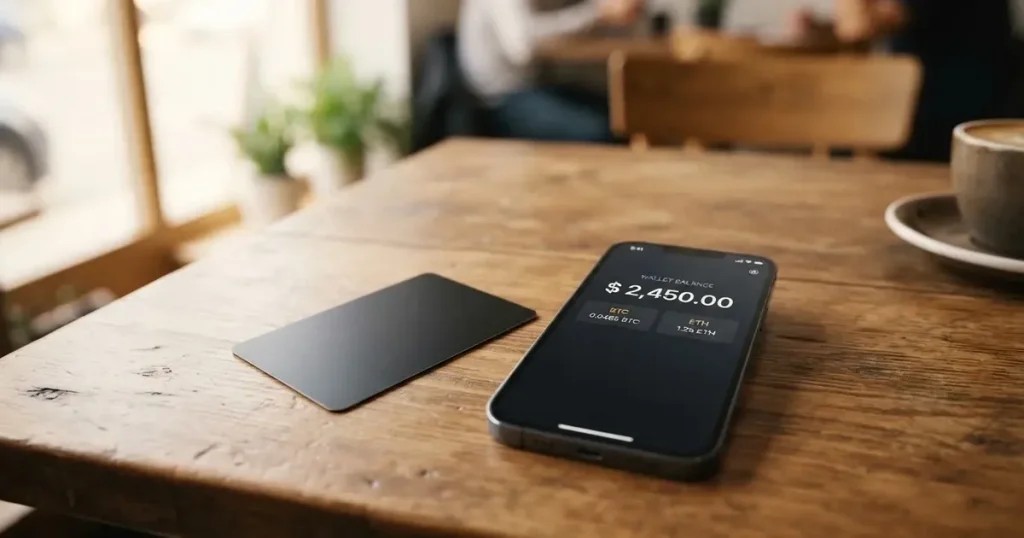
I have read through the Bitpanda Card’s own pages — the card page, the fee table, the support articles and the Product Terms — and I scored it out of 10 across five criteria. It comes out at 6.5 / 10. That is not a bad score and not a great one; it is the score of a card that does a narrow job cleanly.
The conditions described on this page are current as of October 28, 2026.
The Bitpanda Card is a physical Visa debit card that spends directly from a crypto balance held at the Austrian platform Bitpanda. You pick a “main asset” — a listed cryptocurrency, a precious metal or plain euros — and when you pay, it is converted to euros at that moment. The card is euro-only. There is no virtual card disclosed. It suits the euro-area resident who already keeps money on Bitpanda and wants to spend it like ordinary money without repeatedly selling into a bank account first.
It does not suit you if you live outside the euro area, if you travel and need to pay in many currencies, if you want to hold your own keys, or if you need a stable, non-crypto bank balance for subscriptions and rent. On those points the card is either unavailable or out of its depth.
The score, criterion by criterion
| Criterion | Mark | Why |
|---|---|---|
| Who can get it | 4 / 10 | A verified Bitpanda account and residence in the euro area are required; users verified through “Bankident” cannot order. Narrow by design. |
| Cost | 7 / 10 | Opening, the monthly fee and the first delivery are free; a reissue is EUR 5.90; the FX fee is EUR 0 but a Visa mark-up applies; an ATM withdrawal is 2% or EUR 2 minimum; the conversion spread is not disclosed. |
| Top-up options | 6 / 10 | The main asset is your choice of listed cryptocurrencies, precious metals or EUR, converted at payment; Crypto Indices are excluded. |
| Reliability and complaints | 8 / 10 | The issuer is Transact Payments Malta Limited under MFSA supervision (reg. C 91879); no card-specific complaints found; Trustpilot shows Bitpanda at 4.1/5 across 15,896 reviews; complaints centre on blocked withdrawals. |
| Everyday use | 8 / 10 | A physical Visa, a virtual card not disclosed; Apple Pay and Google Pay; ATM with a EUR 500 daily limit. |
| Total | 6.5 / 10 | A clean euro card for people who already keep euros or crypto on Bitpanda. |
The weakest criterion is access, and that is structural rather than a fault: the card is a euro-area product inside a regulated European exchange. The strongest are reliability and everyday use, because it is an ordinary Visa from a licensed European issuer, with the usual everyday affordances. Cost sits in the middle: the headline numbers are friendly, but the spread you pay converting crypto is the number that actually decides your bill, and the card’s public pages do not disclose it.
Will they give you the card?
You need two things: a verified Bitpanda account and residence in a euro-area country. The rule is by residence, not citizenship — where you live, not what passport you hold. Users who verified through a route called “Bankident” cannot order the card. Cyprus and Liechtenstein are excluded as well, according to a support article.
That is the whole eligibility picture on the public pages. Which documents are needed for verification is not stated there, and neither are the KYC tiers or how long verification takes. What that means for you in practice: the Card Terms talk about a “verified” account, but the card page does not spell out the document set or the processing time, so you cannot tell from the marketing pages how long you will be waiting. If that wait matters to you — and for many people who are trying to solve a banking problem it very much does — you would need to read the verification section inside your account before you commit to expecting a card this week.
The short version: if you already have a fully verified Bitpanda account and you live in the euro area, you are in the intended audience. If either of those is missing, none of the rest of this review is going to change the answer.
How to get it
You order the card in the app. It is a physical Visa debit card, euro-denominated, with one active card at a time. A virtual card is not stated on the pages I read, so I will not promise one.
Delivery runs three to seven working days depending on where it is going. The first shipment is free. If you need the card replaced there is a fee, and the card’s own pages are not quite consistent about the figure: the fee table puts a reissue at EUR 5.90, while the FAQ quotes EUR 9.90 for damage, loss or theft. An extra physical card is EUR 10. The card is valid for five years from issue and a replacement is sent automatically when it expires. Which countries outside the euro area it can be shipped to is not stated.
Practical takeaways, then:
- Order in the app; expect the physical card in three to seven working days.
- A first card is free. Budget for a replacement fee somewhere between EUR 5.90 and EUR 9.90 depending on which page of the site you read, and EUR 10 for a second physical card.
- Only one card is active at a time, and it works for five years before it is renewed automatically.
- You will need a verified account and euro-area residence; the “Bankident” verification route and Cyprus and Liechtenstein do not qualify.
Fees: what it really costs
This is the section to read twice, because the card’s headline fees are the easy part and the conversion spread is the part that decides what your lunch actually cost you. The spread on converting crypto is not stated on the card pages. Everything below comes from the fee table and the Product Terms.
| Fee or limit | What it is |
|---|---|
| Account opening | Free |
| Monthly fee | Free |
| First card shipment | Free |
| Reissue | EUR 5.90 in the fee table; EUR 9.90 in the FAQ for damage, loss or theft |
| Additional physical card | EUR 10 |
| Conversion of the payment asset | Platform trading fees are debited on each card payment (Product Terms 4.2); the rate of this fee is not stated on the card page |
| Crypto conversion spread | Not stated |
| FX fee on non-euro payments | EUR 0, but “VISA mark-up fees apply” |
| ATM withdrawal | 2% or EUR 2 minimum, whichever is higher; local bank fees may add; daily ATM limit EUR 500; free withdrawals were a VIP-level perk, and the VIP scheme changed in July 2025 |
| Refunds | Credited to the euro wallet minus fees |
Let me walk three everyday payments through this, because “2%” and “EUR 0” mean very different things in practice.
Paying for coffee in a euro-area café. You tap the Visa. The payment draws on your chosen main asset. If that asset is already euros in your Bitpanda account, you have paid nothing beyond the coffee. If it is a cryptocurrency, the platform’s trading fees are debited from your account on the payment (Product Terms 4.2), plus whatever spread sits between the market price and the price you get. That spread is the number the card’s pages do not publish. In other words, paying with a crypto main asset is not fee-free — it is fee-plus-spread, and you have to look inside the app at the moment of conversion to see the whole figure. For anyone who treats the card as an everyday spending tool, that is the number to watch, and the reason many people keep their main asset in euros.
Paying in a currency that is not the euro, say a trip abroad. The card’s own FX fee is EUR 0, but the page is explicit that “VISA mark-up fees apply.” So the conversion is not costless: Visa adds its own mark-up on top of the network rate. You also have to accept that your spending asset is converted to euros first (the card is euro-only) and then the euro amount is converted again by Visa into the local currency. Two conversions, one of which carries a mark-up. If you spend abroad often, this is where a card built around a single currency starts to cost you.
Taking cash out of an ATM. The fee is 2% or EUR 2 minimum, whichever is higher — so on a EUR 40 withdrawal you pay EUR 2, on a EUR 500 withdrawal you pay EUR 10. Your local bank may add its own fee on top. The daily ATM limit is EUR 500. Free ATM withdrawals used to be a perk for the top VIP levels, and the VIP scheme changed in July 2025, so whether you still get free withdrawals depends on where you sit in a scheme that has since been restructured; check it in the app rather than assume it.
A note on the cashback, since it appears in the same breath as fees: the Product Terms (version 2.0.0, 1 April 2025) fix cashback at 1% of qualifying crypto transactions, credited to the EToken wallet in the asset used, and transactions paid with a non-EToken asset are excluded. Fiat, stocks, metals and stablecoins are excluded too. The page summary has said “up to 2%” at times; the body says 1%. The terms settle it at 1%, and no third-party source I checked confirms the higher figure.
How to Top up the card — and why that phrasing is a bit off
The Bitpanda Card does not really have a “top up.” There is no balance sitting on the card waiting to be filled, because there is nothing stored on the plastic. What you actually do is choose a main asset — and optionally a fallback asset — from your Bitpanda account, and the card spends that asset directly, converting it to euros at the moment of payment. The list of main assets covers the listed cryptocurrencies, precious metals or plain EUR. Crypto Indices are excluded. The minimum payment is EUR 1.
So topping up means funding the Bitpanda account itself, by the usual Bitpanda deposit methods, and then deciding which of those holdings the card should draw on. There is no card-specific top-up fee, because there is no separate top-up step; the fee that applies is the platform trading fee on selling the payment asset, plus any spread, plus the ATM and FX fees if you are withdrawing or paying abroad.
One practical point on money coming off the card. The funds are never on the card — they stay as assets or euros in your Bitpanda account, and you can sell or withdraw them through the normal Bitpanda payouts. If you want to deactivate the card permanently you contact customer support (the steps are not given on the page). And while a “Proof of funds” request is open on your account, all payouts including the card are disabled until it is approved. That is worth knowing before you rely on the card as your only spending route while a compliance check is open.
Paying with it every day
Day to day, this behaves like an ordinary euro Visa. You can add it to Apple Pay — the card page says so — and a support article says you can add the card to Google Pay like any other Visa. Blocked merchants are not stated on the card page, though the Cardholder Agreement is said to list certain transactions the card cannot be used for. Some merchants also look at where a card was issued and decline foreign-issued or prepaid cards; that is a general property of card payments, not a quirk of this one.
You can block and unblock the card in the app, and there is Visa anti-fraud monitoring and 3-D Secure for online payments. Spending limits are generous for a card like this: EUR 10,000 a day, EUR 70,000 a week, EUR 280,000 a month, and EUR 500 a day at ATMs. Only one card is active at a time.
The honest weak point in everyday use is that this is a euro card. Non-euro payments and withdrawals carry a EUR 0 fee on the card’s side, but the Visa mark-up applies. Refunds go to the euro wallet, minus fees. If your life is denominated in one currency and you mostly spend in that currency, none of this matters. If you do not, it is the defining limitation of the product.
What can go wrong
The most concrete risk is a compliance hold. Bitpanda’s own pages say that if the platform requests “Proof of funds”, all payouts including the card are disabled until it is approved. In practice that means your card can stop working not because anything is wrong with the card, but because the exchange account behind it is waiting on a document from you.
Beyond that, I found no card-specific complaints, but the wider Bitpanda picture on Trustpilot is worth reading. The platform sits at 4.1/5 from about 15,896 reviews (73% five-star, 17% one-star, as I read it), and the recurring themes in 2026 user reports are blocked withdrawals and account restrictions, high currency-exchange commission and spreads, slow support during compliance reviews, and German replies to English messages. None of that is card-specific, but the card draws on the same account and the same payouts, so the same friction touches it.
Then there is the structural risk of holding funds with a custodian. Bitpanda is a custodial platform: it holds the credentials to your crypto, so you have to trust it completely. That is a different risk profile from a card that draws on your own wallet, and the history of custodial platforms is not gentle — Mt. Gox (about US$350 million reported stolen, 2011–2014), Coincheck (about US$400 million, 2018) and the Ronin Network bridge (US$625 million, 2022) are the names people remember. On top of that, crypto transfers are typically irreversible: a transfer sent on a network the provider does not support, or to an address belonging to another network, can be lost or need manual support recovery with no guarantee.
Two more things to hold in mind. First, the platform’s trading fees on each card payment are debited from your account automatically, so a payment that looks free at the till quietly costs you a little more at conversion — plus whatever spread applies. Second, older card-account terms on the site describe funds sitting in a segregated safeguarding account, not covered by the Lithuanian deposit insurance, with liability capped at 50 euros absent gross negligence; those older terms name different issuers than the current ones, so I would not rely on the 50-euro cap as a settled fact about this card.
What to take instead
Two alternatives came up repeatedly in comparison, and both trade the Bitpanda Card’s strengths against its weaknesses in a way that helps you decide. Here is the honest side-by-side.
| Bitpanda Card | International Visa Card | UNi Card | Morse | |
|---|---|---|---|---|
| Score | 6.5 / 10 | 6.7 / 10 | 6.1 / 10 | 7.5 / 10 |
| Who | Verified account plus euro-area residence; “Bankident” route and Cyprus/Liechtenstein excluded | Not for residents or registrants of a long list including Belarus, mainland China, North Korea, India, Russia, Türkiye, Ukraine, Vietnam and others | Not stated | Residence-based; 18+; over 140 countries (P2P); several countries closed-beta with an invite code |
| Card | Physical Visa debit, EUR only, one active card | U.S.-issued Platinum Visa, virtual, USD; physical “coming soon” | Multicurrency, Mastercard network; physical/virtual not stated | Fully virtual Visa prepaid for now; spends in any currency |
| Cost to open | Free | $5 one-time; plans Classic free, Pro $9.00/mo, Max $19.00/mo | No annual fee; issuance not stated | Not stated |
| FX / conversion | FX fee EUR 0 but Visa mark-up applies; conversion spread not stated | Visa exchange rate plus 2% FX fee | No FX fee; converted at live OTC rates | Zero FX fees or markups, real-time Visa rate; online and contactless payment free |
| Funding | Chosen main asset: listed crypto, precious metals or EUR | USDC or USDT free at 1:1, plus USD, EUR, SEPA, SWIFT, FedNow | Not stated | Debit card, stablecoin transfer; USDC, USDG, EURC via Solana free; self-custodial wallet |
| Rewards | 1% cashback on qualifying crypto transactions (terms) | None stated | Spend-to-Earn up to 3% | Not stated |
| Availability note | Card page lists eligibility; delivery outside euro area not stated | Purchases blocked in North Korea, Cuba, Iran, Russia, Syria, Ukraine, Venezuela | — | Card “available only in certain countries”; list not published on the card page |
Where each one wins:
- If you cannot get the Bitpanda Card at all — you live outside the euro area, or you verified through Bankident, or you are in Cyprus or Liechtenstein — the alternatives are the only conversation. Of those, the International Visa Card and Morse are both USD or multi-currency products aimed at a wider map of countries; UNi’s eligibility is not stated on its pages, which is itself a reason to check before you commit.
- If you travel and pay in many currencies, Morse and UNi state zero or no foreign-exchange fees explicitly. The Bitpanda Card’s EUR 0 FX fee comes with a Visa mark-up and a euro-only design, which is a poorer fit for multi-currency spending.
- If you want to hold your own keys, Morse’s wallet is self-custodial. The Bitpanda Card is custodial, so you are trusting the platform with your funds.
- If you want cashback and spend crypto, the Bitpanda Card’s 1% (per its terms) is real; UNi advertises up to 3% on spend-to-earn. Neither the International Visa Card nor Morse states a cashback figure on the pages I saw.
- If you want a physical card you can hand to a shop today, the Bitpanda Card ships one and the International Visa Card’s physical version is “coming soon”; Morse is virtual for now and UNi’s physical/virtual status is not stated.
The comparison is not a recommendation of any of the alternatives over Bitpanda — it is a map of which constraint is binding for you. The right card is the one whose one drawback you can live with.
Who I would recommend it to
I would recommend the Bitpanda Card to a specific person: someone who lives in the euro area, already has a verified Bitpanda account, holds euros or a cryptocurrency there, and wants to spend that balance directly without shuttling it through a bank account first. For that person it is a genuinely good card — free to open and maintain, an ordinary Visa that works in shops and at ATMs, sensible limits, Apple Pay, block-and-unblock in the app, and 1% cashback on the crypto it is meant to be used with. The 6.5 is dragged down by things that person will not feel.
I would not recommend it to someone whose main problem is that a bank will not open an account for them. This card does not solve that: it needs a verified account with a regulated European exchange and euro-area residence, and it draws on the same payouts that user reports describe being blocked during compliance reviews. If your issue is banking access rather than spending convenience, this is not the tool for it.
I would also not recommend it as your only card if you travel, if you need a virtual card, if you want to hold your own keys, or if you want a balance that is not tied to crypto prices. It is a euro card that converts crypto to euros when you tap. That is a feature for the person it suits and a limitation for everyone else.
The honest summary: a clean, well-regulated euro product for people already inside the Bitpanda ecosystem, with one number to watch — the conversion spread, which the public pages do not disclose — and one thing to keep an eye on — the account behind the card, since a proof-of-funds request can switch the card off entirely.
Frequently asked questions
What is the Bitpanda Card?
It is a physical Visa debit card that spends directly from your Bitpanda account. You nominate a main asset — a listed cryptocurrency, precious metal, or plain euros — and the card converts it to euros at the moment you pay. There is no balance stored on the card itself. It is issued by Transact Payments Malta Limited under MFSA supervision (reg. C 91879). It is euro-only, and one card is active at a time.
Who can get the Bitpanda Card?
You need a verified Bitpanda account and residence in a euro-area country; the rule is by residence, not citizenship. Users who verified through “Bankident” cannot order it, and Cyprus and Liechtenstein are excluded. Which documents verification needs, and how long it takes, is not stated on the card’s public pages, so check inside your account if the wait matters.
How much does the Bitpanda Card cost?
Opening the account, the monthly fee and the first card are all free. A reissue is EUR 5.90 in the fee table, though the FAQ quotes EUR 9.90 for damage, loss or theft; an extra physical card is EUR 10. ATM withdrawals cost 2% or EUR 2 minimum, whichever is higher. On spending, platform trading fees are debited on each payment, and the conversion spread is not disclosed on the card page.
What are the fees and limits?
The FX fee on non-euro payments is EUR 0, but the page says Visa mark-up fees apply. Spending limits are EUR 10,000 a day, EUR 70,000 a week and EUR 280,000 a month; ATM withdrawals are capped at EUR 500 a day. Free ATM withdrawals used to be a top-VIP perk, and the VIP scheme changed in July 2025, so check whether you still qualify.
How do I top up the Bitpanda Card?
Strictly speaking you do not — there is no separate balance to fill. The card spends a chosen main (and optional fallback) asset from your Bitpanda account, converted to euros at payment, with a EUR 1 minimum. So you fund the Bitpanda account by its usual deposit methods and choose which holdings the card draws on. Crypto Indices are excluded from the eligible assets.
Can I use the Bitpanda Card abroad?
You can, but it is a euro card. Non-euro payments carry a EUR 0 card fee while Visa mark-up fees apply, and your spending asset is converted to euros first and then again by Visa. If you pay in many currencies regularly, this is the product’s weakest point, and a card advertising zero or no FX fees may serve you better.
Is the Bitpanda Card safe, and who has my money?
The issuer is Transact Payments Malta Limited, a regulated European payment institution, which is the reassuring part. But Bitpanda is a custodial platform — it holds the keys, so you trust it completely, and crypto transfers are typically irreversible. The specific thing to know is that if Bitpanda requests “Proof of funds”, all payouts including the card are disabled until it approves.
Does the Bitpanda Card offer cashback?
Yes, at 1% on qualifying crypto transactions, credited to the EToken wallet in the asset you spent, according to Product Terms 2.0.0 of 1 April 2025. Fiat, stocks, metals and stablecoins are excluded, as are transactions paid with a non-EToken asset. You may see “up to 2%” on the site; the terms say 1%, and no third-party source confirms the higher figure.
How do I get money off the Bitpanda Card?
The funds are never on the card — they stay as assets or euros in your Bitpanda account, and you can sell or withdraw them through the normal Bitpanda payouts. To deactivate the card permanently you contact customer support; the steps are not published. Note that payouts, card included, are switched off while any proof-of-funds request is open on the account.
Is Bitpanda a bank, and is the card worth it?
Bitpanda is a crypto platform, not a bank; the card is issued by a licensed payment institution rather than by a bank, so the funds are not the same as a bank deposit. Whether it is “worth it” comes down to one question: do you already hold euros or crypto on Bitpanda and want to spend it directly? If yes, it is a competent, low-cost euro card. If your problem is banking access, or you travel, or you want your own keys, it is not the answer.
App and neobank cards: when one suits you – cryptocardpicker
Content created by the «cryptocardpicker» team